
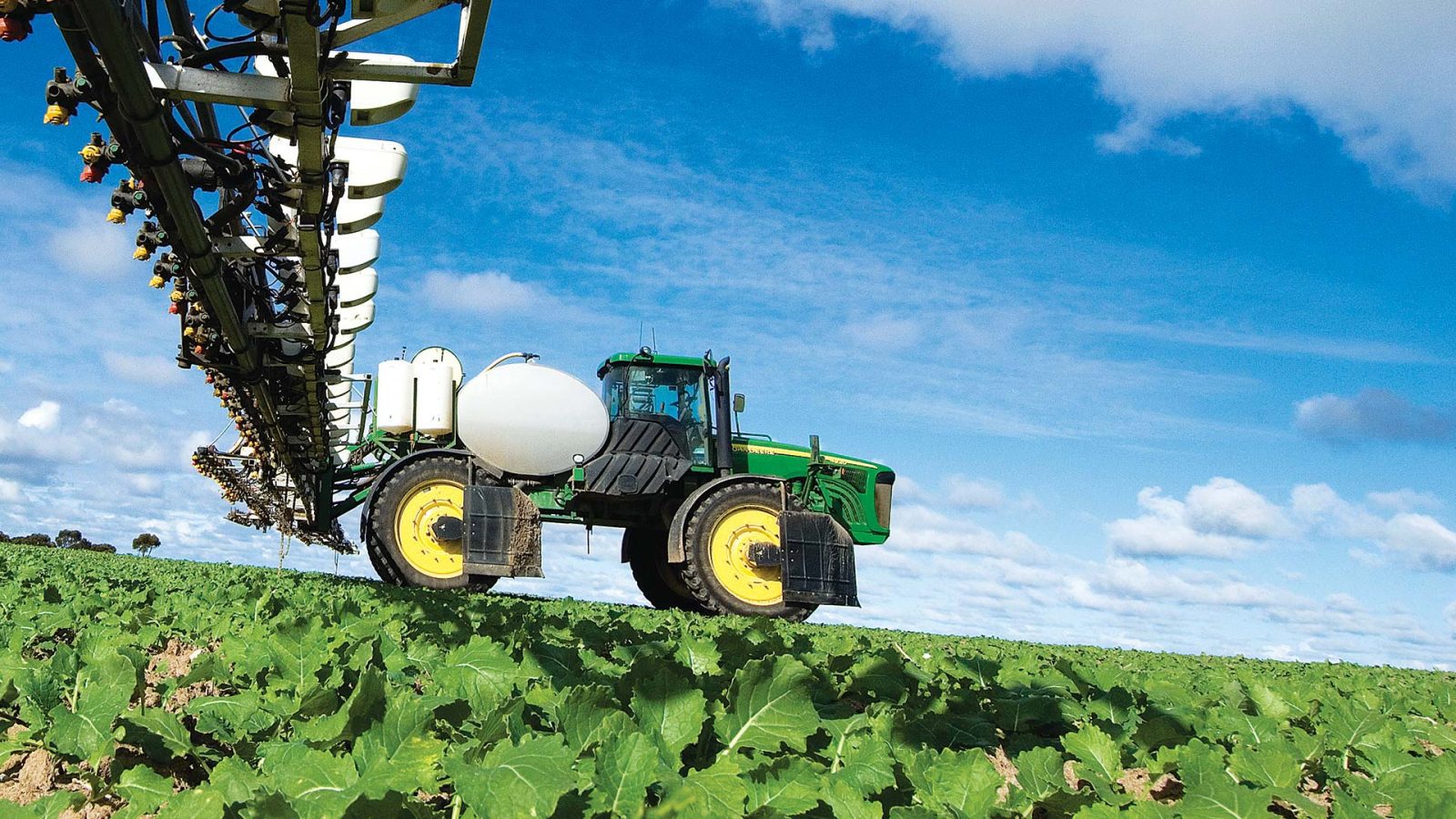
Photo: Evan Collis via GRDC
THE GRAINS Research and Development Corporation’s cash reserves will rise $78.96 million to $836.4M, according to last week’s 2026-7 Federal Budget documents.
The reserves will include an estimated $753M in managed fund investments and $83.4M cash and cash equivalents, as at July 1.
This figure differs from the number used as GRDC’s reserves total published in the organisation’s annual report documents.
The “financial reserve” is also expected to grow, with projections showing it will reach $794.2M by June 30, up $65.7M from the 2024-25 total of $728.5M.
This figure is calculated by subtracting current liabilities from current assets.
The Budget documents had GRDC’s total net resourcing reaching $1.21 billion for 2026-27, up from the estimated actual result of $1.15B in 2025-26.
Alongside the cash reserves, the net resources total includes:
- A forecast $216.1M in levy payments from growers, slightly down on the 2025-26 figure of $219.91M;
- An estimated $125M in Commonwealth Government contributions, a drop from the 2025-26 total of $134.33M
- $25M in interest payments from the managed fund investment, $2M higher than 2025-26;
- $4.88M from royalties, about $742,000 less than last year; and,
- $6.21M from other sources, which is estimated to be $2.2M lower than 2025-26.
GRDC is budgeting for an operating deficit of $9.7M in 2026-27 due to increased resesearch, development and extension expenses.
R&D investment is predicted to be $315M in 2026-27, up from $264M in 2025-6.
Total expenses jumped about $57M to $387M in 2026-7.
Speaking with Grain Central, GRDC managing director Nigel Hart said this operating deficit would be funded from the reserves built during strong seasons.
He said it was projected that GRDC would make an operating deficit for at least the next four years.
These forecast deficits are $29.4M in 2027–28, $34.9M 2028–29 and $50.5M in 2029–30.
“We’ve made losses before…it’s the nature of our industry,” Mr Hart said.
“The purpose of having reserves is to be able to sort of make sure that in those years we’ve got below-average production, we can cover off our forward contract commitments.”
Mr Hart said a key component in the deficit was the uplift in R&D expenditure, as well as the rise in the cost of research.
“The cost of research has continued to climb.
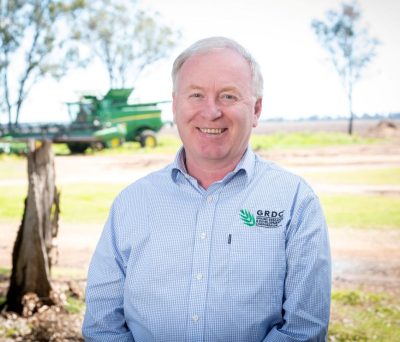
GRDC managing director Nigel Hart.
“Then there’s the underlying uplift in our core levels of research and investment.
“Then on top of that, as we talked about with the review that we did over the last 12 months, there’s about $50-60M per annum which we’re looking to invest in these areas that we discussed with growers of the Grainstorming process.”
He said increases in core research investment included projects focused on weed management, the Grain Automate program, and soil-borne diseases.
“We’re taking this opportunity while we have a good set of resources to deepen our investment in areas where we think we want to try and accelerate getting those gains out into the paddock sooner.”
The progressive uplift in RD&E expenditure would dwarf annual spending levels from around five years ago, which sat between $170M and $200M.
Mr Hart said the organisation remained conscious of its role overseeing grain growers’ levy funds allocated to research investment.
“We’re not hiding from the fact that it is an enormous amount of money and….it’s a very, very big responsibility for us to continue to spend it wisely, not fritter it away, focus on what we’ve always done.”
Commonwealth investment secure
Along with record crop years, levy contributions from growers and the Commonwealth government have also progressively risen over the decade.
From the lows of 2019-20 and 2020-21 where Commonwealth payments were $53.4M and $68.8M respectively, the contributions have risen to more than double in $138.3M in 2023-24 and $134.3M in 2024-25.
With Federal Budgets under pressure, there is growing concern in the industry that the contribution may come under threat, particularly if the GRDC reserve remains strong.
The connection between the Commonwealth contribution, GRDC’s long-term financial sustainability and overall performance appears to have been an ongoing concern for the Federal Government departments.
A former GRDC chair told Grain Central that he had faced questions over the level of benefit delivered for the funding provided by the government.
“So now that the reserves are even bigger, I’m just surprised that there hasn’t been a push from government to reduce the percentage of the matching dollar,” he said.
Mr Hart said he was confident that this contribution was not at risk as GRDC addresses key issues for the Federal Government.
“We continue to work very closely with government around government priorities and if you actually look what their priorities are around particularly biosecurity, over the last couple of years, we’ve had a big uplift in our biosecurity investments, National Grains Diagnostics Surveillance Initiative.
“They’re obviously concerned with climate; so again, we’ve got a lot of programs and it’s not just recently, but over the last decade or more we’ve been investing in, and we are the lowest emissions intensity farmers in the world.
“We’ve continued to drive that investment, and the government can see the benefits and values of doing that.”
Plus for productivity
Mr Hart said sustained productivity gains in the grains sector, driven by growers, adjacent businesses and GRDC, continued to underline its worth to the government.
“The whole ecosystem from a grains perspective is certainly performing very well and the government recognises that.
“The grains sector productivity leads not only the [agriculture] sector but also the country and…we also beat the French, we beat the US, Canada and the Argentinians.
“This is a function of our innovative growers; they’re not subsidized; they get out there and think of very innovative ways to change their farming systems.
“We work with them on a whole bunch of R&D that helps to support that.
“I think that’s why they continue to be very supportive of that co-contribution with us.”
According to the Budget, the 2024-25 gross value of grains production was gazetted as $26.9B, the third highest on record.
It was also well-above the seven-year rolling average GVP of $21.8B, considerably above that projected from the long-term trend of $15.7B.
Grain Central: Get our free news straight to your inbox – Click here
Weather forecasts are not giving accurate predictions to allow farmers to make strategic decisions about sowing crops or fertiliser applications and it seems the best forecasts come from USA and Europe. Could SOME reserves be used to collate the best of forecasts for Aussie grain growers?
The reserves are an opportunity to buy some of the best agricultural brains in the world to deliver outcomes for the current contributors
This would include blue sky research and better weather forecasts that I know exist.