
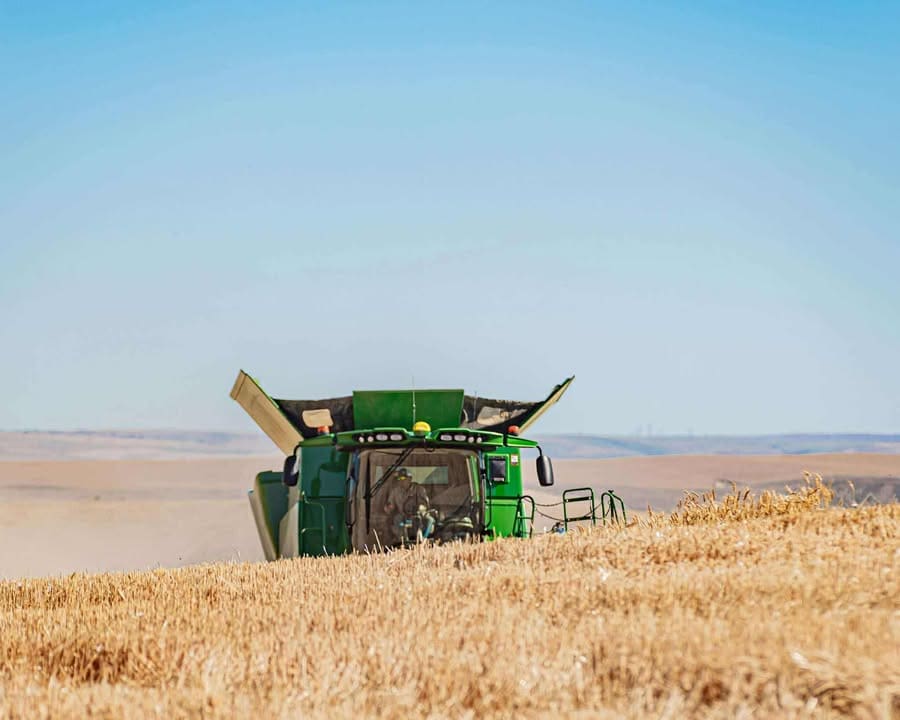
Harvesting wheat at Kortge Wheat & Cattle in Oregon’s Wasco County. Photo: Theresa Peterson
WHEAT farmers across the US have made good harvest progress ahead of widespread rains that are expected to delay the campaign in most regions for the next 10 days before drier weather is forecast to roll across the winter wheatbelt late in July and into the first week of August.
To open last week, the United States Department of Agriculture’s official crop progress report put the winter wheat harvest at 63 percent completed, up from 53pc a week earlier, on par with the five-year average of 64pc, but well behind the 70pc reaped on the same date last year. The USDA’s most recent winter wheat crop condition report was issued on July 7, with 48pc of the crop rated good to excellent, unchanged from late June but slightly lower than the 51pc recorded at the same time last year.
The Hard Red Winter wheat harvest was reportedly nearing 40pc complete, winding down in Texas, Oklahoma, and Kansas, and the focus was moving further north. The Texas harvest added seven percentage points in the week to July 13, reaching 90pc compared to the five-year average of 97pc. In Oklahoma, it was 94pc complete compared with the five-year average of 99pc, while in Kansas, Colorado, and Nebraska, those numbers were 93pc and 88pc, 47pc and 46pc, and 35pc and 43pc, respectively.
In Montana and the Pacific Northwest states of Idaho, Oregon, and Washington, the winter wheat harvest is progressing well on the back of hot and dry weather. While average quality is expected, lower-than-average yields are anticipated due to persistent dry conditions throughout much of the growing season.
Wheat Associates sees wheat quality a little lower
According to last Friday’s harvest update from US Wheat Associates, quality and yields continue to be variable, depending on environmental factors experienced throughout the capricious growing season. While yields in areas with adequate growing season soil moisture are expected to be higher and protein lower, areas with excessive moisture at harvest are seeing test weights and protein trend lower.
Sample testing last week revealed a slight downward trend in test weights, reflecting samples received from areas recently impacted by harvest rain. Last week’s mean was 78.9kg per hectolitre compared to 80.7kg/hl in 2024 and an average over the past five harvests of 79.5kg/hl. Average protein content was 11.9pc when measured on a moisture basis of 12pc, the same as in 2024 but a full percentage point below the five-year average. At 357 seconds, the falling number results harvest to date are very similar to 2024, implying a sound crop thus far.
The Soft Red Winter wheat harvest was estimated to be 91pc completed as of July 13, which put it behind last year’s pace but ahead of the five-year average. Yields are reportedly averaging around 6.7 tonnes per hectare (t/ha) through Illinois, Kentucky, and Ohio, but many samples are exhibiting abnormally high vomitoxin levels due to a wetter-than-normal growing season in many eastern US states.
Results from last week’s US Wheat Associates testing put the mean grade thus far at SRW No 2. Protein averaged 9.5pc on a 12pc moisture basis, down from 9.8pc in 2024 but slightly above the five-year average of 9.4pc. The test weight of 77.1kg/hl is an improvement over the prior week but remains below last harvest and the five-year average, which were 78kg/hl and 78.4kg/hl, respectively. Falling number results also improved week-on-week to 298 seconds, but still lower than the five-year average of 320 seconds.
Spring wheat conditions were reported as 54pc good to excellent in last Monday’s USDA update, up slightly from 50pc a week earlier, but still well behind the 77pc rating at the same time in 2024. Around 78pc of the crop had thrown a head, up from 61pc in the July 6 report, and marginally ahead of the 75pc five-year average.
USDA calls total US wheat area down, yield up
In last week’s global supply-and-demand update, the USDA pegged total US wheat production at 52.5 million tonnes (Mt), slightly higher than the June forecast of 52.3Mt, but significantly lower than the 53.7Mt reaped in 2024. This is based on a projected harvest area of 14.8 million hectares (Mha), down from 15.1Mha in the June report and 15.6Mha in 2024. This implies an average yield across all wheat categories of 3.54t/ha, compared to 3.47t/ha in the June update and 3.45t/ha last harvest.
Winter-wheat production is forecast at 36.6Mt, down fractionally from 36.7Mt in 2024. A reduction in the harvested area from 10.6Mha to 10Mha is expected to be largely offset by a 4.8pc improvement in yield from 3.48t/ha to 3.64t/ha, the second highest on record.
Breaking it down by class, HRW output is estimated to total 20.5Mt, or 56.1pc of the winter crop harvest. With 9.2Mt or 25pc of the total, SRW is the second-biggest winter-wheat category, followed by soft white and hard white with 6.4Mt and 500,000t respectively, or 17.4pc and 1.5pc of the total.
The current spring wheat production forecast, including durum, is 15.9Mt, 6.2pc less than the 2024 crop of 16.9Mt, following a 4.5pc reduction in the harvested area to 4.8Mha, and a 1.8pc fall in the average yield estimate to 3.32t/ha.
Excluding the relatively poor-yielding durum wheat from the equation, this season’s average yield forecast for the “other spring wheats” is the second highest on record, behind the 2024 harvest. This lofty projection caught the market off guard, as the significantly poorer crop conditions this season do not support such an outcome.
Hard Red Spring dominates the spring-wheat category with 12.8Mt, or 80.4pc of the total. Durum runs a poor second on 2.2Mt, or 13.7pc of the output estimate. Soft white and hard white make up the balance on 700,000t and 200,000t respectively, or just 4.7pc and 1.3pc of the projected total.
Despite the lower US wheat production outlook in 2025, the USDA has increased the export forecast from 22.5Mt in 2024-25 to 23.1Mt in the 2025-26 marketing year on the back of heightened competitiveness in the international market and a relatively high carry-in of 23.1Mt, up from 19Mt in the 2024-25 season.
The influence of Trump’s global extortion campaign on US wheat exports in the coming year is yet to play out, but deals such as that announced with Indonesia last week and Bangladesh over the weekend are likely to have a significant impact on global trade flows, particularly in Australia’s backyard.
HAVE YOUR SAY