
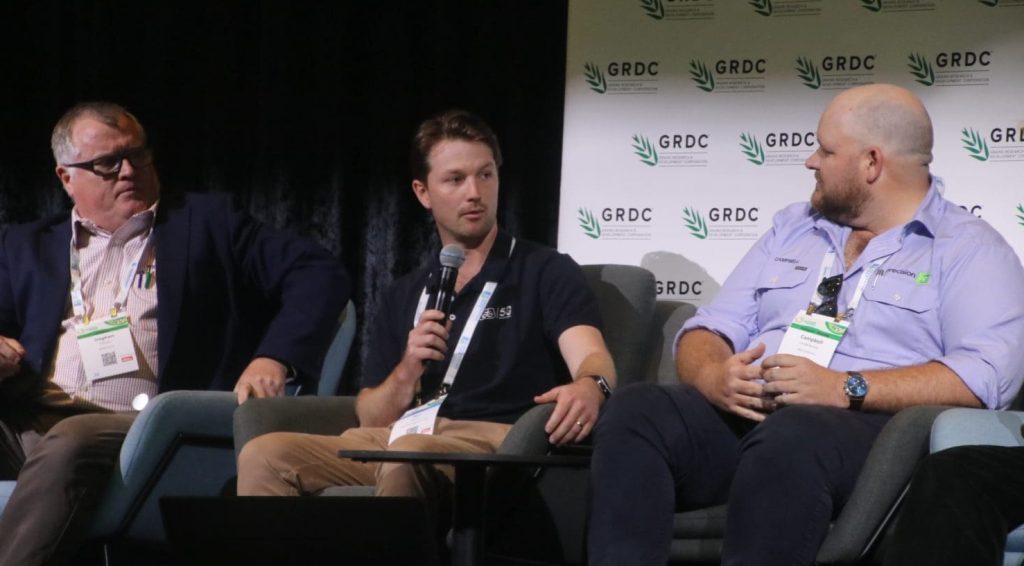
Mort & Co CEO Stephen O’Brien, Pioneer Seeds summer crop portfolio manager Ben Vercoe and Precision Agriculture Campbell Underwood discuss ESG reporting during the recent Australian Summer Grains Conference.
THE POTENTIAL impact of mandatory emissions reporting on grain growers was a hot topic at this month’s Australian Summer Grains Conference, with panelists and attendees able to provide little clarity around what future reporting requirements could look like.
Legislation came into effect on January 1, requiring many large Australian businesses to prepare annual sustainability reports containing climate-related financial disclosures.
These reports will need to include: a company’s material financial risks or opportunities relating to climate; metrics and targets for the financial year like scope 1, 2 and 3 greenhouse gas emissions; and information about the entity’s governance, strategy, or risk management in relation to these risks, opportunities, metrics and targets.
Scope 1 emissions cover those released directly from a company’s operations, while scope 2 includes emissions generated outside a company’s boundary to produce electricity used on-site.
Scope 3 covers all other indirect emissions across the supply chain, such as those tied to transport, raw-material production, and waste disposal.
The requirements will be phased in over the next three years, with the first group to begin reporting for the financial year starting on or after 1 January 2025.
A second cohort will follow from 1 July 2026, with the final group coming into scope from 1 July 2027.
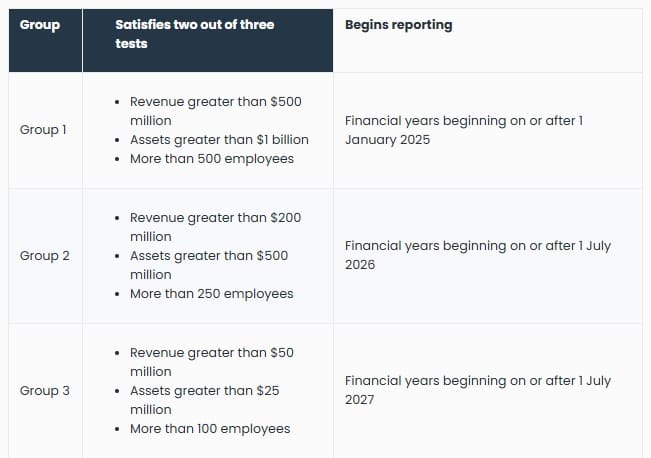
Table 1: Commencement of reporting requirements for entities meeting the required thresholds Source: ASIC
Although most growers will not be required to prepare a disclosure, all growers who sell to one of the reporting companies will contribute to that entity’s scope 3 emissions.
Before a standard was published by the Federal Government, there was little information on what data would need to be provided for scope 3 emissions.
If measurements were required over an estimation, this would effectively mandate all growers undertake some form of emissions study on their operation.
In September, an Australian Sustainability Reporting Standard was published as a guideline to reporting entities.
It detailed that a reporting entity was “permitted to use estimation in measuring its scope 3 emissions” but it should “prioritise direct measurement”.
The standard left this up to the judgement of the company, but recommended it must use “all reasonable and supportable information that is available to the…reporting date without undue cost or effort”.
Work in progress
Members of the industry panel held during the Australian Summer Grains Conference earlier this month were asked whether they had a clear plan for dealing with this new legislation.
AgForce Grains policy director Ruth Thompson asked company representatives what scope 3 mandatory emissions reporting was going to look like for them and their customers.
Pioneer Seeds summer crop portfolio manager Ben Vercoe said as GenTech Seeds, a company owned by the Yates family, they were progressing work to finalise how they would determine the company’s emissions.
“From a Pioneer perspective here in Australia, we are well and truly on the journey of working that out,” Mr Vercoe said.
“The Yates family and the board have just signed off on a sustainability pathway forward.
“We have a fellow employed to just focus on that area.”
He said that it was “a real focus for us”, and will commence with determining scope 1 and 2 emissions before “looking at what are our scope 3 emissions and what do we need to do going forward around how we’re going to report on it”.
He said as part of this process, Pioneer would establish “how it was going to potentially impact our customers and how does it impact us from people who are supplying us as well”.
Mort & Co chief executive officer Stephen O’Brien said the lotfeeding business was in the same position as Pioneer Seeds.
“There’s a lot of work we’re doing with 1 and 2,” Mr O’Brien said.
“Scope 3 is very much in discussion, both internally but also externally to make sure that we’re in front of it.
“We know there is a lot of [work] to be able to report it, and report it accurately and that’s under discussion now.
“It’s early in the piece.”
RaboBank commodities analyst Paul Joules said the issue was not in his area of expertise, and that RaboBank was working through the issue.
“It’s something that we’re still ironing out and something that is a work in progress,” Mr Joules said.
Thankfully, companies will have “transition relief from the requirement to disclose scope 3 greenhouse gas emissions” for the “first annual reporting period in which they apply”.
This will give entities additional time to work on how they will measure and report scope 3 emissions.
Key grower focus
The issue of emissions reporting drew comments during the conference from growers who may be required to report directly to the government, or who have a business interest in reporting emissions as well as overall sustainability.
Boolah Farms principal Stuart Tighe said carbon emissions and ESG reporting was one of the biggest trends at top of mind.
“[It’s] ESG mandatory reporting, as well as what else the market particularly is looking for, or is predicting that they’re going to be looking for,” Mr Tighe said.
Coggan Farming finance and development manager Emily Coggan said she was focused on reviewing the business’ policies and procedures over the next five years.
She said this would include “bringing that whole picture together in the way that we do things” that was a central element of ESG and carbon emissions reporting.
Located near Meandarra, Coggan Farms operates a mixed-farming operation across 22,000 hectares.
“It is really what the crux of the ESG reporting is looking at: how does the whole ecosystem work together, what do the numbers look like and what is the narrative that overlays over the top of it,” Ms Coggan said.
“I’m very keen to spend a bit of time over the next half-decade interrogating that, and seeing where we are on the other side.”
Grain Central: Get our free news straight to your inbox – Click here
HAVE YOUR SAY