
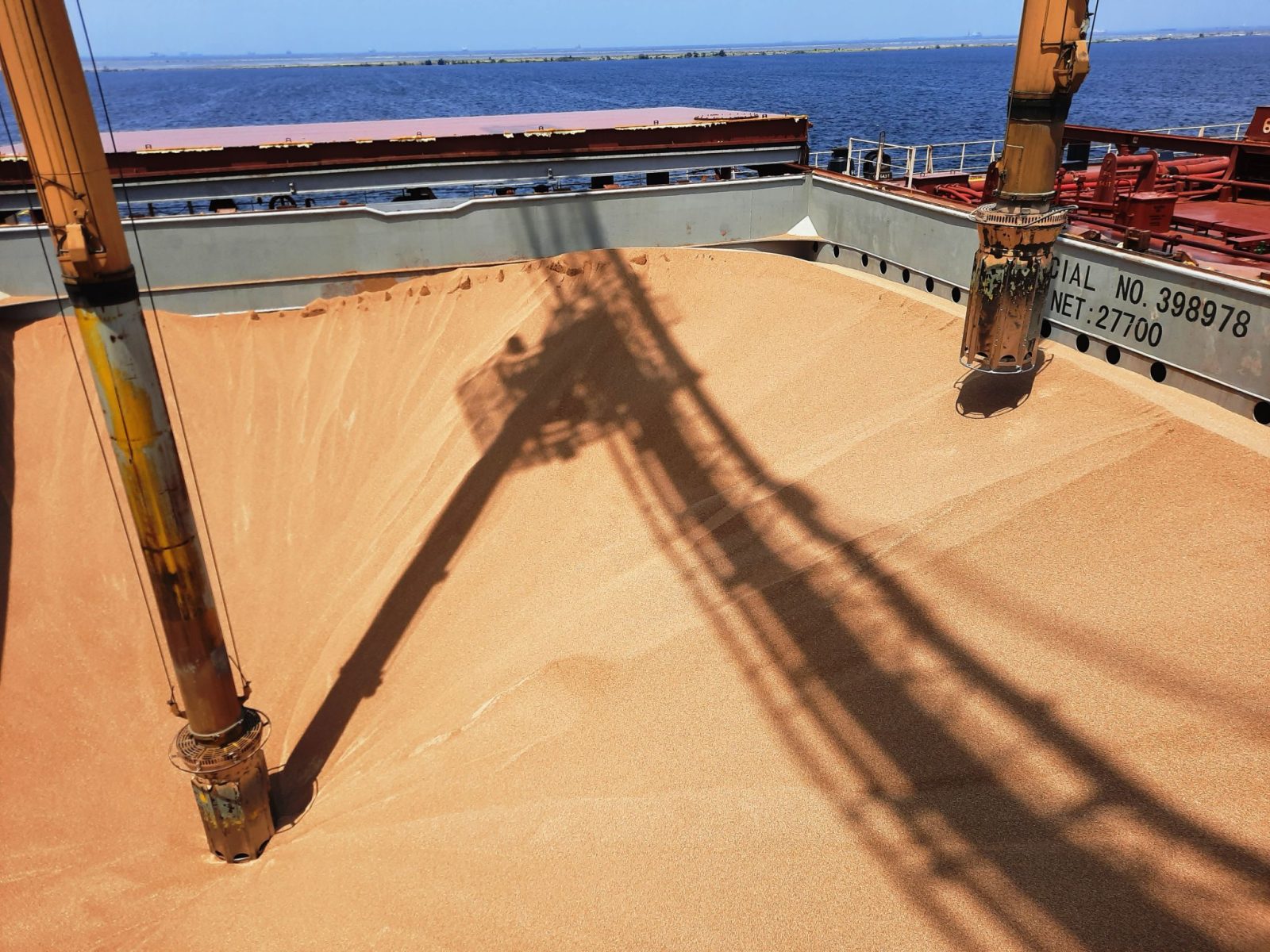
Canadian wheat discharging at Bogasari’s Jakarta flour mill in 2022. Photo: Ocean 21 Holdings
THE INDONESIAN Government last week revealed plans to prioritise wheat and soybean imports from the United States as part of a comprehensive trade agreement, primarily to appease Donald Trump, but it is also reported to have established important new agricultural trade channels between the two nations.
According to Indonesia’s Agriculture Minister Andi Amran Sulaiman, the initiative is part of a US$4.5-billion agricultural import commitment that reduces tariffs and is tied to a broader reciprocal deal encompassing energy purchases and aircraft acquisitions.
The minister cited domestic supply gaps and the need to stabilise food prices as the primary motivations, largely ignoring the bullying tactics adopted by the US administration. Sulaiman added that there was a possibility of importing additional commodities such as milk and beef from the US, but said final decisions will depend on a comprehensive evaluation of national demand and domestic supply.
While expressing openness to international trade cooperation, the minister stressed that imports will only proceed if domestic production is unable to meet national needs, and the negotiated price is in line with international values. He reiterated the government’s commitment to maintaining a balance between opening the market and safeguarding local producers, amid the evolving dynamics of global agricultural trade.
Under the deal, Indonesia will eliminate a number of non-tariff barriers and recognise US Food and Drug Administration certifications for certain goods. At the same time, the US will reduce tariffs on Indonesian exports to the US from the previously advised 32pc to 19pc.
According to Indonesian trade data, soybean imports reached 2.68 million tonnes (Mt) in 2024, almost 18pc higher than the previous year, with the majority sourced from the US. The most widely consumed soybean food products in Indonesia are tempeh and tofu, while soybean meal is a crucial component in stockfeed rations, particularly for the poultry sector.
Wheat imports from July 2024 to May 2025 totalled 9.4Mt, a decrease of 21.5pc compared to the previous corresponding period. Australian exporters enjoy a geographical advantage when trading with Indonesia, as well as a customer preference for yellowish noodles produced from Australian wheat. Australia captured a market share of 31.1pc, followed by Canada and Ukraine with 22.3pc and 17.9pc respectively. The US market share was only 6.9pc, with a value of just US$195M.
The latest announcement comes hot on the heels of a commitment by the Indonesian Flour Mills Association (APTINDO) to double its annual purchases of US wheat to 1Mt each year for the next five calendar years. Purchases in 2025 will be prorated with a minimum of 800,000t agreed. While cautious, analysts suggest this could reshape Indonesia’s grain-sourcing landscape, which has traditionally leaned on Australia and Canada. This deal is particularly beneficial for Hard Red Winter wheat growers, with this category accounting for 27pc of US wheat exports to Indonesia in the past decade.
Wheat expansion
Wheat consumption in Indonesia has surged by 22pc over the past 10 years, on the back of growing demand for high-quality flour. Domestically produced wheat flour continues to dominate the local market with a 99.9pc market share. Nevertheless, demand for imported wheat flour did increase by 36.9pc to 102,667t of wheat equivalent in the 11 months to the end of May 2025.
The milling industry in Indonesia continues to expand, adding one new mill and 400,000t of capacity over the past 12 months. The sector currently boasts a total of 31 flour mills with an installed capacity of 14.8Mt annually. The island of Java is home to 24 mills, including the latest build, with five mills on Sumatra and two more on Sulawesi.
According to the latest Grain and Feed Update from the US Department of Agriculture’s Foreign Agricultural Service, Indonesian wheat demand will increase from 10.6Mt in the 2024-25 marketing year to 10.9Mt in 2025-26. Food, seed and industrial consumption is expected to account for more than 87pc of the total at 9.5Mt, up from 9.3Mt in 2024-25, while feed and residual use is forecast to rise from 1.3Mt to 1.4Mt. Wheat demand from flour mills is expected to remain strong as higher demand from bakeries, biscuit manufacturers, small and medium enterprises, and households drives up flour consumption.
Corn compounding
Due to the seasonality of local corn production, stockfeed mills continue to include wheat as a vital source of energy in feed formulations. However, higher domestic corn output, combined with fluctuating international wheat prices and the government’s recent reluctance to allow wheat imports for fodder, has driven animal feed compounders to reduce the proportion of wheat and use more corn in livestock rations.
With no domestic wheat production, Indonesia is totally reliant on imports to meet internal demand. FAS decreased its 2024-25 wheat import estimate this month from 11Mt to 10.5Mt due to a significant post-election drop in flour use, the lack of import quota allocations for wheat inclusion in stockfeed rations and a weakened Indonesian rupiah. FAS does see wheat imports returning to at least 11Mt in 2025-26 to satisfy the projected increase in domestic demand; however, this is still much lower than its early-season forecast of 12.6Mt back in April.
Australian wheat exports to Indonesia in the eight months to the end of May 2025 totalled 2.54Mt, or 16.9pc of the nation’s total wheat shipments. This compares to 2.47Mt in the previous corresponding period. In the 12 months to the end of May 2025, 3.31Mt of wheat was shipped to Indonesia, down from 4.52Mt in the preceding 12-month period.
With China largely missing in action compared to the previous season, Indonesia is Australia’s biggest wheat customer in the October 2024 to May 2025 window. The second-biggest destination is The Philippines with 13.8pc, followed by Thailand with 8.7pc, Vietnam with 6.8pc and Yemen with 6.4pc. A year earlier, it was China claiming top spot with 24.3pc of the export campaign, followed by Indonesia with 16.6pc, The Philippines with 9.7pc, Yemen with 7.7pc and Japan with 5.9pc.
HAVE YOUR SAY