
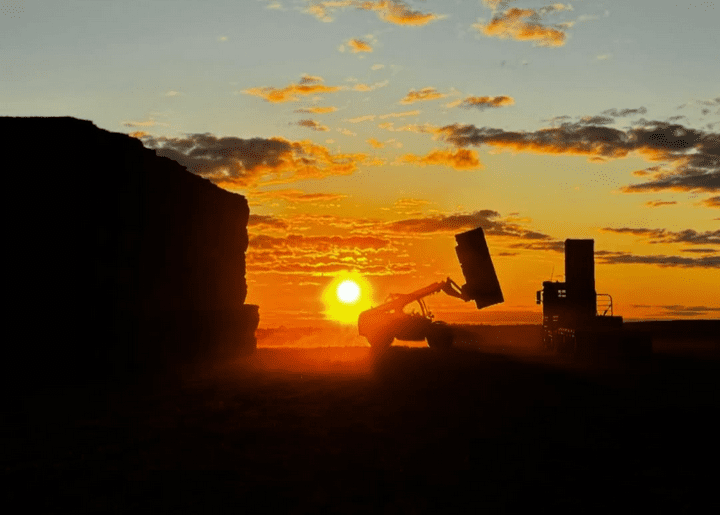
Loading hay in Victoria last season. Photo: Green & Gold Contracting/@shovel_d
EASTERN Australia’s haymaking season has started, bringing with it the promise of restocked sheds and local supplies to end the south-east’s worst fodder shortage ever.
Buffering the impact of drought centred in South Australia, Victoria and southern New South Wales has been hay trucked in from as far afield as Western Australia, the Northern Territory, and Queensland, demand for which has now fallen away.
After good winter rain in some areas, many ewes in SA, Vic and southern NSW are now on green feed after 12 months or more in containment pens, but beef and dairy cattle and lambs are still primarily on full or supplementary rations.
Apart from graziers and mixed farmers wanting to restock their own sheds, the late autumn break means most vetch, cereal, and canola crops in SA and Vic are 3-10 weeks behind where they normally are at this time of year.
Hay prices are yet to drop to their pre-drought levels, and could hold at current rates well into spring, with new-season hay expected to be slow to get to market.
While hay prices have eased from their May-June peak, they are still well above where they were 12 months ago, when hopes were high for the 2024-25 crop, and before floods on the NSW coast and in south-west Qld supercharged demand for fodder in eastern Australia.
Southern business slows
Qld business Fodder Link has around 80 percent of its client base in feedlots in northern New South Wales and southern Qld.
In recent months, it has sold an unprecedented amount of fodder into southern grazing regions.
“Demand has really died away down south,” Fodder Link principal Cameron Angel said.
“There are just a couple of straggling single loads people are chasing, and there’s still a very limited supply of product around.”
Mr Angel said reports were coming through of some southern livestock producers cancelling orders for loads of straw and hay, releasing small amounts of fodder on to the prompt market.
However, sourcing more than a single truckload in the southern market remains a challenge.
“Cereal hay is in very tight supply; there are limited amounts available on the east coast of Australia.”
Mr Angel said new-season hay was “just around the corner”, weather permitting.
“Some product has been cut and is on the ground now in places like Emerald, Biloela and Monto, and a little around St George and Charleville too.
“In southern Qld and northern NSW, lots of people are ready to cut hay; we just need a weather window now.
“Traditionally, the second week in September is go time.”
The Bureau of Meteorology’s outlook is pointing to above-average rainfall for spring for eastern Australia, which augurs well for later-developing crops, but is far from ideal for haymaking.
“We’re quite concerned with weather patterns we’re seeing.”
“From my perspective for hay, my concern is for quality.
“It’s going to be really challenging to make nice hay and straw.
“We need three weeks of dry weather.”
This week has not been one of them, with rain in parts of northern NSW and southern Qld waterlogging some paddocks, and flood warnings issued for several rivers in northern NSW, where losses of lucerne and other fodder crops could be considerable.
WA hay helps bridge gap
Prior to the drought, cereal hay was trading at around $320-$350/t delivered in Vic, SA, and southern NSW, but is still changing hands at roughly $500-$550/t, depending on quality and delivery point.
This is down from its $650/t peak hit prior to the SA Government permitting hay from regions of WA free of green snail to arrive in or transit the state.
Hamilton-based Green & Gold Contractors is one of several Vic companies that has been bringing in hay from WA since June.
“Normally our saviour would be South Australia, but they’ve had similar conditions,” director Vic Hoffmann Dohle said.
“The WA stuff is premium quality; it’s beautiful, consistent export hay…but it does have $300/t of freight on it.”
Green & Gold Contractors’ clients are dairies and beef cattle and sheep operations in Vic’s Western District and south-west.
All three sectors upped their demand once Vic’s fodder shortage became chronic early last year.
“Demand has backed off in the past two to six weeks, but for cattle, there is still demand.”
Like other fodder merchants in south-eastern Australia, Green & Gold Contractors is trying to predict when the region’s demand will shrink to pre-drought levels, and the near-term variables of pasture growth, stock numbers, and local hay availability.
They have not yet turned off the tap on WA hay.
“We still do have hay coming over to service regular clients.”
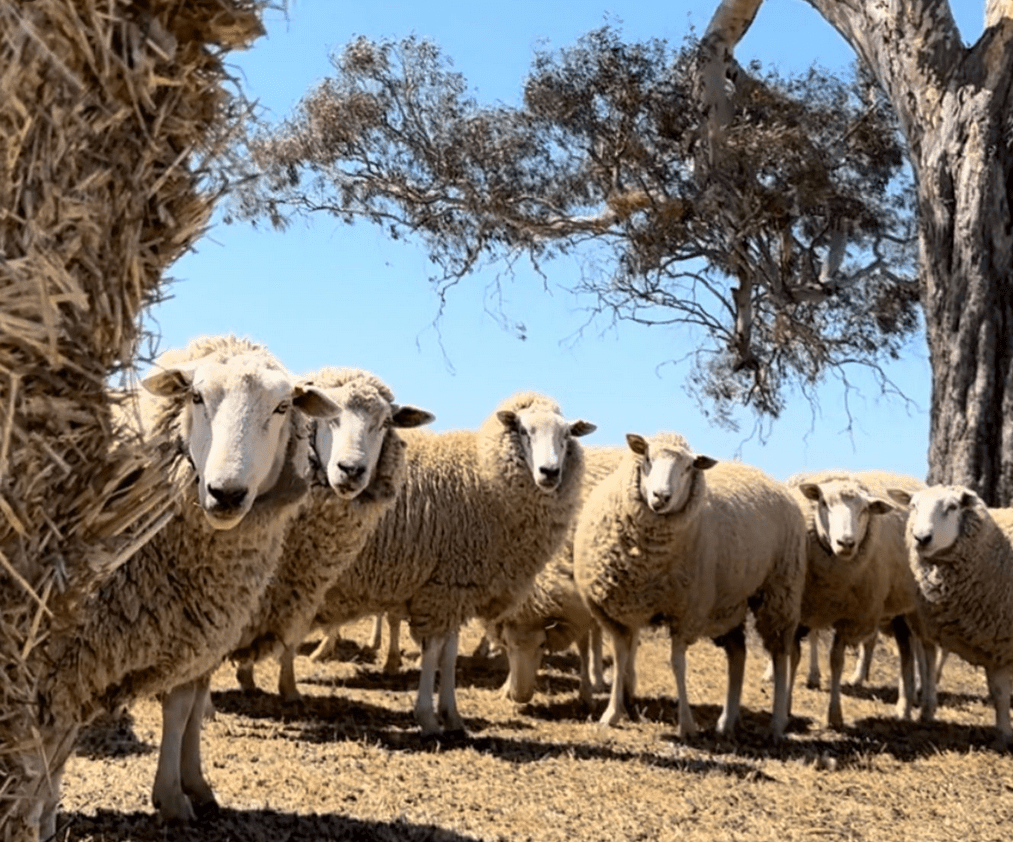
Ewes in containment pens at the height of the drought last year. Photo: Vic Hoffmann Dohle
Ms Hoffmann Dohle said recent rain has relieved some drought pressure, but by how much varied greatly at a local, district, and regional level, and even within farms and paddocks.
“The forecast looks better than the season.”
“Down south, feed’s starting to get away, but by no means is it lush.
“It’s been a mixed bag across every district for the past two years.”
The family business produces prime lambs and makes hay for its own use, and for sale.
“New-season hay production in the Wimmera and the Mallee looks better than it did last year, but we don’t have subsoil moisture, and we’re going to be reliant on rain through spring.”
Hay-cutting is expected to start in the Mallee next month, around three weeks later than normal because of the late autumn break.
Ewes get first pick
Ms Hoffmann Dohle said sheep, and lambing ewes in particular, were being given the first crack at pastures, after wildly variable joining and lambing outcomes for mobs in containment pens over the past 12-18 months.
Anecdotally, scanning results have been as low as 30-70 percent, while marking has had an equally disappointing low, but a peak of up to 110pc from lambing in containment pens.
“There are some horrible stories out there.”
With lamb prices as strong as they are, ewes are getting priority on the first of the feed.
Ms Hoffmann Dohle said some people have held hay for on-farm use, or destocked, or got feed, and were therefore reducing the call for hay in the spot market.
“There’s more hay available than what there was six weeks ago, and prices are softer than they were six weeks ago.”
With most hay sheds across south-eastern Australia empty, or close to it after the prolonged hand-feeding period, Ms Hoffmann Dohle said the amount of just-baled hay available to the market could well be reduced from its pre-drought level.
“What remains to be seen is what the demand will be, because there has been destocking.”
In SA, Clare-based Platinum Livestock’s Toby Cousins said some demand for wheaten and oaten hay existed ahead of spring feed getting away, but most sheep have gone back on to pasture in recent weeks.
“A lot of people have joined their ewes, and most of them are out of containment pens now.”
“There’s still a bit of hay around, but not much.”
Mr Cousins said mixed farmers were likely to restock themselves with hay before offering any to the cash market, and still needed another rain or two to bolster production prospects for hay and harvested crops.
The late break could make for a late hay-cutting season, and a feed gap between regenerating pastures and fresh hay and/or stubble after harvest.
“Farmers are 8-10 weeks behind on where they’d normally be, and pastures are just starting to pick up.”
“The lamb and ewe job is ticking along fairly well, but the Mid North is not restocking yet.”
Grain Central: Get our free news straight to your inbox – Click here
HAVE YOUR SAY