
RESTRICTIONS on the use of the insecticide fenitrothion are expected to have minimal impact in the grains industry, but have sparked some concern when it comes to locust control.
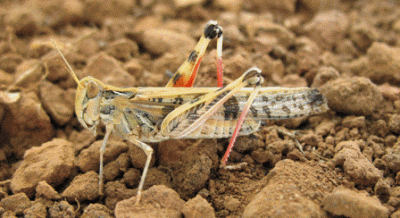
As of mid-2026, fenitrothion will not be an option for control of plague locusts. Photo: DAFF
Announced last month by the Australian Pesticides and Veterinary Medicines Authority, and following a year-long chemical review and public consultation, the changes will restrict fenitrothion’s approved use to stored grain only from mid-2026.
The APVMA ruled that most current uses of fenitrothion in broadacre cropping, pastures, horticulture, poultry houses and grain storages will be cancelled, citing unmanageable risks to workers, wildlife and the environment.
The ruling follows more than 200 little corellas and several sulphur-crested cockatoos being found dead or dying across multiple suburbs in Newcastle in March, with fenitrothion applied to barley confirmed as the cause.
Fenitrothion has historically been used to control locusts, grasshoppers and beetles.
While the APVMA stressed there is no current risk to food safety, it determined that the chemical’s widespread use poses unacceptable environmental harm, particularly to birds, small mammals, and aquatic species through spray drift.
Handy for stored grain
Under the trade name Sumithion, Sumitomo Chemical Australia manufactures the active ingredient fenitrothion, which has also been available under generic labels.
Grain Central understands Sumitomo developed fenitrothion for use on stored grain, but its approved uses grew to include control of some pests in pastures.
Fenitrothion has also been used as a structural treatment in and around silos and poultry sheds, mainly in the tropics, where insect pressure is greater for longer because of high temperatures and humidity.
At a cost of less than one cent per tonne of storage capacity, the literally “dirt cheap” and highly effective diatomaceous earth (DE) is the dominant and recommended structural treatment used in grain storages across Australia.
“Diatomaceous earth is the primary product we’d suggest,” Horsham-based stored grain specialist Chris Warrick, Primary Business, said.
“It has a broader spectrum than fenitrothion to try and control a greater range of pests.”
Townsville-based grain-storage specialist Brock Dembowski said fenitrothion was used by growers without sealable storages suitable for phosphine, and as a handy option for grain in storages which never or rarely empty and therefore cannot have DE applied internally.
“The most common ones are bulk handlers or feed manufacturers because they’ve got grain in 24/7,” Mr Dembowski said.
“It’s easier to do full-blown clean-ups on a grower’s property when you’ll have storages completely empty throughout the year.”
Mr Dembowski said losing fenitrothion as a structural treatment meant it was “one less bullet to fire at the insects”, particularly when relative humidity was above 70pc and DE was known to lose some of its efficacy.
“We’ve got a few other structural treatments to use, so we’ll just have to rotate more effectively with what’s available.”
He said fenitrothion has been good to use in rotation with phosphine to held minimise resistance build-up.
“The big-ticket one is red flour beetle – that’s proven to be the most problematic; it’s got strong resistance to phosphine.
“Every time I sieve grain at a site, I can guarantee one will be there.”
Grain Central asked CBH Group as Western Australia’s major bulk handler, Bunge as South Australia’s, and GrainCorp as eastern Australia’s whether they used fenitrothion at their sites.
Only Bunge responded, saying: “We have integrated pest management processes in place to protect grain in storage that utilise approved treatments and follow all applicable regulations.”
Locusts
Along with fipronil and metarhizium, fenitrothion can currently be used to combat locust outbreaks.
As locust numbers build in western Queensland, AgForce south-east Qld director and biosecurity policy committee member Belinda Callinan said the phase-out of fenitrothion was “rather concerning”.
“It’s one of only a small number of registered actives for locust control; we need a number of actives to be able to manage the risk,” Ms Callinan said.
“If we lose that product, we’ve got only two chemicals remaining.”
While the APVMA can issue special-use permits, Ms Callinan said there was no guarantee one for fenitrothion would be forthcoming in the face of locust pressure post mid-2026.
“I don’t know whether you’d be able to get it back for a special use.”
Unlike fipronil, fenitrothion is an organophosphate, seen to contain unacceptably high health and environmental risk.
Under the Green Guard label, the fungi metarhizium is a bio-control agent, but has a short shelf life.
Ms Callinan said having more than one active available to spray on locusts at the nymph stage in volume, and at short notice, would be desirable, but that may not be possible once fenitrothion is removed as an option.
Spraying of locusts in concerning numbers is best done when they are banding at the nymph stage and, as with best practice for other pesticides, using more than one or two chemistries has less chance of the targeted species building resistance.
Grain-growing regions of Qld have not seen severe locust pressure since the late 1990s, but AgForce grains president and Warra grower Brendan Taylor said building numbers and increasing activity were of concern.
Mr Taylor said he believed fenitrothion was used very little in cropping operations these days.
“The last time I used it was in the late 1990s for locusts.
“Given the scenario for locusts in the central west…there might be a call for it again.”
Like Ms Callinan, he said he was concerned about having limited options to spray locusts as they head east and south, and possibly cross state borders.
“In the ‘90s, there was so much spraying done, they ran out of insecticide.”
“We don’t want to see that happening again.”
Grain Central: Get our free news straight to your inbox – Click here
HAVE YOUR SAY