
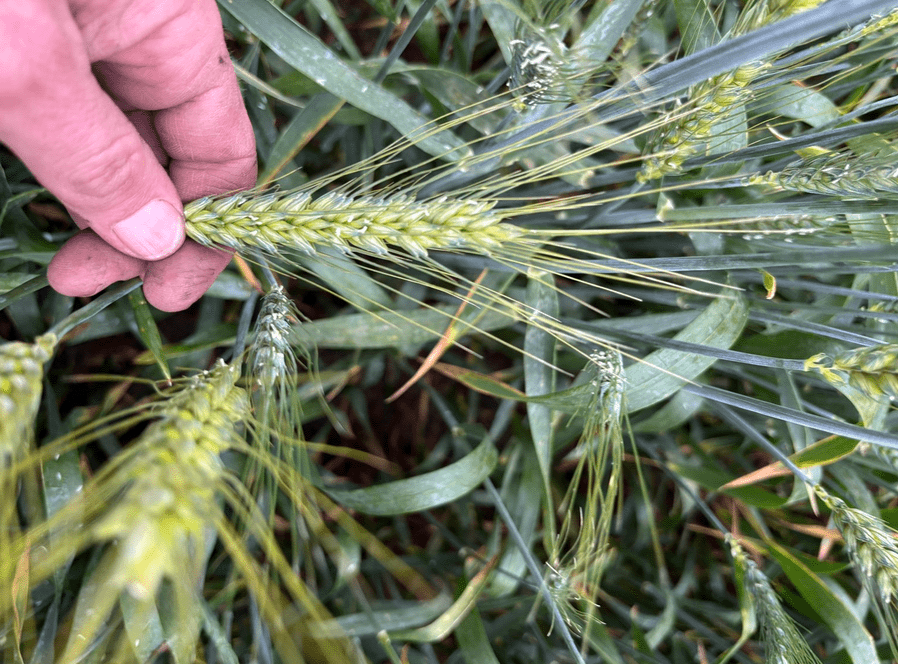
Heads fill on Lancer wheat in the Moree district, where above-average yields are in sight. Photo: Ben Boughton
PRICES for wheat and barley are plumbing new depths as yield prospects consolidate in some districts after recent rain.
However, the precariousness of the season cannot be overstated, and much of South Australia, Victoria, and the southern half of New South Wales need more rain to ensure even average yields.
In Queensland, a number of growers are getting close to starting harvest on early barley in Central Queensland and on the western Downs.
In northern NSW, ideally timed rain in the past day or two has further boosted above-average yield prospects as heads fill.
| Prompt Sep 4 | Prompt today | Jan Aug 21 | Jan today | |
| Downs barley | $303 | $301 | $300 | $295 |
| Downs SFW | $322 | $318 | $318 | $315 |
| Downs sorghum | $325 | $320 | Mar-Apr $310 | $310 |
| Mel barley | $325 | $318 | $325 | $318 |
| Mel ASW | $360 | $345 | $350 | $345 |
Table 1: Indicative prices in Australian dollars per tonne.
North drops below $300
Bids on wheat and barley have now sunk to around the $300/t mark, a level seen by most growers as below the limit of acceptable pricing.
Confident of a large current-crop carry-out, and a big new crop coming, consumers and exporters are largely absent from the market.
“Consumers don’t have to buy anything; for the grower, that’s the problem you have with no exports going on,” one trader said.
Knight Commodities Goondiwindi-based broker Gerard Doherty said some business was taking place for October delivery as values consolidate at lower levels.
“It seems nearby holes have been covered, but we have seen a bit more October engagement this week,” Mr Doherty said.
“Barley’s really come under pressure.”
Mr Doherty said variable rainfall throughout the growing season means many wheat crops in the Goondiwindi district look likely to yield 4-5t, but plenty of 2-3t/ha yields also look possible.
“I’m still adamant the crop is nowhere near as big as last year’s, but there are some very sweet patches.”
Mixed farmers are now running the ruler over turning some under-performing crops into hay, rather than harvesting for grain as intended at planting.
However, the hay market has eased considerably in the past two months, and if extra hay is cut, it will likely go into growers’ depleted on-farm reserves.
“If SFW wheat is now $315, and barley is $300, hay doesn’t need to be that good to start knocking those values off.”
With a wetter-than-average spring forecast by the Bureau of Meteorology, Mr Doherty said growers were conscious of both a larger-than-normal discount for feed wheat from the base APW grade, and potential for an inflated premium for high-protein wheat.
“September looks largely dry for Queensland, but that wet spring forecast is still very current.”
While SFW’s discount to new-crop APW is currently expected to be $50/t or more, Mr Doherty said a dry run until late October could well narrow the margin.
“It could pull in to less than $15.”
Very little rain fell in Qld in the past week, but the northern half of NSW recorded some significant falls in the week to 9am today, and will help pile yield into filling heads.
Registrations included: Dubbo 47mm; Moree and Mungindi 16mm; Narrabri 11mm; Peak Hill and Wellington 86mm; Quirindi 18mm; Trangie 36mm, and Walgett 27mm.
Rain brightens south’s prospects
Rain this week has brightened prospects for crops in the southern half of NSW, as well as across the SA and Vic grainbelts.
Registrations in south-central and southern NSW include: Barellan 26mm; Cootamundra and Temora 38mm; West Wyalong 41mm; Young 35mm.
“Things look a lot brighter than they did a week ago,” Peters Commodities Wagga Wagga-based trader Peter Gerhardy said.
“We’ve had some great rain in the Riverina.
“Crops are late, and this will definitely energise them.
“This rain is not enough to finish them, but it gives them a fortnight’s reprieve.”
Crops that missed the rain and are facing yield prospects well below average may be cut for hay to replenish on-farm supplies.
Mr Gerhardy said the incentive to finish store lambs may prompt a bit of extra haycutting this season for near-term needs, and to build fodder reserves for next year and possibly beyond.
“A lot of store lambs are trading now, and people are creating their own little feedlots.”
Pinion Advisory Horsham-based broker Andy Brown said consumer demand was thin for anything other than small parcels.
“It’s hard to sell volume at the moment,” Mr Brown said.
On export, bulk and containerised interest reflects the weight of the Northern Hemisphere crop, and limited forward selling from growers has traders reluctant to go short for early slots.
Where the SA and Vic crops end up will depend very much on rain this and next month.
In Vic, some cropping districts have jagged 10-20mm in the past week, but others missed out, or had only single-digit registrations.
In SA, rain was more widespread, and higher registrations in the week to 9am today include: Alawoona 23mm; Cleve 22mm; Crystal Brook 33mm; Kadina 50mm; Laura 45mm; Melrose 36mm; Paskeville 24mm, and Wirrabara 35mm.
“We’ve been lucky to have cool weather so far.
“The crops are 4-6 weeks behind and we needed a cool finish; so far, we’ve had it.”
Grain Central: Get our free news straight to your inbox – Click here
HAVE YOUR SAY