
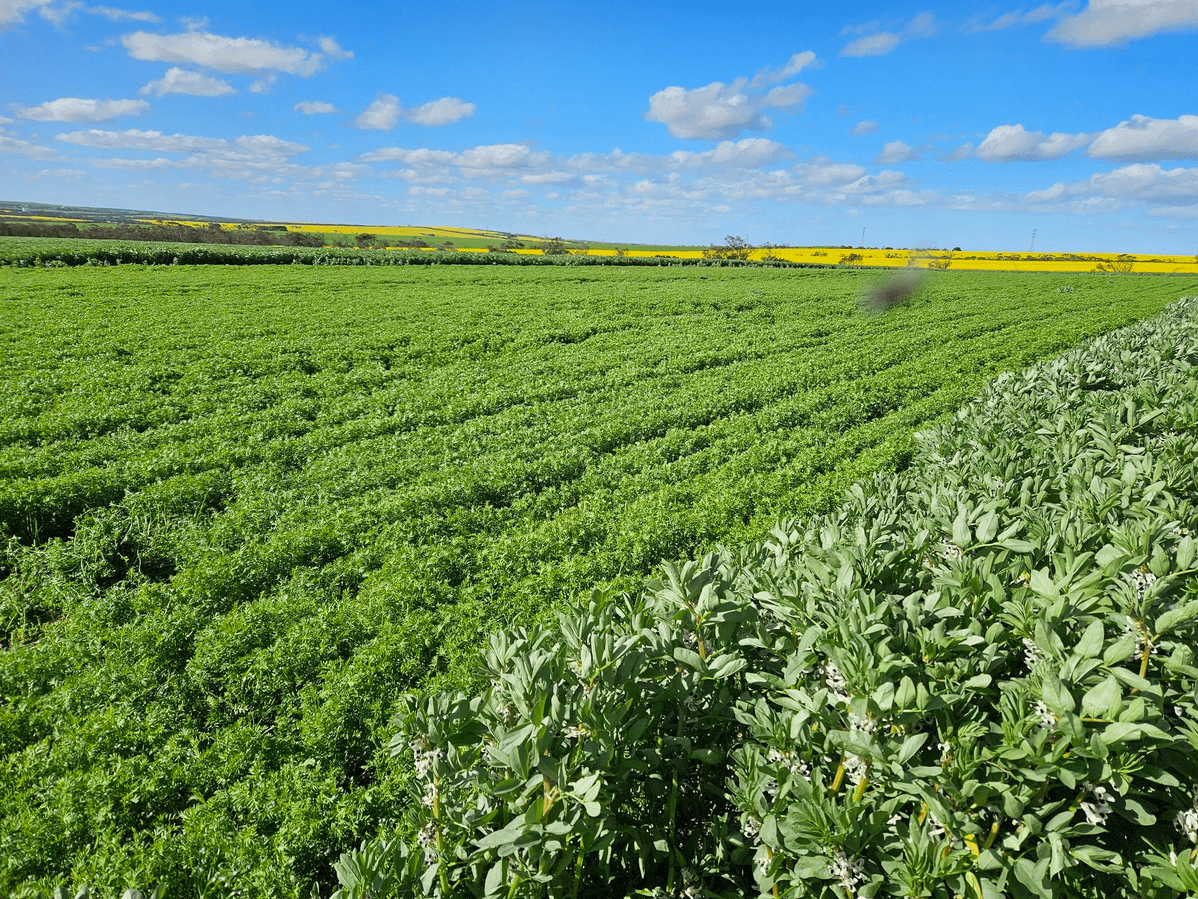
Lightning lentils and Bendoc faba beans growing in the Boston district on SA’s Lower Eyre Peninsula. Photo: Joshua Telfer, PIRSA
YIELD prospects for Australia’s chickpea, faba bean and lentil crops have consolidated in the past month to coincide with enough of a drop in new-crop prices to arrest forward selling by growers.
On chickpeas, harvest is gathering pace in Queensland and will start in around four weeks in New South Wales, with growers expecting average or better yields.
Faba beans are a mixed bag, with the north expecting above-average yields after an ideal growing season, while most southern crops, and lentils too, will be lucky to make average yields unless they get big rain by early October.
Export activity appears confined to Qld’s early chickpeas, with Canadian lentils and European faba beans getting the lion’s share of business in well-supplied global markets.
In its estimates released September 3, ABARES lifted its national crop forecasts for chickpeas to 2.1 million tonnes (Mt), lentils to 1.7Mt, and fabas to 854,000t.
All prices quoted are in Australian dollars per tonne unless otherwise stated.
Chickpeas
Chickpea prices have tanked in the past month to $620-$640/t for November-December delivery Brisbane, down from around $755/t a month ago.
Recent values were at their highest in Townsville at $670/t delivered port to capture chickpeas now being harvested in northern Qld.
These strong values have captured some of the early Central Qld harvest, where bids have now lost their premium over Brisbane prices.
Chickpeas were expected to be the cash sell for growers this harvest, but their values have sunk to a level that makes wheat and barley look like better options.
“We arrived at this conclusion $20 ago,” Sunrise Commodities managing director Scott Merson said.
An indicative gross margin for growers west of the Newell Highway in NSW puts wheat at a yield of 4t/ha and $260/t on farm for a gross margin of $1040, against chickpeas at 1.5t/ha and $570/t for a gross margin of $855/t.
“The market is telling you to sell your wheat.”
Northern Qld crops are being harvested at a rapid pace, and in ideal conditions, while many CQ growers have started harvesting and delivering their chickpeas.
At Mungindi on the Qld-NSW border, B&W Rural agronomist Nellie Lawson said district yields should be average or better at 1.5-3t/ha.
She said chickpea crops were thriving, and ranged from the late-flowering to peak-podding stage, with a lack of moisture stress contributing to rosy yield prospects.
“We’ve had magnificent winter rainfall over a very broad area,” Ms Lawson said.
Recent rain means the southern Qld-northern NSW chickpea crop will have a gentle finish, with the harvest peak expected from late October to mid-November.
“It’s at least three and probably four weeks until the chickpea harvest starts,” Ms Lawson said of the Mungindi crop.
Harvest of the large Walgett crop is expected in November, as are crops closer to Moree and Narrabri.
Faba beans
Bids for new-crop faba beans have eased around $10/t in the past month, with Warda types at around $390-$400/t delivered port, and up to $410/t for Fiestas.
Australian Grain Export pulse trader Andrew Vogelsang said a large European crop was going to weigh heavily on the Egyptian market.
Domestic demand has also moderated now that 12 months or more of drought feeding in South Australia, Victoria, and southern NSW has tailed off.
“Egypt is 80 percent of the world market, and they’re sitting on a lot of stocks,” Mr Vogelsang said.
“Right now, they’re not enthused in the slightest.”
Several cargoes to Egypt left Brisbane and Newcastle in the early part of the 2024-25 shipping year, but signs of a repeat are yet to be seen in the upcoming shipping year which starts next month.
Mr Vogelsang said Qld and NSW production “will look pretty spectacular again”.
In contrast, SA and Vic crops are looking at mostly average yields, provided spring brings finishing rain, and late frost does not hit at flowering.
On the domestic front, pellet manufacturers in SA and Vic could well be in the market for an increased proportion of faba beans, particularly if imported soymeal prices rise from their very low levels, and canola meal does not present as an affordable option.
Strong sheep, lamb, and cattle prices are supporting the finished feed market.
“A lot of guys have moved on to pellets, and they’re not feeding faba beans.
“We’re going to get to the point this year where the pellet market is going to be a significant part of where our demand will come from.
Lentils
Despite a late break in the season, SA and Vic crops are looking remarkably good in most regions.
However, a lack of subsoil moisture means their yield potential will fall away without rain.
Sparke Ag director and senior consultant Matthew Sparke is based at Horsham in Vic’s Wimmera region, where lentil crops are “just starting to flower” and looking at an average yield potential.
“Crops don’t look too stressed; they’ve got another 10 days to a fortnight, and if we don’t get rain in that time, they’ll start going backwards,” Mr Sparke said.
Crops in the Wimmera have generally been getting more frequent and heavier rain than those in the Mallee.
“South of Horsham got 8-10mm this week; the north might give you a few cement- wetters.”
New-crop prices delivered port are down to around $590-$600/t, reflecting the fact that Middle East and South Asian markets are well supplied by Canada as it heads into its shipping period.
The values are at least $200/t below where they were for the early part of the 2024-25 shipping year, and $100/t down on last month’s new-crop values.
In SA, Eyre and Yorke peninsula growers have been forward selling since May, and will supply the tonnage for some early-season bulk expected to go to Bangladesh and India.
Vic growers are not as comfortable with forward selling, and Mr Sparke said the depressed prices are likely to see growers sell on spikes throughout the coming marketing year.
“I reckon a lot of guys will store or warehouse or punt them…and starve the trade.”
Canola remains the likely cash sell for growers who have it across SA, Vic, NSW, and even into southern Qld.
“Lentils have taken a pretty dramatic fall in the past month’; they’re back $140-$150/t since August 16,” Mr Vogelsang said.
“A large reason for that is because of a crop significantly above expectations out of Canada.”
In Australia, Mr Vogelsang echoed Mr Sparke’s take that crops have had rain when needed, but the lack of subsoil moisture is of concern.
Even if, contrary to the Bureau of Meteorology’s seasonal outlook, spring rain cuts out, a crop 50pc bigger than last year’s, when a brutal season in SA saw 1.1Mt harvested.
Grain Central: Get our free news straight to your inbox – Click here
HAVE YOUR SAY