
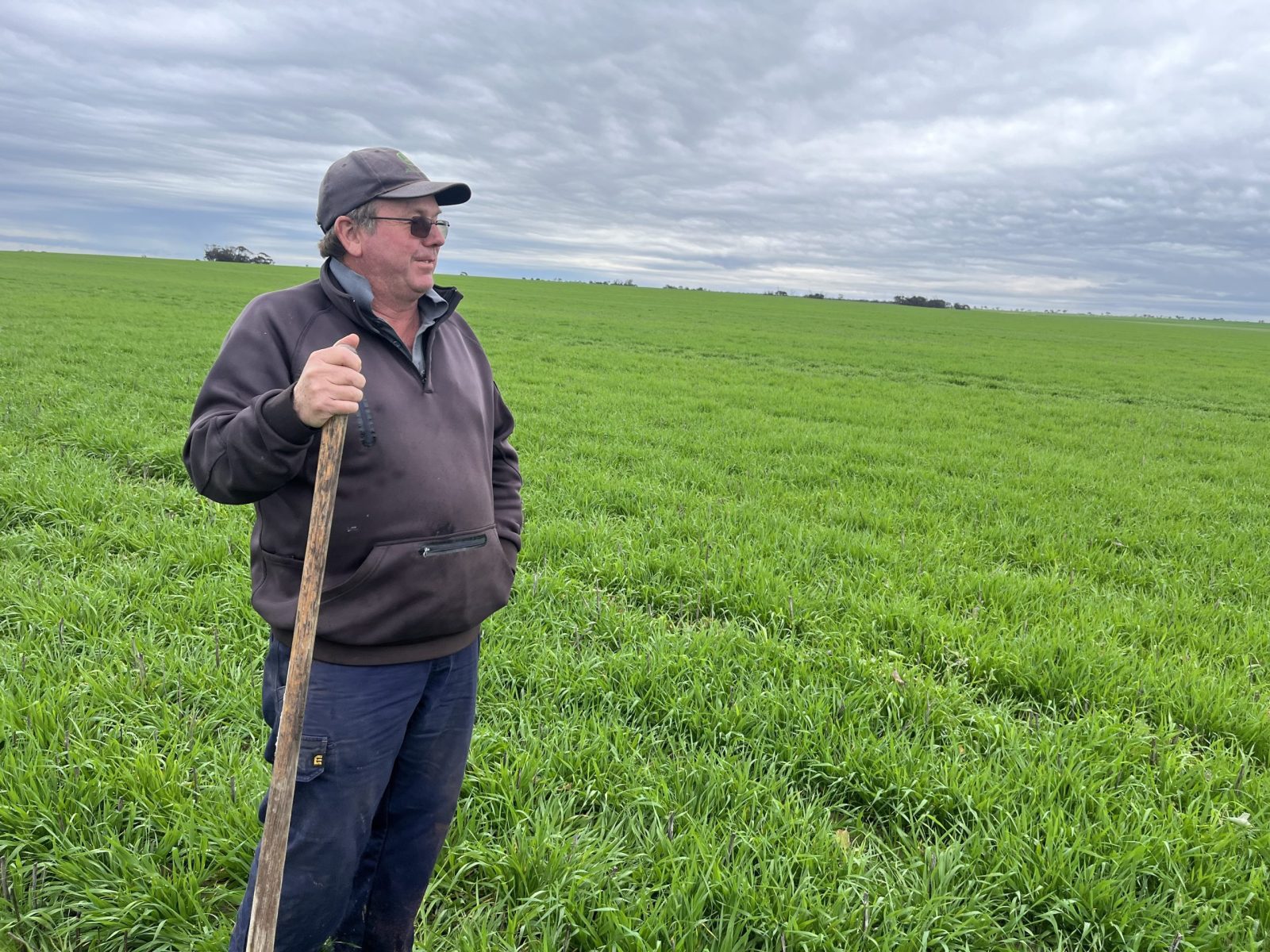
Wimmera grower Geoff Vivian looks over land on the family’s Kaniva property that has been improved with the use of biological fertilisers, and which has generated ACCUs under a soil-carbon project. Photo: LawrieCo
LIKE many farmers, Geoff Vivian was sceptical about using biological fertilisers, but after first-hand experience with a soil-carbon project set to provide valuable income following a tough year, he is now on board and excited about its future benefits.
On their farm in Victoria’s Wimmera region, Geoff and his family added 3870 tonnes of soil carbon through the project.
Managed by AgriProve and using LawrieCo’s soil carbon-building fertilisers, the project generated 10,548 Australian Carbon Credit Units, and Mr Vivian is hoping it can achieve a good return, with the current market at $37-$38/ACCU.
“They are in the hands of brokers and available for sale,” Geoff said.
“It’s been very surprising and I still feel a little sceptical about everything being finalised, but it is good money and it will prove to be very handy after the year we had.
“If you can pull this lever and have it in your pocket after tough years, it will be valuable and we will look to increase projects over coming years.”
Geoff and his wife Donna, together with their eldest son Liam, operate a 2430ha cropping program over their own property near Kaniva, plus leased and share-farmed land.
They also run a small flock of Merino breeders joined to White Suffolk terminal sires for prime lamb production, as well as trade sheep on summer stubbles.
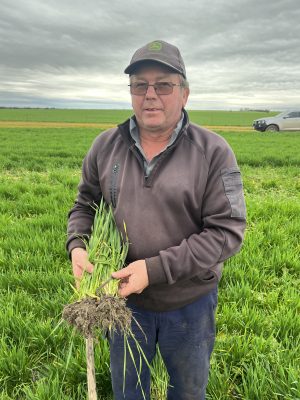
The Vivians used SureCROP VAM over all their crops this year to promote deep and healthy root systems. Photo: LawrieCo
Geoff and Donna also have a younger son who is working on a nearby farm, and another son and daughter who are working and studying in Adelaide.
The family farms a mix of soils ranging from loamy Mallee country and red rising loam areas through to blue clays and including some light black soils.
They rotate a range of crops on continuously cropped land, including wheat, barley, canola, oats, and faba beans.
Crops are sown using their Horwood Bagshaw seeder with conventional fertilisers including mono-ammonium phosphate with zinc and manganese, and with applications of urea.
Stubbles also have been burned previously, but that has largely been to combat snails.
Geoff said after years of using synthetic fertilisers, their soils were becoming “a little stale” and were not producing strong crops.
“It got to a stage where we could have crops fall over, so we were looking at options.”
“If we had yield mapping and were set up for variable rate applications, we could look at that.
“And with the costs of fertiliser and chemicals as well, we thought it was a better option for us to look at a good little project and opportunity with LawrieCo to see what happens.”
Together with AgriProve, four areas were set up for the project, including a control area where the LawrieCo soil carbon-building fertilisers were not applied, and they have since grown faba bean and canola crops.
Crop residue in the areas was retained and the LawrieCo fertilisers used included a foliar application of HumiPLEX ZMC at 3 litres/ha, while BioMAX F75 also was applied as a buffer with foliar chemical sprays at 125ml/ha.
Sourced from Nutrien Ag Solutions in nearby Bordertown, South Australia, HumiPLEX ZMC contains 6 percent zinc, 8pc manganese, 2pc copper, 9pc sulphur, 1.6pc fulvic acid, and microbial metabolites and necromass as biostimulants; BioMAX F75 contains 75pc fulvic acid.
The average soil-carbon increase in the treated areas was 7.1 tonnes/ha, compared with no increase in the untreated area.
Geoff said the faba beans also produced a lot more biomass and above-average yields, while the canola, which was impacted by late spring rains causing disease, yielded similar to other crops.
Applications of additional LawrieCo fertilisers have continued in the project areas and also have now been adopted over the family’s broader cropping program.
These include the mycorrhizal and nutrient seed treatment SureCROP VAM, the water-holding concentrated humic product, BioMAX Soluble Humate Prill, which contains natural chelated nutrients and is applied with their MAP at seeding, and foliar-applied nutrients, NutriMAX PhosCal and BioMax BOOST.
“Being moisture-retaining, I had my doubts about the prills going out with the MAP, but it went well.
“It’s very impressive in what it can do for fertility and moisture.
“We mixed the seed dressing in a spot sprayer and had good agitation for the application and that also went well.
“The (SureCROP) VAM on the seed gets the crops up and going with more vigour, and the roots have gone down deeper and are showing more microbodies.
“We have used the seed dressing everywhere, and we saw great establishment and vigour, and we have used the foliar products on other paddocks.
“It’s really shone out this year, with the late start, just how healthy and dark green the crops are; I would normally have to be throwing out a lot more urea to see that.
“We have put 80 kilos (per ha) out in some areas, but you can’t tell the difference with where we haven’t, particularly in the oats.
“I would have to be putting 180 kilos (of urea) out to get them to look like that.”
Nutrien Bordertown senior agronomist Jamie Weatherald said the Vivians had achieved great results with the LawrieCo fertilisers, and were gaining traction through the region to help build soil carbon and fertility.
“We didn’t expect the uptake would escalate as quick as it has, and some of the results have been surprising and encouraging,” Mr Weatherald said.
“There are a number of farmers in the area who have started (soil carbon) projects and the LawrieCo products definitely have a good fit.
“One of our main objectives is to build carbon and fertility in soils.
“We are doing this as part of our farming practices, so why not get paid for it now.”
Mr Weatherald said the reliable farming region provided the opportunity for conventional and biological fertilisers to play a strong role in improving soil fertility and crop health.
Mr Vivian said years ago, he never thought he would be applying biological products, but he now had good confidence to use them.
“We certainly never thought about it; we would just get on the tractor, sow it, go with your
traditional applications and harvest it.”
“Now we are improving soil fertility and nutrient efficiency, and also increasing the land value, and that’s what we want to do for the generations to come.
“So far, our investment has been similar to our previous program, but once we get the soil fertility up, we will also trial backing off our synthetic fertiliser rates.”
He said the management of the soil-carbon project by AgriProve, including soil testing and audits, went smoothly and they would look at further projects into the future.
“We have a new block that’s about 800 acres that we might have a crack at.”
Source: LawrieCo
HAVE YOUR SAY