
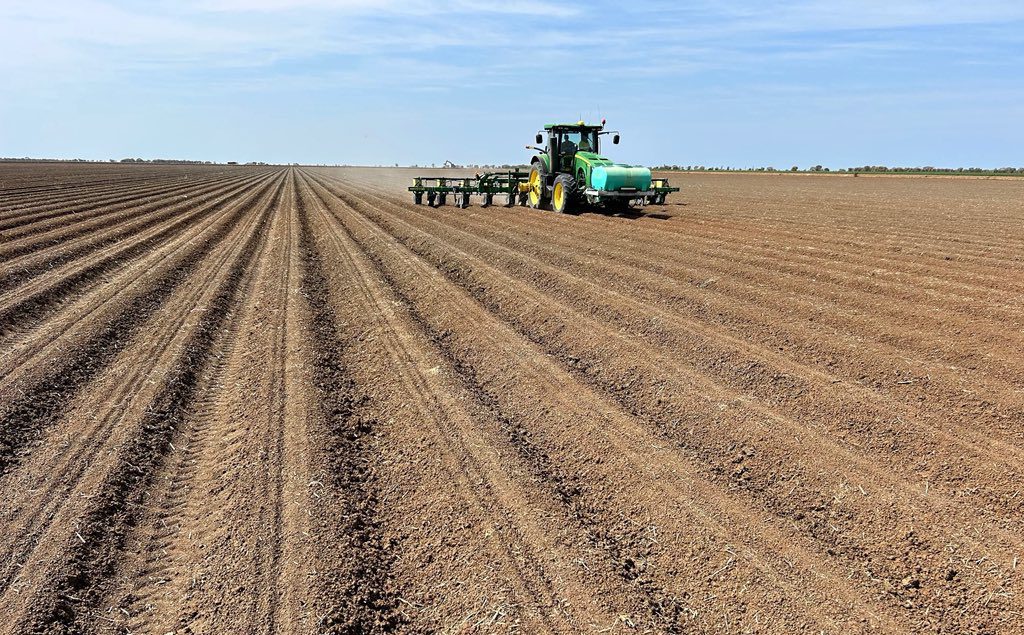
The first cotton crops to be planted in southern NSW this season have gone in in the past week. Photo: Summit Ag
PLANTING is underway across most of eastern Australia’s cotton-growing regions, with some crops already out of the ground in warmer climates.
Cotton Australia general manager Michael Murray said signs for this season were positive, with Australia’s 1500 cotton growers, 90 percent of them family farmers, expecting to grow just over 4 million bales.
As well as producing around 910,000 tonnes of lint, the crop is expected to produce close to 1.1 million tonnes of cottonseed.
“This year we are expecting about 393,000 green hectares to be planted, predominantly in New South Wales and Queensland, with crops also being planted in the Northern Territory and Western Australia,” Mr Murray said.
“If expectations are accurate, we will see more than $2.7 billion generated for the national economy with most of that money filtering down into the 249 communities that benefit directly from cotton-growing.”
October is when most growers start planting cotton, but with the crop’s footprint spreading in northern Australia, planting and picking dates can vary considerably due to differing conditions; in some regions, picking and planting takes place in the same month.
The global price outlook for cotton is flat, but demand for Australian lint is seen as steady due to its proximity to main markets, and its quality and strength.
“We have witnessed prices of up to $1000 per bale but the latest trends show the price hovering around the $550 per bale with the price outlook suggesting a $600 per bale is possible in the next 12 months.
“We export everything we produce, and thankfully demand is still strong with recent figures from cotton marketing news service Cotton Compass revealing that in July 26 percent of bales exported went to China, 19pc to India, 15pc Vietnam and 13pc both to Bangladesh and Indonesia.”
Mr Murray said Australian growers were generally positive about the upcoming crop, with many reporting good levels of soil moisture.
“The availability of water is still an issue with some regions like the Central Highlands of Queensland having no new allocations, relying on existing supplies and the prospect of new allocations if rainfall increases dam levels.”
In the Central Highlands, planting started in early August, and most crops have shown healthy early growth, reflecting good soil moisture, and warm ground temperatures.
Emerald grower Ross Burnett said with no allocation this season but some carryover from last season, they are hopeful of a good crop.
“We have taken a calculated risk to be planting with the limited water we have so we are somewhat hedging our bets on the spring rain and hoping that arrives earlier rather than later.
If we get enough rain by November-December and achieve inflows into the dam, then things can turn around quite quickly, and any allocation will help us to grow economic yields.”
Cotton Australia’s regional managers, based in each of the cotton growing regions, have provided up-to-date reports on each region:
Central Highlands
Planting has been going for several weeks, with cotton already out of the ground in some areas and looking healthy and strong, and first irrigations are taking place on some farms.
Despite an announced water allocation of zero for growers so far this year, around 14,000ha of irrigated cotton is still expected due to carry-over water from the previous season, and with the hope of follow-up rain.
Around 4000ha of dryland is also expected.
Ginning will continue through to November, with some cotton still being carted into the gin from northern Qld growers.
Dawson and Callide Valleys
Some growers have started planting the expected 8500ha of irrigated cotton with some already finished planting, while others will plant in October.
Dryland growers are expected to plant in November.
There has been a good start to planting, with full allocations helping growers with a positive start to the cotton season.
Darling Downs
Planting is yet to start on the Darling Downs, with growers waiting on soil temperatures to rise.
The main planting window opens this month and extends until the end of November.
Expected area sits at 36,000ha of irrigated crop and 12,000ha of dryland.
Rainfall over the winter months has led to mostly full water storages and good soil moisture profiles.
Ginning of the 2024-25 crop is expected to finished at the end of this month.
In the Brisbane Valley, some planting began on August 28, with seedlings emerging seven days later due to good conditions.
Macintyre Valley
In the Macintyre, growers will be looking to start planting this week when soil temperatures increase.
Growers are expected to plant about 20,000ha of irrigated and 8000ha of dryland.
St George/ Dirranbandi and Mungindi
September temperatures have been following the averages and the CSD FastStart Soil temperature sites in the region are all suggesting good soil temperatures for planting.
Most growers are wary of historical cool-to-cold snaps in September, so held off planting before now.
A few growers have started to plant, and conditions for their crops have thus far been favourable.
Estimates are St George and Dirranbandi will plant around 18,000ha, all irrigated, and Mungindi around 15,000ha irrigated, plus 5000ha dryland.
Northern NSW
An interrupted preparation for this season due to above-average rainfall this winter has delayed ground preparation, resulting in growers still being busy pulling up hills and applying fertiliser.
September saw flooding in the Namoi Valley, and flowing rivers in the Gwydir Valley, allowing growers to capture precious water to fill their dams on farm, and bolstering public storages in the Namoi which are at near capacity, and the Gwydir at 81pc.
Cotton area looks like being down from last season and many gins have finished or will be done by this week.
Some planting took place last month, but most growers will have kicked off by next week.
Macquarie Valley
After some recent rain, ground is rapidly drying, and pre-watering and planting is expected to start for most growers from October 12.
The majority of picking was completed late April-early May with conditions being ideal.
Ginning is still going, but will finished early November.
Close to 25,000ha is expected to be planted in the Macquarie Valley.
Southern NSW
On the back of a stellar 2024-25 season, which delivered exceptional yields, planting for the upcoming season has started.
With reduced water allocations this year, the total planted area is forecast to be significantly lower, and only 40-50pc of last year’s area.
Northern Australia
Isolated showers were seen across the NT at the end of last month, with temperatures and build-up feels continuing to rise.
Crop destruction is advancing, and will be completed before mid-October.
Planting windows typically commence on December 1 for the NT/FNQ and January 1 for the Ord.
Predictions for 2025-26 plantings remain similar for the NT at around 10,000ha.
The Ord will most likely increase area to around 15,000ha and FNQ growers remain optimistic for an increase in plantings, up to 5000ha, on the back of a successful season.
Source: Cotton Australia
HAVE YOUR SAY