

Weather: Wet track. Rain sticking around in southern Australia, making harvest progress painfully slow – clearly an issue with a number of end users paying up to get spot wheat. Globally, nothing new I am afraid.
 Markets: China buying wheat from the US as a show of good faith seems a little strange to me. Not without precedent however. Once again, I don’t think it shifts demand for Aussie wheat but it can drive sentiment and move US futures. Meanwhile, Russia and the Ukraine are hitting infrastructure – something the market could not care less about. It seems Donald’s focus on Russian sanctions is good for about 15 minutes a fortnight – lights up Truth Social with sanction talk, then things go quiet.
Australian Day Ahead: Cup Day has historically been a quiet one for the Aussie trade – add in some wet weather and phones may ring out.
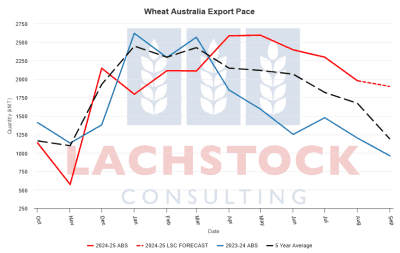 Offshore

Wheat
Wheat futures in Chicago jumped as China was reported to be seeking its first US shipments in over a year, adding to last week’s soybean orders under the new US–China trade truce.
Traders cited potential inquiries for 240–400kt of SRW and HRW for Dec–Feb loadings, viewed more as a goodwill gesture than an economic play.
Basis values in the US river market firmed, suggesting cash buying interest.
Prices briefly eased on uncertainty around confirmation, before regaining highs as the White House confirmed China would lift tariffs on US wheat as part of the deal.
SovEcon lifted its Russian export forecast by 0.4 million tonnes (Mt) to 43.8Mt, noting better demand at lower prices but warning that seasonal weather and competition from Argentina and Australia could slow shipments.
Other grains and oilseeds
Sentiment across ags was buoyed by the prospect of China returning to US markets, though confirmation remains limited due to the ongoing government shutdown.
Soybean inspections fell to 965kt for the week to Oct 30 — less than half of year-ago volumes — leaving cumulative exports down 40pc YoY.
The WASDE report will return Nov 14, providing long-awaited clarity on crop balances.
In Brazil, planting is slightly behind average (corn 68pc vs 72pc; soy 46pc vs 47pc) but StoneX upgraded 2025/26 output forecasts to 178.9Mt soybeans and 135.2Mt corn, both above USDA’s prior view and reinforcing strong global supply prospects.
Macro
Australia: Household spending rose just 0.2pc m/m in September, following a flat August, while Q3 volumes lifted only 0.2pc q/q, pointing to weak discretionary demand heading into Christmas.
ANZ-Indeed job ads fell 2.2pc m/m in October, marking six declines in seven months.
The RBA meets today and is expected to hold rates steady, with Q3 trimmed mean CPI at +1.0pc q/q likely supporting a unanimous decision.
Lachstock continues to see scope for one final 25bp cut in February 2026.
United States: The ISM manufacturing index eased 0.4pts to 48.7, with production and inventories weaker, while the prices index fell to 58.0 amid higher steel, aluminium and tariff-driven input costs.
FOMC officials remain divided on a December cut, but regional data — including initial jobless claims steady at 219k — suggest the economy has held up despite data blackout constraints.
Australia
In the west markets were a little softer across the board with canola A$822 and GM $690. Wheat was bid $339, and barley $299 FIS Albany.
Through the east canola was softer at $800 and GM $728 track Port Kembla, while wheat $341 and barley $305 were both a little firmer.
Old crop wheat demand remains strong with cool temps and wet weather delaying new crop. Delivered Geelong is $375 vs $350 for new, and Hanwood $340 vs $330.
Delivered Darling Downs markets have firmed slightly over the past fortnight, with Jan+ barley $306 and wheat $334.
HAVE YOUR SAY