
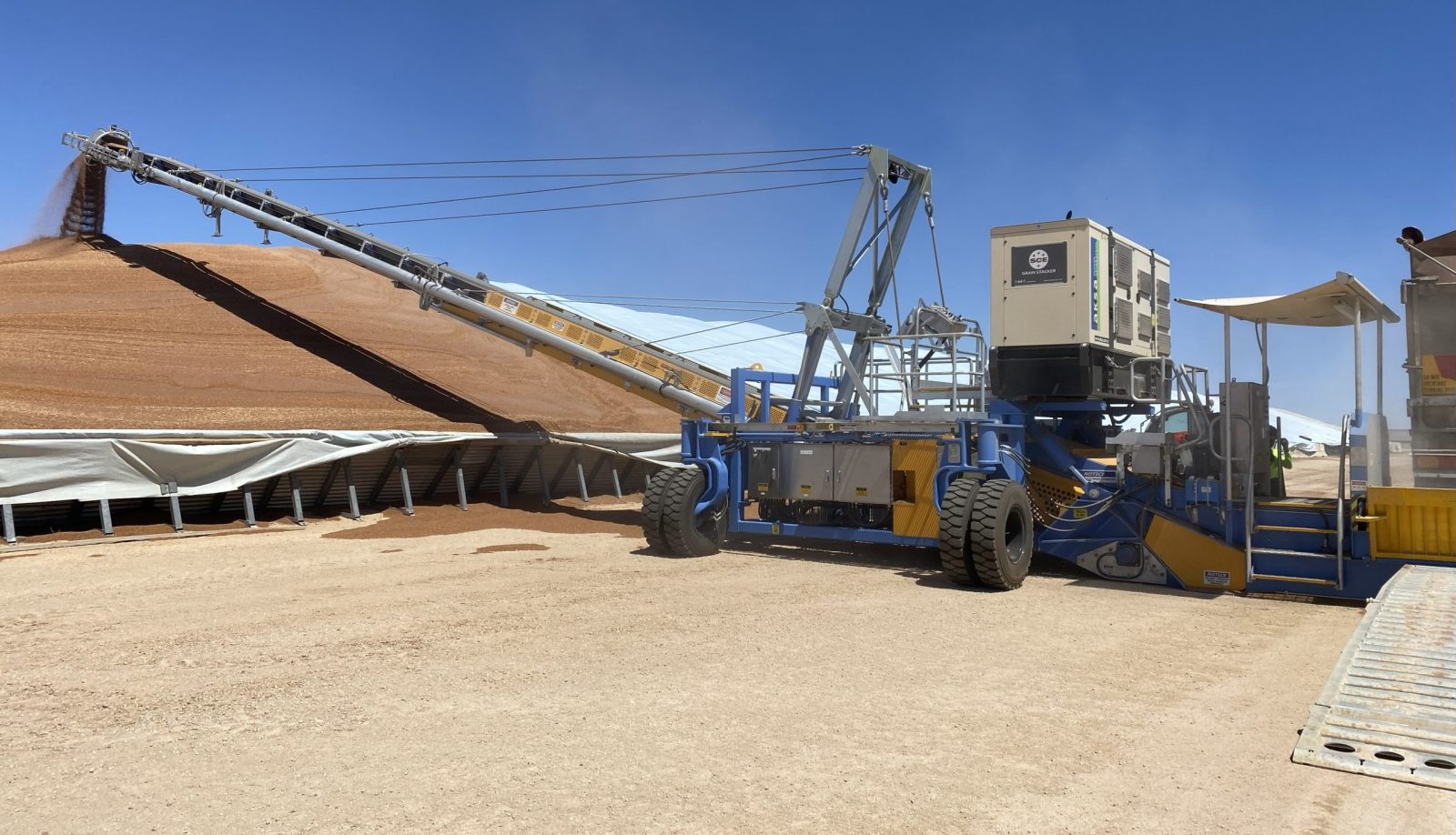
Faster stackers are in use at many LDC sites across eastern Australia, including this one at Woorinen being used to fill a lentil bunker. Photo: LDC
AN EXPANDED Louis Dreyfus Company asset base and service offering is giving Australian grain and cotton growers access to new and improved supply chains.
In the past year, the expansion has been driven by pulses joining cereals and oilseeds as commodities traded by the global major, and by the finalisation of LDC’s takeover of Namoi Cotton.
The acquisition has made LDC Australia’s largest ginner, and added Wee Waa in northern New South Wales and Goondiwindi on the Queensland-NSW border to its list of grain sites.
It has also given LDC a stake in the Kimberley Cotton Gin at Kununurra, which exported its first containers of lint out of nearby Wyndham last month.
On the trading front, Townsville’s first ever bulk grain cargo kicked off LDC’s 2025-26 chickpea shipment program, which is expected to soon include LDC’s first self-loaded cargo out of Barney Point in Gladstone, as well as cargoes loaded in Brisbane by third-party providers.
South Australia is also in the picture, with LDC now accumulating for its first bulk lentil exports from SA via T-Ports.
“When you look back five years, LDC in Australia had three cotton gins and no other assets, and a small grain- trading business,” LDC’s Australia chief executive officer and head of grains and oilseeds David Johnson said.
“Today, we have 15 cotton gins and 13 grain sites.”
Mr Johnson said improvements at the grain sites, including LDC’s Melbourne terminal, are about improving efficiency across the supply chain, starting with deliveries coming in from on farm.
“It all adds up to giving the growers a better turnaround time.”
“The investments LDC is making are aimed at trying to improve supply chain options for growers and give them value, and a better service.”
LDC’s move into ginning in Australia started in 2010 with its purchase of Dunavant’s three gins, and its grain-handling network launched in 2022 with its purchase of Emerald Grain, added to last year with its acquisition of the Pearsons site at Kyalite.
Lift in southern capacity
In up-country Victoria, Mr Johnson said a 4ha expansion of the LDC site at Elmore, north-east of Bendigo, has finished in time to catch the fast-approaching Vic harvest peak.
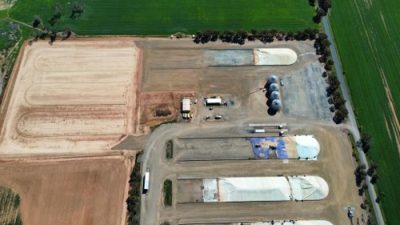
Additional bunker storage at LDC’s Elmore site has increased its capacity by half ahead of this harvest. Photo: LDC
The expansion has lifted capacity at the site by 50,000t to 150,000t.
“Our Elmore site has been landlocked in recent years; we’ve filled it through each of the past five seasons, so we’ve leased area next door and built 50,000 tonnes of additional bunker capacity,” Mr Johnson said.
“We’ve expanded bunkers from our existing site across into this new area, and added three new ones.
“At the same time, we’ve been doing a lot of work with all our bunker sites over the past three years by putting in renovated stackers to speed up receivals, upgrading the sample stands, and putting in tare weighbridges to remove bottlenecks.
“Now that we have these really high-capacity stackers, we need to make sure the rest of the site can keep up with them, and most of our sites now have separate gross and tare weighbridges to improve the traffic flow to these bigger bunkers.”
Mr Johnson said a significant upgrade is also taking place at LDC’s Melbourne terminal, built in 2001 and acquired through its Emerald Grain purchase.
The work will add 17,000t of storage to take the site’s total capacity to 65,000t.
“With another elevator, it’ll mean we can load ships and transfer grain within the terminal at the same time, which will make it more efficient.
“We’re also just about to complete a project at the terminal where we’ll separate the rail flow path from one of our road pits.
“That’s been an issue in the past because road and rail have had to share a transfer belt, so if the train is late and we have trucks booked in, it slows things down for everyone.”
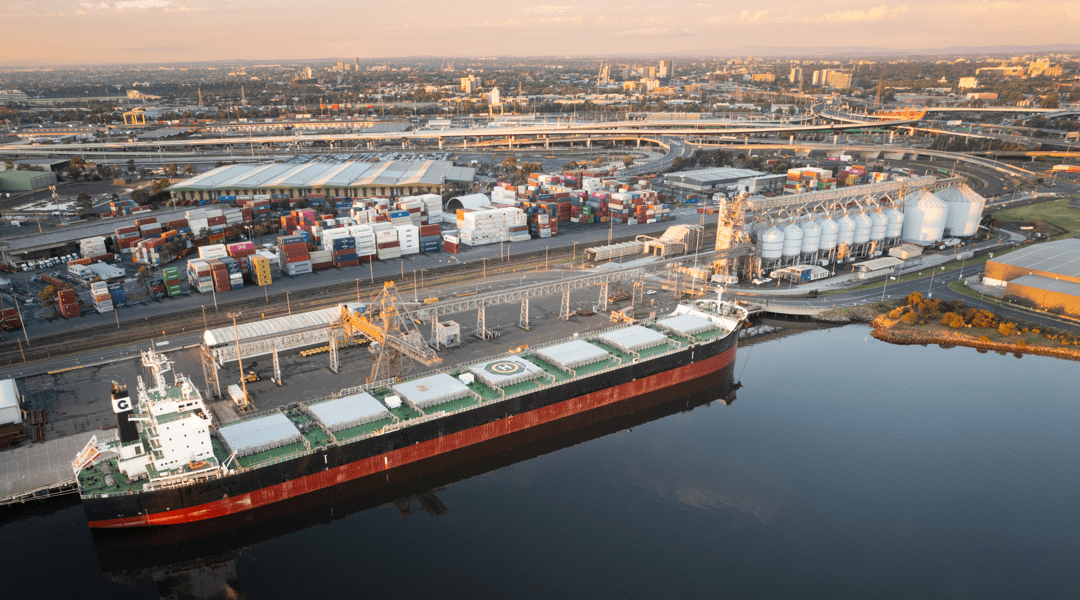
LDC’s Melbourne terminal is undergoing an upgrade which will allow road and rail deliveries to be made simultaneously. Photo: LDC
LDC operates two trains to carry grain into Melbourne from its bulk sites in Vic and southern NSW.
“By separating those flow paths, we’ll be able to provide a guaranteed receival time for growers bringing grain in on road.”
Additional storage being built at the Melbourne terminal will take its number of silos at the site from 20 to 28.
“One of the reasons for the expansion is to be able to handle a broader range of products through the terminal.
“We’ve shipped lentils, chickpeas and maize in the past year, as well as the wheat, barley and canola that we regularly ship.”
Mr Johnson said climbing landside costs were making containerised exports less attractive, and pushing more volume and more commodities into bulk.
“In the past year, we’ve basically put all of the lentil exports that used to go out in boxes into bulk shipments, and the more those infrastructure fees go up, the more grain will move away from container exports.”
As evidence of this, LDC is accumulating for its first bulk lentil cargo out of SA, due to load at Wallaroo on Yorke Peninsula later this month, with another expected next month.
“That’ll be out of T-Ports, which we have utilised over recent years for wheat and barley.”
New path through Gladstone
Aside from its acquisition of the former Namoi Cotton sites at Wee Waa and Goondiwindi, LDC’s big news in the north has been its move into portside operations at Barney Point, which offers an alternative supply chain to growers in the Gladstone port zone.
This month, LDC has started taking deliveries of chickpeas to its bunker adjacent to the terminal in readiness for its first cargo.
“That will be the first test of exporting from Barney Point, and we’ll assess whether we’ll take a longer-term position at that terminal, which could mean building bunkers to be able to handle multiple commodities.
“We started receiving two weeks ago and we’re full throttle at the moment.”
“Hopefully we’ll be able to do a couple out of chickpea cargoes out of Gladstone, and when the sorghum season comes, we can have a crack at sorghum.”
LDC last month executed the first ever bulk grain cargo out of Townsville, with established local operator Sizer & Cogill accumulating and loading the chickpeas.
“I think we’ll just do the one this season out of Townsville because that soaked up the local chickpeas from out west.”
Harvest outlook mixed
While cereal and chickpea yields in Qld and northern NSW have been good to excellent, the outlook for most crops in southern NSW and the Mallee in north-west Vic is for below-average production.
“It’s really patchy this year.
“Around our sites, Woorineen is very, very good.”
A late break, limited subsoil moisture and below-average in-crop rain have all added up to a challenging season for some crops.
“To the west of Nullawil, things start to go backwards; it’s probably the north-west of the Mallee that’s suffered the most, whereas other districts have caught some bands of rain through the season.”
Cool and showery conditions mean crops in Vic outside the early-maturing Mallee could well be in for a later-than-average harvest, and with a higher yield outlook than was expected early last month.
“I think this rain over the past few weeks is going to be very beneficial for the southern crops in the Wimmera and Western District and north-east Victoria, and even up into NSW around our sites at Coolamon and The Rock, particularly for wheat.
“The general feeling is the canola and the barley’s handled the conditions pretty well, but the wheat crops are the one that would have struggled the most without these late rains.”
All LDC sites are now open for harvest.
Grain Central: Get our free news straight to your inbox – Click here
HAVE YOUR SAY