
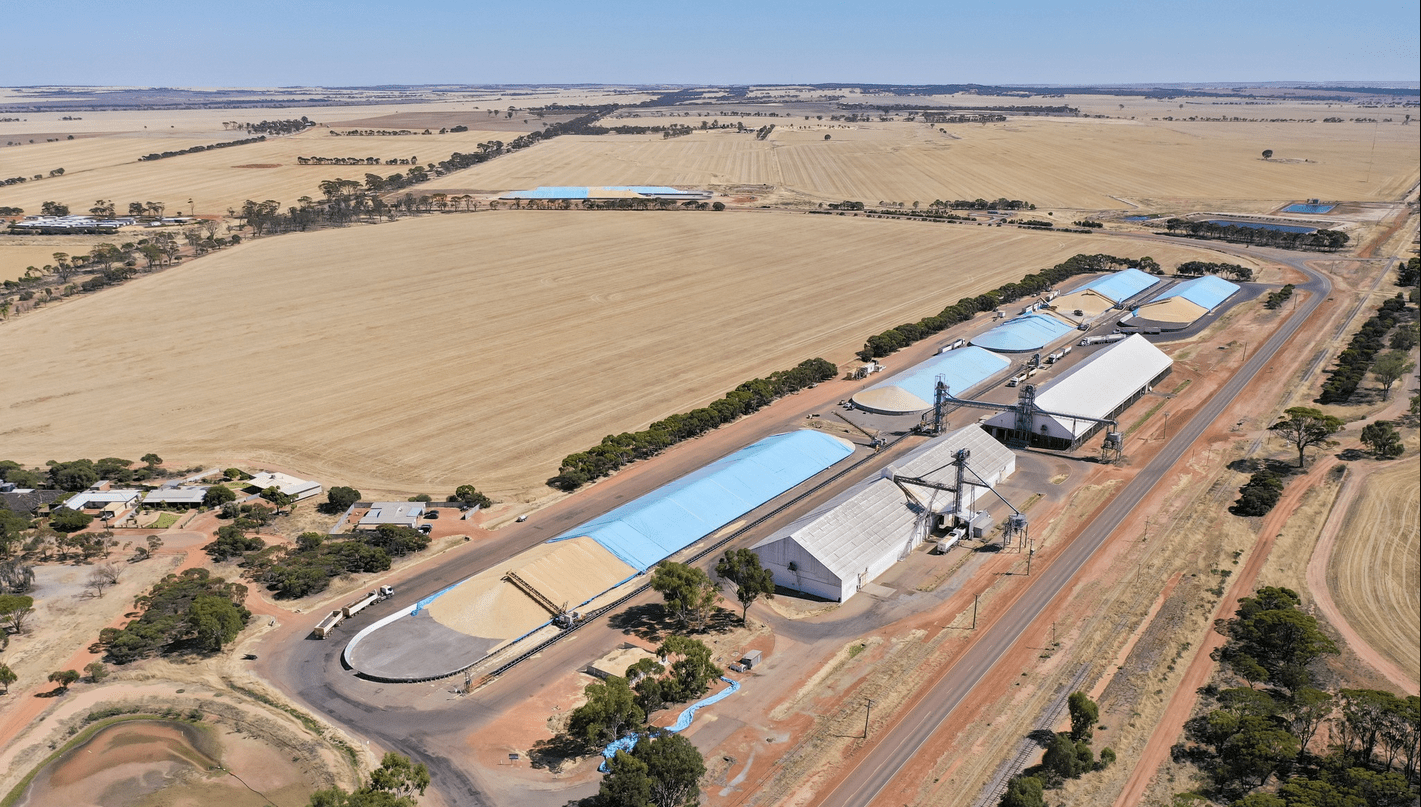
Bunkers fill last harvest at CBH Group’s Narembeen site, which lost rail access when Tier 3 lines closed in 2014. Photo: CBH Group
A RECENT study shows growers in Australia’s biggest grain-growing state are investing in on-farm storage and trucks to help them better market and handle their crops, and compensate for shortfalls in off-farm services and infrastructure.
Published in the Agricultural Systems journal, the study was undertaken by University of Western Australia PhD candidate Garima, supervised by Professor Doina Olaru and Dr Brett Smith from UWA’s Business School, and UWA Institute of Agriculture and Hackett Professor Kadambot Siddique.
Entitled Farm-level adaptations to harvest logistics constraints in export-oriented grain systems, the study found logistical pressures to be most acute in regions with long transport routes and limited receival and labour capacity.
It outlines the increased use by growers of their own trucks, temporary and permanent on-farm storage, and harvest and carting strategies to avoid limitations at bulk handling sites, which in WA are primarily owned and operated by CBH Group.
“Growers are adapting rapidly, but many of their strategies compensate for deeper structural gaps in the logistics system,” Garima said.
“Storage and freight decisions are tightly shaped by spatial inequalities and shifting delivery rules.”
The study points to a small but growing set of private bulk handlers catering to niche or geographically advantaged producers, adding optionality where geography permits.
Room for improvement off farm
The study included 48 surveys, 19 interviews and media and policy document analysis.
Its first stage interviewed 57 growers farming holdings ranging in size from 200ha to 50,000ha, median size 6425ha.
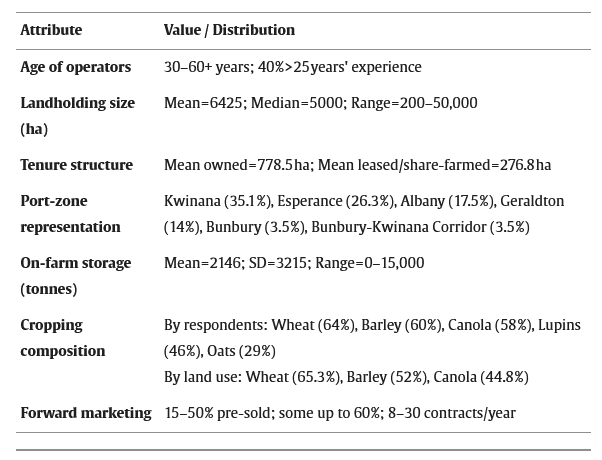
Table 1: Summary of characteristics for 57 growers sampled.
Enterprise structure was predominantly cropping, with 81 percent of respondents operating grain-only systems.
The study highlights the growing strain WA’s grain supply chain has been under since 2018, with crop sizes increasing amid inconsistent investment in infrastructure, and persistent logistical bottlenecks.

Garima pictured in 2023 with one of the study’s interviewees, Mid West grower Rod Birch, Catalina Farms. Photo: UWA
WA has produced its two biggest crops over the past three seasons.
These are estimated by the Grain Industry Association of WA at 26.06 million tonnes (Mt) in 2022-23 and 22.42Mt in 2024-25, and everything points to WA’s current harvest easily breaking the 2022-23 record.
The study said while macro-level infrastructure such as ports, rail networks, and major receival sites remain essential, the efficiency of harvest logistics increasingly hinges on micro-level systems and rules.
These include on-farm storage availability and bulk-handler opening hours, mass limits applicable to and conditions of rural roads, and contract hauler availability during peak harvest windows.
The study said: “the practical question becomes whether trucks can turn around fast enough to keep headers moving without extended queuing or idle time.”
The study cited the 2022-23 and 2024-25 harvest experiences, which pushed logistics “beyond capacity, despite technological improvements such as the Carters Delivery Form.”
This CBH Group app has been designed to manage the delivery process electronically.
“Growers consistently reported misalignments between harvest pace and freight throughout, leading to delays at sites, congestion, and missed pricing premiums.
“Even with significant investments by CBH in logistics upgrades, critical bottlenecks remained.
“For example, carrying over the 2022 harvest alone reportedly led to $1-2 billion in foregone export premiums and demurrage penalties.”
Higher cost per tonne for some
The study said interview data identified infrastructure shortfalls — especially poor-quality roads, limited port access, and congestion — as ongoing constraints.
“Infrastructure bottlenecks can slow things down—not just queuing at the port or sampling delays. Roadworks are a major issue,” one grower said in an interview for the study.
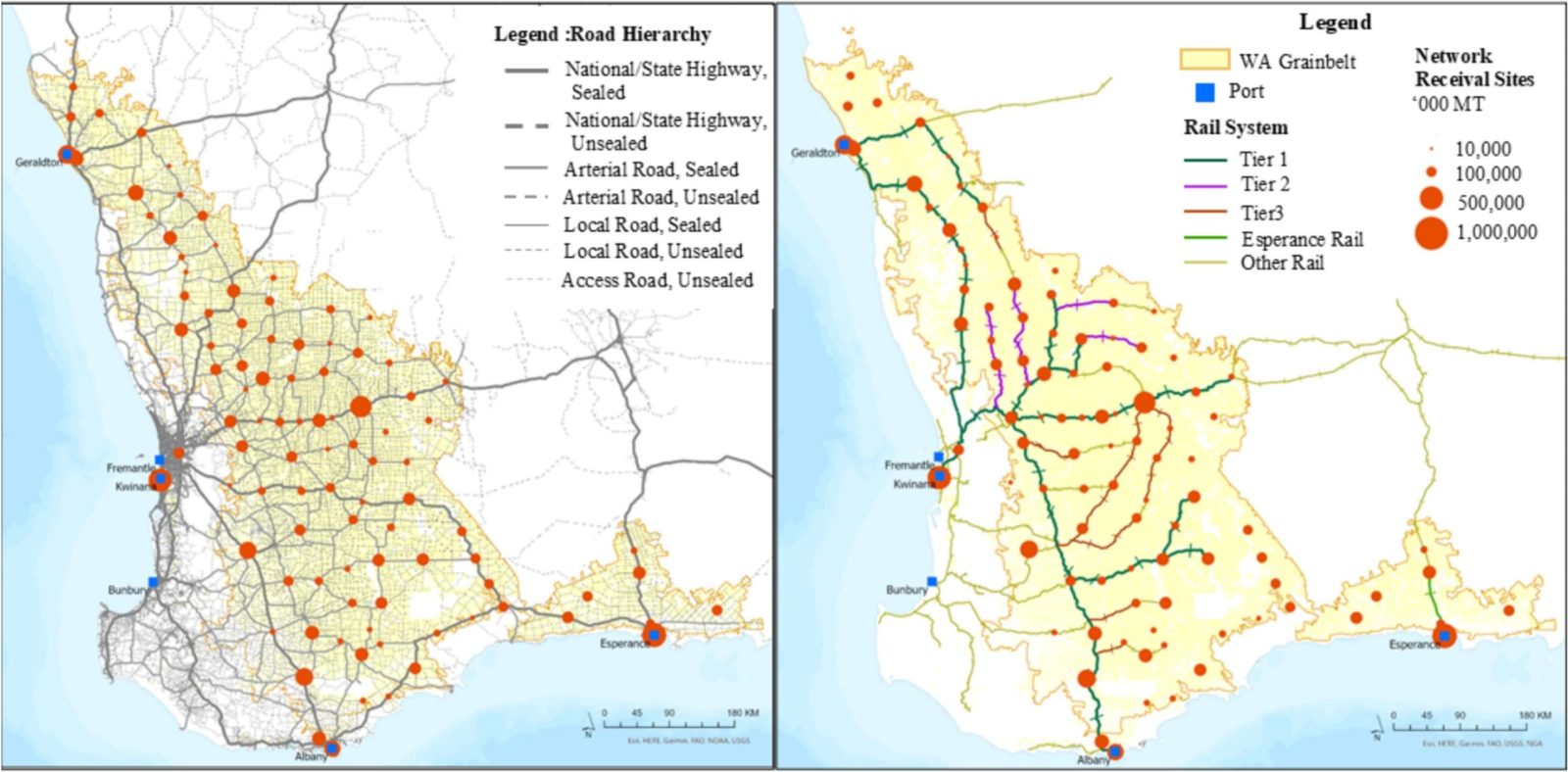
Figure 1: Overlay of road (left) and rail (right) infrastructure with grain-receival network sites in the WA grainbelt.
Others noted logistics decisions are shaped by more than just distance: “We try to avoid Bruce Rock due to higher receival costs… Kellerberrin is faster, so we’re not getting held up”, another grower said.
The study said CBH Group’s Path to 2033 Strategy, which includes cutting site numbers from more than 150 to less than 100 in a bid to improve system efficiency, has adversely impacted some growers.
“In practice, it increased travel distances and freight costs, disproportionately affecting growers located more than 150km from ports, particularly those producing specialty crops.
The study said the policy has had flow-on effects for crop choice and delivery timing.
Compounding these challenges is the ongoing decline in rail reliability, primarily the 2014 closure of Tier-3 rail lines, which has shifted more grain on to local roads, contributing to road wear and longer hauls.
“This shift has increased transport costs by up to $5/t in regional silos, dependent on the Tier 3 lines, and the deterioration of rural roads.
As one grower noted: “Road infrastructure… is deteriorating… the level of use has changed dramatically but funding hasn’t kept up”.
Seasonal issues such as wet conditions and contractor shortages further exacerbate transport delays.
Several growers also linked the increased freight burden to a rise in road-accident rates, particularly in mixed-use corridors impacted by mining and tourism.
Increased self-reliance
Responses showed large-scale operations typically use a hybrid freight model, combining one or two of their own truck-and-trailer units with contracted services carting up to 10 loads daily during the harvest peak.
Smaller farms relied more on third-party freight providers.
Not surprisingly, the study showed larger farms were more likely to have shed or vertical storage for grain.
“Owner-operated farms demonstrated higher fixed-asset investment and greater freight autonomy.
“A statistically significant correlation occurred between total land area and on-farm storage capacity, indicating that scale — more than experience or age — was the primary driver of infrastructure adoption.”
Responses showed forward marketing was widespread but variable, with pre-sale accounting for 15-60pc of total production, often through 8-30 contracts per year.
“The extent of forward selling was closely linked to on-farm storage capacity and cash-flow considerations, particularly in higher-rainfall regions or across regions with limited delivery options.”
The research was supported by UWA, WA’s Grower Group Alliance, and the Federal Government’s Future Drought Fund.
Assistance with data collection and harvest events was provided by Grower Group Alliance regional groups and the WA Department of Primary Industries and Regional Development.
Grain Central: Get our free news straight to your inbox – Click here
HAVE YOUR SAY