
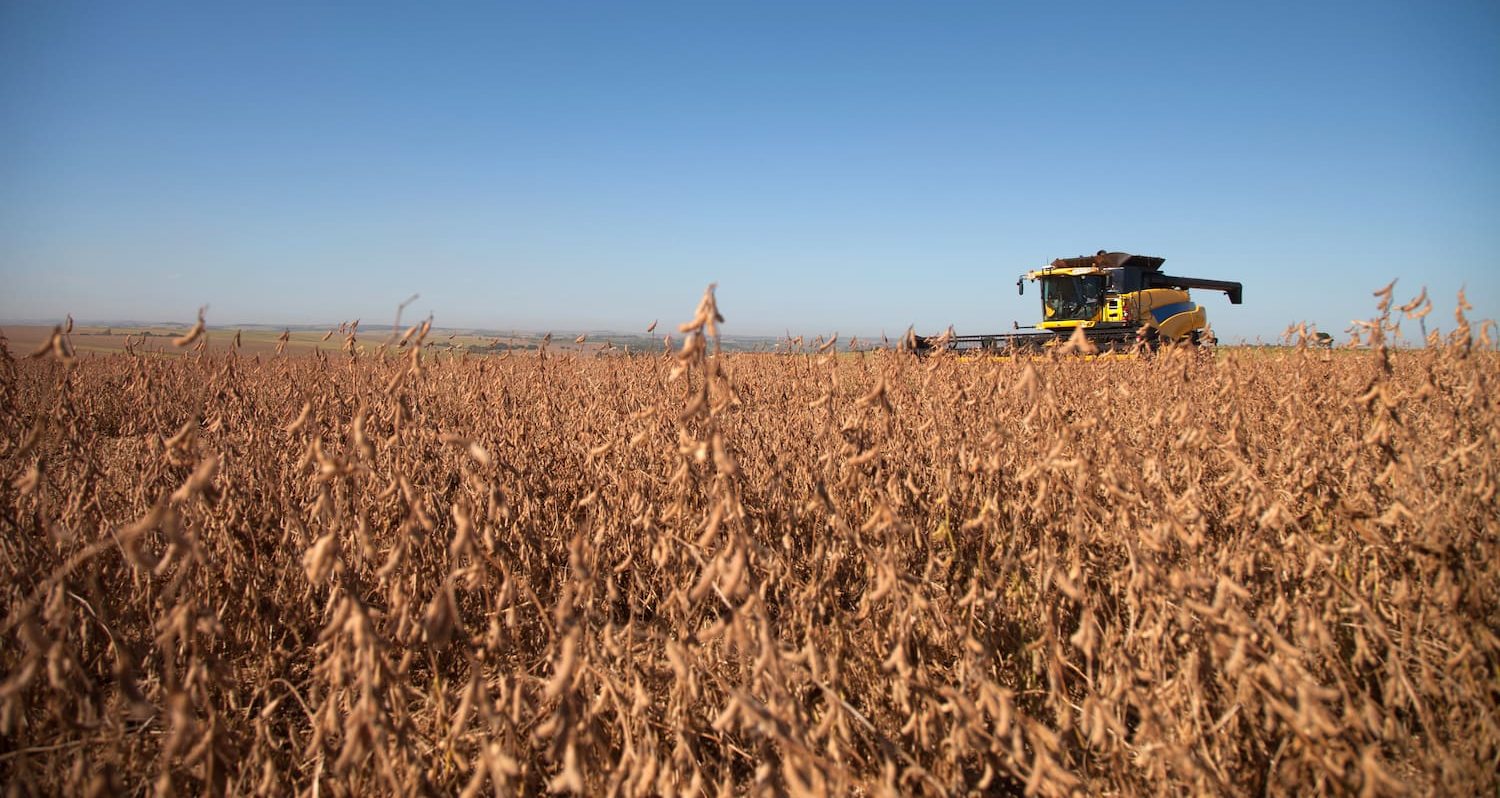
Soybean harvest Mato Grosso. File photo: Shutterstock
THE GEOGRAPHIC spread and ever-increasing scale of Brazil’s soybean production program each season is so vast that the conclusion of the planting program in the south of the country now coincides with the commencement of harvest activities in the northern growing regions.
The planting program kicked off in September last year, and despite a strong start, inadequate rainfall in November disrupted seeding activities in key producing states, particularly in the Central and Southern regions. This led to planting delays and replanting of fields in several of the worst-affected areas, resulting in the mid-November planting progress of just under 70 percent being the lowest ever recorded.
More general rains eventually arrived, especially in the southern states, allowing seeding activities to regain momentum and advance significantly through late November and December, with no major interruptions to fieldwork reported. As a result, planting of the final paddocks in Rio Grande do Sul was largely completed in the first two weeks of January.
The United States Department of Agriculture pegged the harvested area at a record 49.1 million hectares (Mha) in its January global production update, up from 48.8Mha in its December report. This is 3.6pc higher than the 2024-25 area of 47.4Mha and is 12pc above the five-year average.
The crop is reported to be in good to excellent condition in the key producing states of Mato Grosso, Paraná, Goiás and Mato Grosso do Sul. Satellite-derived Normalised Difference Vegetation Index analysis indicates above-average crop conditions at the peak of the growing season in these four states. According to the USDA, NDVI values at the peak of the season are a relatively accurate indicator of soybean yields, and analysis of the current crop during this critical period supports the above-average yield prognosis.
The likelihood of a return to neutral El Niño–Southern Oscillation (ENSO) conditions in the January to March period, from the current La Niña conditions, is likely to see beneficial rainfall in the southern states, again supporting above-average yields. La Niña generally causes dryness in Brazil’s southern states, especially in Rio Grande do Sul, which is expected to be the nation’s second-largest soybean producing state this season.
Harvest of the early-planted soybeans commenced at the beginning of January, marking the start of what is expected to be the second successive record crop. Progress remains slow at this early stage, with just 2pc completed by January 15, according to AgRural, up from 0.3pc completed a week earlier and slightly above the 1.7pc progress reported a year earlier. Harvest in Mato Grosso, Brazil’s largest soybean producing state, is still two to three weeks away.
The soybean-growing season is quite complex, with the harvest in the north stretching from early January to late April, while the southern harvest runs from late February through to May. The traditional cropped areas in the south have a completely different growing season from those in the tropical north. The northern areas of Brazil double-crop their land, with soybeans immediately followed by corn, or another summer crop. Southern areas plant their crops later and usually only double-crop after harvesting winter wheat.
With a record area and above-average yield potential being reported from the field, 2025-26 production forecasts are lofty. The USDA increased its estimate by 3 million tonnes (Mt) to 178Mt in this month’s global supply and demand report, up from 171.5Mt last season, 154.5Mt in 2023-24 and 162Mt in 2022-23.
Brazil’s Conab (Companhia Nacional de Abastecimento) went in the opposite direction in its January 15 crop monitoring report, clipping 1Mt off its December production forecast to currently stand at 176.1Mt, off a harvested area of 48.7Mha. Conab sees the domestic crush increasing by 5.9pc year on year to 60.5Mt, resulting in a 5.9pc growth in soybean meal output to 46.6Mt and a 6.4pc rise in soybean oil production to 12.2Mt.
The state-owned company expects the country’s total grain output in 2025-26 to increase to 353.1Mt, 1Mt higher than the 2024-25 harvest. With the total planted area increasing by 2.1Mha to 83.9Mha, that means that soybeans will account for 58pc of the nation’s cropped area this season and contribute a tad under 50pc of total output.
Agribusiness consultancy Safras & Mercado is far more optimistic, increasing production in last Monday’s update from 178.8Mt to 179.3Mt. With an expected carry-in of just 4.5Mt, the agency estimates this will push the total 2025-26 season supply 5pc higher year on year to a record 183.8Mt.
Safras & Mercado expects expanded domestic crush capacity to increase the domestic soybean crush from 58.5Mt in 2024-25 to 60Mt in the current season. The resultant soybean meal production is forecast to increase 2pc to 47.4Mt, and soybean oil output is projected to grow 3pc to 11.7Mt.
On the export front, the USDA raised its forecast by 1.5Mt to 114Mt in its January update, up from 103Mt in 2024-25 and 104.2Mt a season earlier. Conab trimmed 200,000t off its export estimate this month, bringing it to 111.8Mt, but it is still 3.3pc higher than the 2024-25 campaign of 108.2Mt. Safras & Mercado have the most conservative export expectations, currently forecasting a 3pc fall to 105Mt.
HAVE YOUR SAY