
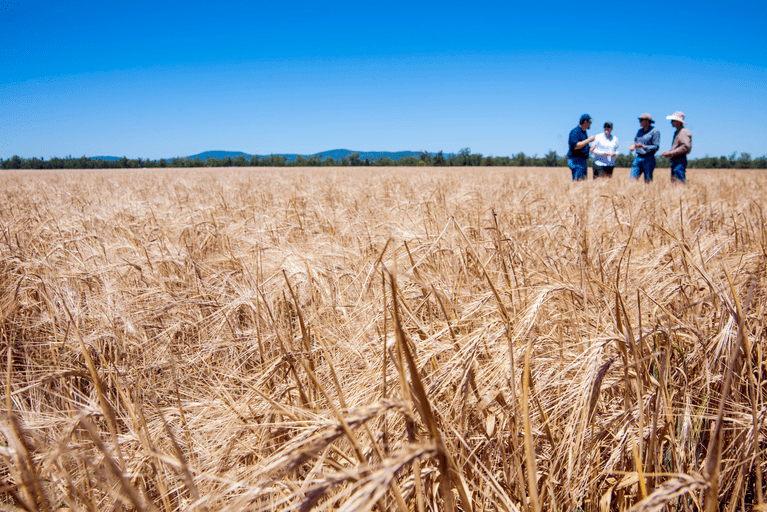
FarmPrint allows farmers to evaluate, benchmark and report on greenhouse gas emissions. Photo: CSIRO
THE AGRICULTURE sector now has a new tool to support the evaluation, benchmarking and reporting of greenhouse gas (GHG) emissions from farms via the FarmPrint tool.
Launched this week by CSIRO, it allows farmers to demonstrate their environmental performance and tackle the challenge of reducing their agricultural footprint.
FarmPrint has arrived at a time when the agriculture sector faces increasing pressure from markets, lenders, and supply chains to demonstrate clear emissions reporting.
Originally developed as a prototype by CSIRO with early support from the Clean Energy Finance Corporation, FarmPrint has been refined over the past 12 months through trials on CSIRO research farms.
It allows farmers, advisors and finance-sector partners to assess performance against regional benchmark data and to monitor changes in farm-level emissions over time.
CSIRO’s senior research scientist working on FarmPrint, Murray Hall, said testing in the field, under real-life conditions, had provided valuable feedback to ensure the tool is robust.
“This first phase of the tool embraces a cradle-to-farm gate approach, measuring not just on-farm greenhouse gas emissions but also emissions embedded in supply chains, for example in fertilisers, chemicals and diesel,” Dr Hall said.
“We look forward to working with the agricultural sector to add new capabilities, support reporting, refine calculations and help farms identify pathways to reduce emissions.”
The calculations embedded in the platform will align with evolving national and international reporting protocols.
FarmPrint aims to support collaboration and transparency.
A dedicated webpage provides access to documentation and an Application Programming Interface (API) allows integration with other software and data systems.
Dr Hall said CSIRO was engaged in a range of innovative research in the digital agriculture space, and FarmPrint converts that research into a practical tool for farmers.
“FarmPrint will be an important addition to the kit bag of sustainable farm management into the future.”
CSIRO acknowledges the support of Macquarie Bank through the Clean Energy Finance Corporation in the early development of FarmPrint.
Source: CSIRO
Wonderful advice. One item worth adding in the future, if currently omitted, is a measure of the albedo enhancement (AE) from cover crops compared to plowed fields. AE by reflecting heat back into space, when it reaches the top of the atmosphere (TOA) has an equivalent atmospheric carbon offset. One sq km with an additional radiative forcing of -25 W/m2 reflects 600,000 kWh per day and of this , about 25% reaches the TOA. This is equivalent on average to 16,800 tons of carbon dioxide equivalent offset for the duration of the AE project. This is in addition to the additional carbon sequestered in the soil by this regenerative agriculture. In this way the farmer helps fight climate change, just like painting his barn roof white.