
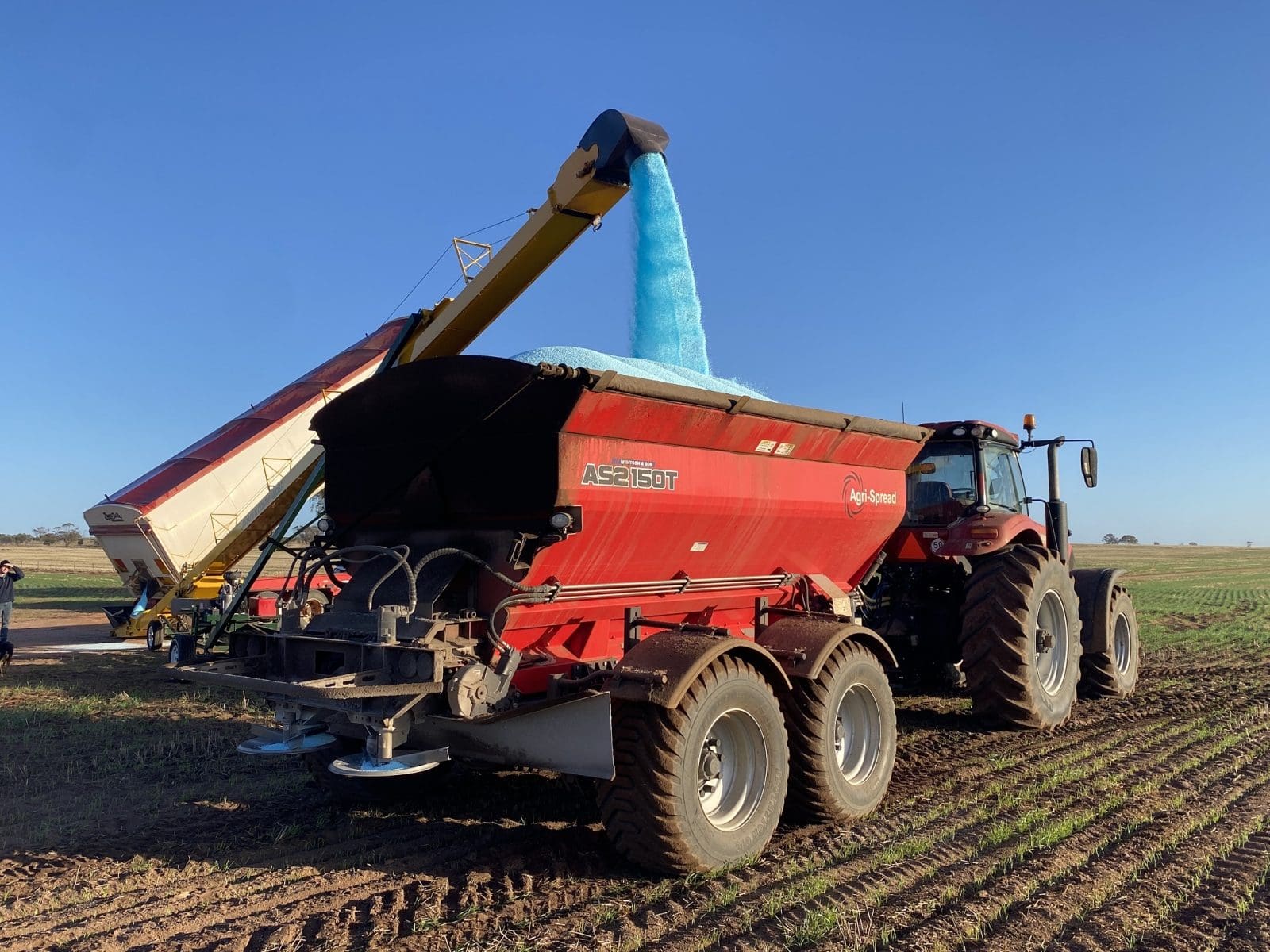
Urea prices are expected to hike in response to the latest Middle East conflict.
THE United States-Iran conflict is expected to raise fertiliser prices and negatively affect farmer margins, according to the latest CBA Agri Commodity Weekly Alert.
Issued today, and authored by CBA director and sustainable and agricultural economist Dennis Voznesenski, the alert looks at some of the likely outcomes from the conflict.
In the alert, Mr Voznesenski, who in 2024 independently released his book, War and Wheat, wrote about the US-Iran conflict.
He said it has now slowed vessel movements in the Strait of Hormuz, directly south of Iran, to a trickle, and that BBC reports indicated three freight vessels from the US and United Kingdom have already been struck.
“The Strait of Hormuz is a key waterway that oversees the transport of roughly a fifth of global oil and Liquefied Natural Gas supply,” he said in the alert.
He said global commodity tracking platform Kpler indicates around one third of global urea trade also passes via the Strait.
“Reduced supplies of fertiliser from the Middle East have a direct impact on fertiliser prices.
“Furthermore, higher energy costs typically lead to higher production costs for feriliser producers, raising prices.
“How much fertiliser prices rise will depend on how prolonged the disruption to vessel movement is in the Strait of Hormuz.”
Mr Voznesenski referenced US President Donald Trump saying nine Iranian naval vessels had already been sunk, but that would not stop Iranian attacks on vessels via other methods.
“Farmers that have not yet made their fertiliser purchases for the 2026 season will likely be hit the most,” Mr Voznesenski’s report said.
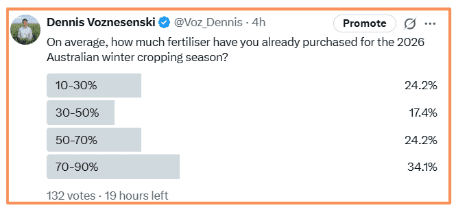
A poll conducted on the X platform today showed that many Australian growers still have considerable exposure to fertiliser price hikes. Source: Dennis Voznesenski
According to a survey on social media platform X roughly 40 percent of Australian farmers have less than half of their fertiliser needs for 2026 already purchased.
Iran does not export wheat, and large global wheat export flows are not expected to be interrupted, barring an escalation where Russia becomes involved.
“However, we could see price support due to a build-up of “just in case” grain stocks in the region.
President Trump has said that the Iranian military operation is ahead of schedule, but also that US objectives could take a month to achieve.
“Over the next 2-3 weeks, wheat prices and fertiliser prices are likely to remain elevated.
“Farmers who have already locked in fertiliser prices and still have wheat on-farm from last harvest may find themselves in a temporary but favourable position.”
“Beyond three weeks, while fertiliser prices are likely to remain elevated, the price of wheat is likely not to stay high due to ample global supplies.”
Source: CBA
HAVE YOUR SAY