
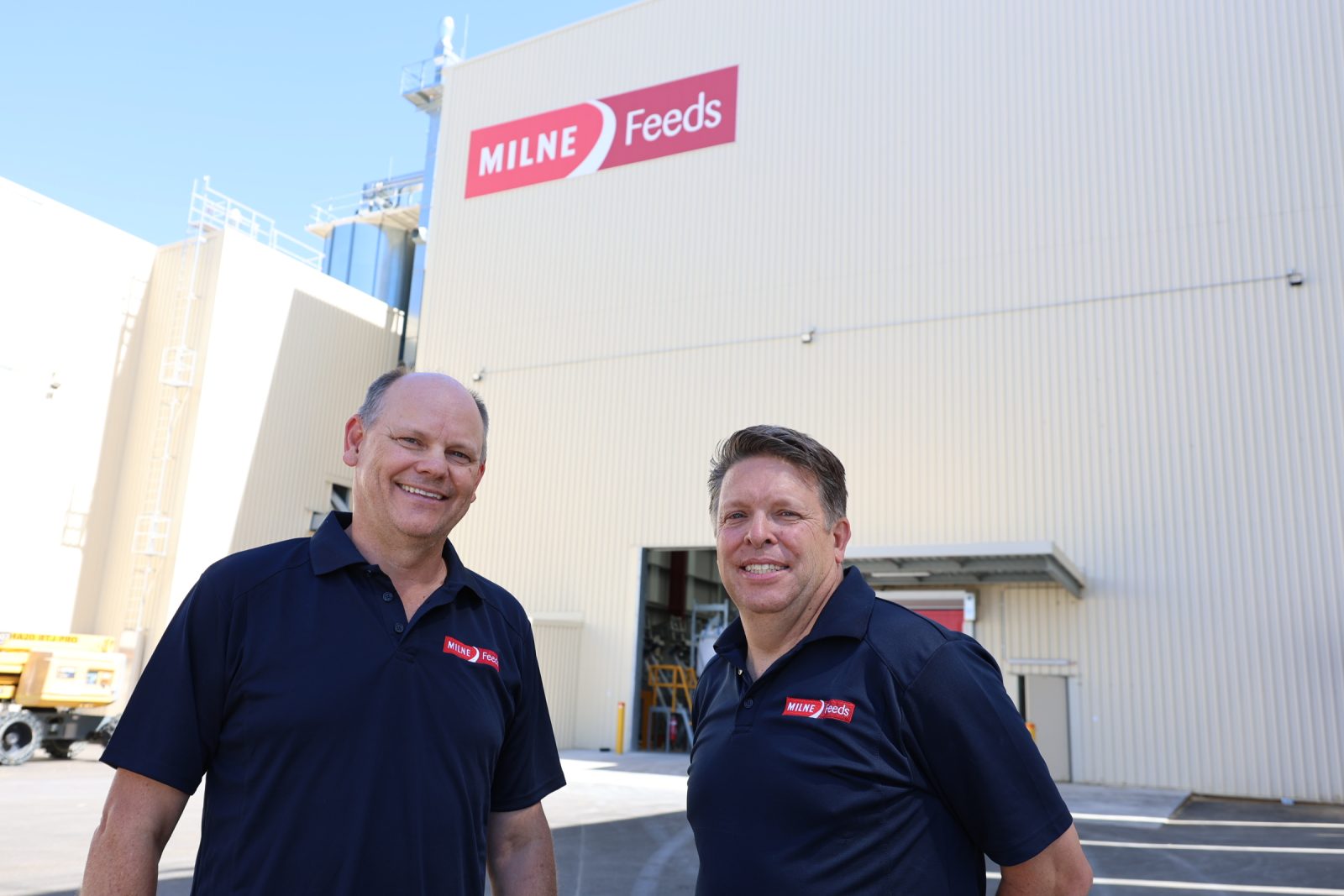
Milne AgriGroup and Mt Barker Free Range Farms general manager Michael Tarling and Milne Feeds sales manager Paul Nenke.
A RECENT expansion has seen Milne AgriGroup double its production capacity to 300,000 tonnes annually, making its mill in the Perth suburb of Welshpool the largest manufacturer of pelletised ruminant feed in Australia.
Milne is now exporting its formulated pellets throughout Asia, and is also expanding distribution domestically, with 6000 tonnes going into South Australia in its first 18 months in that market.
Milne AgriGroup and Mt Barker Free Range Farms general manager Michael Tarling said the expansion is helping Australian livestock producers and offshore beef and dairy operations move away from “home mixes” and get the best from nutrition science.
Easy2Gro brings value, methane benefit
Feed for beef and dairy cattle combined accounts for around half of Milne AgriGroup’s pellet production, with sheep one third, and equine the balance.
As global markets increasingly look for food produced with reduced carbon emissions, Milne is quietly rolling out its Easy2Gro pellet initially to sheep growers and later cattle, so those that market their meat, wool, and milk, can get ahead of the curve.
At the centre of Easy2Gro is its patented HyFibre technology developed by Milne’s research-and-development team, which conducted preliminary tests on the new product at Milne’s Mt Barker operation in WA’s Great Southern.
The tests used USDA-approved Open-Path Fourier Transform Infrared (OP-FTIR) spectroscopy over blocks of weeks to compare methane emissions on an empty yard, on sheep fed a “home mix” of straw, lupins, and cereals, and then on Easy2Gro.
Easy2Gro has since been tested over three replicated trials with sheep using USDA- endorsed methods, and combined results show methane emissions are cut by up to 70 percent when compared with sheep fed on grain mixes.
“There isn’t a premium being paid for methane mitigation presently; you have to do it in advance of the market coming to you,” Mr Tarling said.
“We did sheep first because of their shorter feed time, and results have shown a lower level of methane produced per kilogram of carcase weight, and a superior rate of feed conversion compared to a traditional home grain mix.
“It’s taken three years to develop and prove up the results, and the next stage is beef cattle and dairy.”
Prior to Easy2Gro becoming available, Milne’s sheep market was split evenly between EasyOne, developed for ewes and finishing lambs, and LambGro, exclusively for finishing lambs.
Easy2Gro sits between EasyOne and the higher-energy LambGro on specifications and price.
“We’re not asking the customer to pay a premium for the carbon-reduction benefit.”
Easy2Gro has been available since October, and already accounts for half the sheep pellets sold by Milne.
“It’s the result of 20 years of R&D into optimising ruminant nutrition, and it’s quickly become our highest-demand sheep feed.”
Sheep, cattle feed chosen path
Milne AgriGroup is owned by Graham Laitt and family, and employs 600 staff across the Welshpool site, at its Mt Barker farms, a convenience meal centre in Forestdale, and at its processing and value-adding facility in Perth’s east Rockingham.
A pioneer of high-welfare farming at scale in Australia, Mt Barker is the largest free-range pork producer in Australia, and is also a sizeable producer of free-range chicken.
The Mt Barker chicken and pork lines hold significant WA retail and wholesale market share, and are also sold in supermarkets as far afield as Queensland.
Following the Mad Cow Disease outbreak, legislation required mills making both monogastric and ruminant feed to choose one or the other because of concerns about cross-contamination with animal products in the ruminant mix.
It means feed for Mt Barker chicken and pigs is made to Milne AgriGroup specifications at the Weston Animal Nutrition mill at nearby Hope Valley using inputs bought by Milne AgriGroup’s grain buyer David Syme, who also buys inputs for pellets made at Welshpool.
“This feedmill used to make our own chicken and pork feed as well as being involved in ruminant feed,” Mr Tarling said from the Welshpool site.
“We went down the ruminant road; because we’d done all that research, we felt that was our direction.”
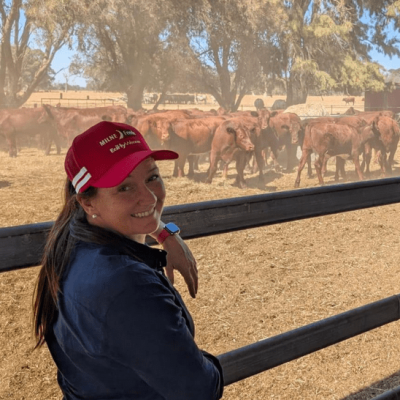
After seven years with Emanuel Exports, Holly Ludeman in January joined Milne AgriGroup as its group veterinarian. Photo: LinkedIn
Milne’s output used to include high-fibre maintenance pellets for live sheep vessels loaded in Fremantle.
Mr Tarling said short-term contracts, and demand dependent on seasonal variations in destination countries, made the live sheep trade a low-return operation.
“We looked at it and backed ourselves to diversify into other markets.”
“Between 2008 and now, we’ve weaned ourselves off them; it was low-margin product.
“It has proven to be a good move given the cessation of live sheep exports from 2028.”
“Our growth is domestic and export, and that includes Japan, South Korea, New Zealand, Taiwan, and some developing markets in Indonesia and Vietnam.
“None of this was possible before the latest expansion as we were capacity constrained.”
Mr Tarling said WA’s demand for ruminant feed depended greatly on the season, with winter and spring typically low-volume seasons, and peak demand occurring in summer and autumn.
“In October, we don’t sell much sheep feed; in April if it hasn’t rained, we sell a lot.”
It is still the case across WA’s mixed-farming regions, which has encouraged Milne to move into export, as well pastoral regions in Australia’s north, and engage agents in SA and Victoria.
By 2007-08, sales of pellets for beef and dairy cattle and sheep had grown considerably in the peak demand period over WA’s driest months.
“It got to the point that every year, when we’d have summer drought from February to June, we’d be turning away customers.
“To fill the back half, we had to take on export customers.”
To satisfy peak domestic and export demand concurrently, Milne came to the realisation it needed to supercharge its capacity.
After much investigation of prospective sites in WA, the board decided to expand at Welshpool.
“We were already on land with proximity to products and customers, and with excellent access to road networks.”
The build got a $5-million grant from the WA Government’s $50M Investment Attraction Fund.
The new mill was built beside its existing mill, and was commissioned in November last year to double the site’s capacity.
“Our goal is now to do 300,000t of finished feed for domestic and export.”
Lessons from grocery
Milne Feeds was established on the Welshpool site in 1910 by William Milne, and stayed in the Milne family until 1987.
That year, it was acquired by interests associated with Mr Laitt, who brought with him insights from his many years with Peters & Brownes, one of WA’s biggest agrifood businesses.
Its dairy base included the manufacture and distribution of Peters ice-cream in WA, and an understanding of the importance of distribution networks in Fast Moving Cold Goods.
“What Mr Laitt saw in FMCG…he wanted to bring to stockfeed.”
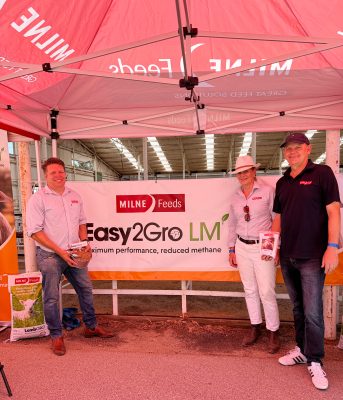
Milne Feeds sales manager Paul Nenke and nutritionist Elizabeth Owens with Michael AgriGroup general manager Michael Tarling at Wagin Woolorama. Photo: Milne Feeds
That included branded marketing, wide distribution and new product development through R&D.
Milne invested heavily in R&D from 2003, and launched its EasyOne pellet in 2005 to kick off its branded feed journey.
Servicing the sheep market, the range comprised formulations for lambs and adult sheep in paddock and feedlot environments.
EasyBeef came next.
The distribution model is all about convenience for producers, and many Milne depots are set up on customers’ farms.
“We have 15 depots from Geraldton to Esperance, so you don’t have to travel more than 100km to get our feed.”
Farmers who deliver Milne’s key inputs of wheat, barley, and lupins to Welshpool also have the option of backloading with finished feed.
“A lot of customer swap grain for pellets in what we call an offset, where they might bring in $20,000 worth of lupins and go home with $25,000 worth of pellets.
“They just have to pay the balance for what is a far superior outcome for the animal.”
Producer experience
Earlier, and through Dowford Investments, Mr Laitt had bought the neighbouring Liveringa and Nerrima stations in WA’s Kimberley.
Red Brangus cross weaners from the stations were trucked south and fed on EasyBeef pellets to get them to target weights at much faster rates than could be achieved on their home properties in the Kimberley.
“We were the ones that were starting backgrounding north of Perth in those early days.”
Gina Rinehart’s Hancock Prospecting bought a share and then the balance of both Liveringa and Nerrima in 2014 and 2015, but Milne still has a foothold in the Kimberley with agencies in Broome and Derby.
Milne AgriGroup is exhibiting at the Northern Territory Cattlemen’s Association Conference in Darwin March 18-20 with plans to service a broader customer base in the NT.
In the Wagin district of WA’s Wheatbelt, Mr Laitt owned mixed-farming country that ran 70,000 sheep, and they too were fed Milne pellets.
“The fact that we had our own livestock gave us an incentive to reduce the cost of feeding animals.”
Milne also makes a range of pellets for dairy cows, heifers and calves.
“We have a very solid dairy platform, with 40pc of WA’s dairy customers.”
Expansion in SA
Beyond WA and export, SA has developed as a significant market for Milne AgriGroup products, and has taken 6000t of feed in 18 months.
It started during the drought of 2024, with Steve Whillas and Tracey Lehmann of Eyre Peninsula Integrated Commodities at Kimba their SA agents.
“During the drought, Tracey and I realised we were going to run out of hay in South Australia, which we did, and grain was very expensive,” Mr Whillas said.
While SA has its own pellet manufacturers east of Adelaide, Mr Whillas said they “struggled to keep up with demand” during the drought.
“There was a massive need for feed to come into SA.”
Mr Whillas said Milne pellets during those tough months enabled producers to maintain condition in their ewes, and put weight on lambs to sell for cash flow when crops were struggling, or not planted at all.
“Now we’re in the second year of the feedlot market, and we have a steady stream of business.”
Aside from Kimba, Milne pellets are available at points west in Wudinna, where a bulk depot has just opened to supplement a bulka bag supplier, and Ceduna.
To the east, an on-farm depot has been set up at Crystal Brook.
A cost-effective freight solution has come from trucks heading home from WA after delivering specialised cargoes.
Think Queensland bananas, and Coopers beer.
“It’s given them a backload, and it’s helping everyone.”
At less than $600/t landed Eyre Peninsula, Mr Whillas said the Easy2Gro pellets stack up on price.
“There’s also the safety factor; a pellet provides a fully balanced diet, and that’s bang on what people want.
“Last year we supplied a lot of pellets that kept ewes alive, and we’ve just started doing cattle pellets.”
Grain Central: Get our free news straight to your inbox – Click here
HAVE YOUR SAY