
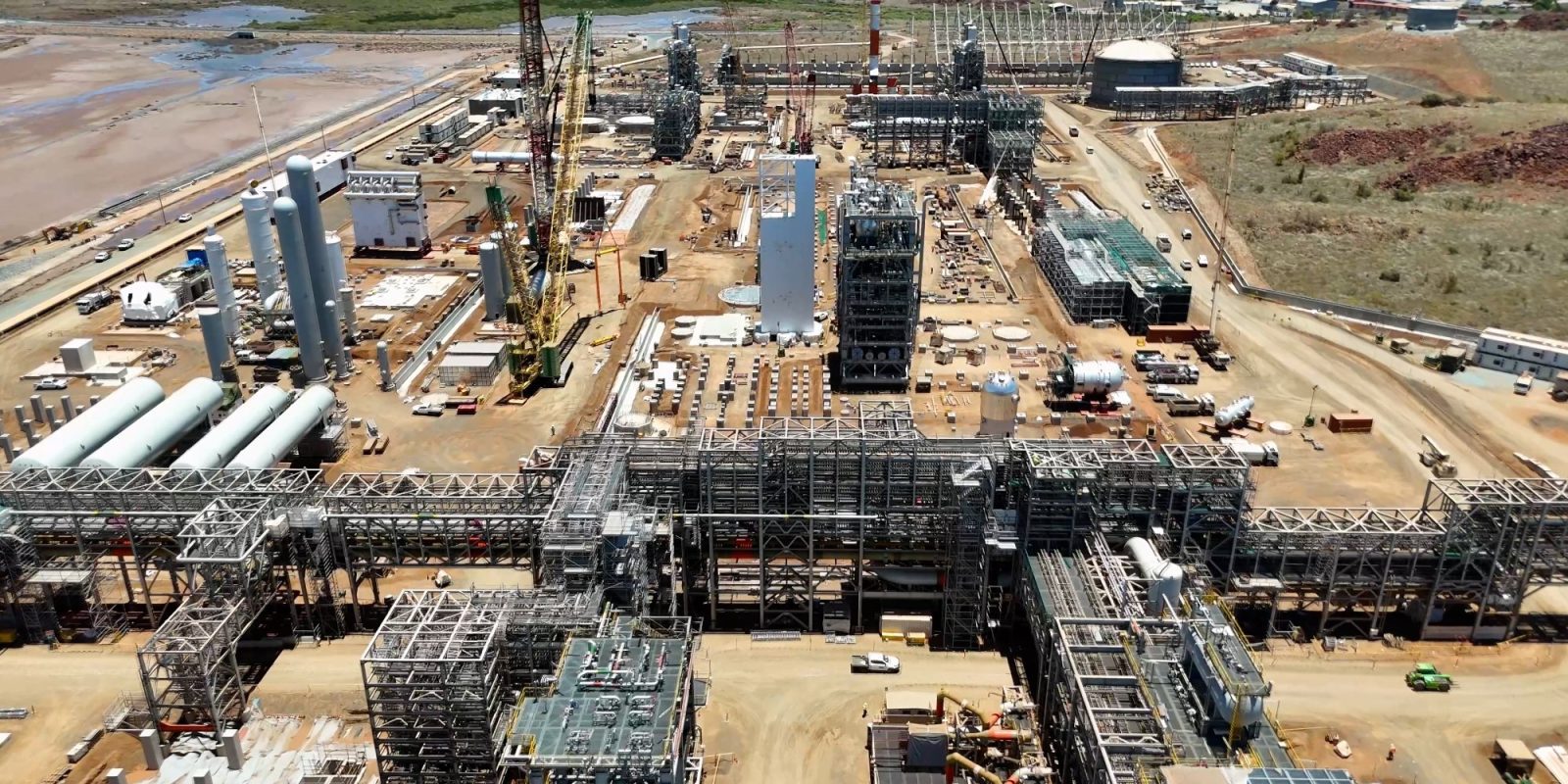
Construction of Project Ceres’ urea plant near Karratha is well advanced, as shown in this image from November 2025. Photo: Clough Group
THE COMPANY behind a major Western Australian fertiliser project, Perdaman, says it plans to start producing 2.3 million tonnes (Mt) of urea per annum from June 2027.
With conflict in the Middle East severely disrupting fertiliser supply chains, domestic manufacturing has become a major focus for Australian growers.
Against that backdrop, the $6 billion Project Ceres, currently being built just north of Karratha in the Pilbara region, is set to become Australia’s only urea-producing facility.
A Perdaman spokesperson has confirmed that of the total production, at least 1Mt will be made available for domestic use, with commissioning on track for March 2027, with “full production” due to start in June 2027.
The end product will be transported via a new multi-user wharf and facilities, also under construction, at the Port of Dampier.
Federal Minister for Resources Madeleine King said on March 11 that the Perdaman project was key in reducing Australia’s “dependency on the importation of urea for fertiliser”.
“It will provide important and stable supply chains for farmers into the future for all the agricultural industries and the work they do which is required to feed Australia and our regional neighbours,” Ms King said.
“The Perdaman urea project is one of the largest downstream processing and manufacturing investments in Australian history, and it will solidify our supply chains.
“At a time where we are seeing constraints on the export of urea through the Strait of Hormuz in the Persian Gulf, knowing that this project will start production in March of next year will be very reassuring for Australian farmers into the future.”
Potential domestic availability
Domestic urea production in Australia ended with the closure of Incitec Pivot Limited’s (IPL) Gibson Island facility in late 2022.
In 2023, IPL announced it had secured a 20-year off-take agreement with Perdaman to take up to 2.3Mt per annum of granular urea from the Karratha plant.
Last year, IPL (now known as Dyno Nobel) confirmed it had sold this agreement to Macquarie Group’s Commodities and Global Markets business for gross proceeds of up to $145 million.
ASX-listed agribusiness, Ridley, which acquired Dyno Nobel’s fertiliser distributions assets, also announced it will have access to a quantity of Perdaman’s urea production.
In a statement to the ASX, Ridley said it had secured supply from the holder of Dyno Nobel’s contract, now Macquarie, of at least 700,000t per annum “on favourable terms relative to its current supply arrangements”.
It is not yet clear how Macquarie Group will direct its off-take agreement, although comments from its legal adviser Hamilton Locke at the time of the deal suggested a portion would be aimed at the domestic market.
“We were delighted to support Macquarie CGM on legal aspects of this strategic transaction that positions it as the key supplier of urea into the Australian market, with significant reach into the global market,” Hamilton Locke corporate partner Michael Boyce said.
Project background
Perdaman, a WA-based multinational company with offices in New Delhi and Hyderabad, India, broke ground on Project Ceres in April 2023.
It secured funding for the project in 2022, with the Northern Australian Infrastructure Facility committing funds to the project and supporting infrastructure.
The funding included up to $220M to the Perdaman Urea Project, up to $95M for Water Corporation to support its Burrup seawater brine disposal scheme, and up to $160M for Pilbara Ports Authority to expand Port of Dampier.
The WA Government also provided more than $50M for roadworks, detailed design of a new Dampier Cargo Wharf and upgrades to seawater supply infrastructure.
Export Finance Australia also provided a $269M loan to the project, alongside NAIF and 12 other commercial lenders.
Project Ceres is backed by a 20-year supply agreement with Woodside, which operates the Scarborough Gas Project.
It will also generate 101MW of power onsite through gas turbine generators, supplemented by an average of 5MW from installed solar.
This energy will be used entirely to power the plant’s operations, ensuring reliable and self-sufficient energy supply for the facility.
Water needs will be met through collaboration with the Water Corporation, including access to a common-user seawater pipeline and an expanded supply network in Dampier.
The site includes land leased from the WA Government’s Landcorp and part of the Burrup East-West Service Corridor, enabling urea to be transported roughly 3.5km for shipment via a closed conveyor to the Pilbara Ports Authority.
Australia’s only other large-scale urea project, NeuRizer’s Leigh Creek development in South Australia, is expected to have a production capacity of up to 1Mt annually.
However, the project is currently stalled amid the environmental approvals process and construction of the production plant has yet to begin.
Grain Central: Get our free news straight to your inbox – Click here
So pleased to hear about this project. Will Perdaman be able to supply ALL of Australian agricultural needs or will we still need to import Urea? Also, is the production of Ammonia also included, since both are mentioned as one of the problems with the hold-up in the Strait of Hormuz?
I’m looking at sustainability within our own four walls in the event of any form of global calamity.
However, the project is currently stalled amid the environmental approvals process and construction of the production plant has yet to begin.
How many times has this nation again been held hostage, considering the urgency and lack of self sufficiency of this nation’s need for self-sufficiency? How about all politicians start to act in the interest of this nation – those politicians who opposed the reserve of fuel 90 days being published and made accountable; after all, diesel not very important (excepting for industry defense etc).
Great future for Dampier