
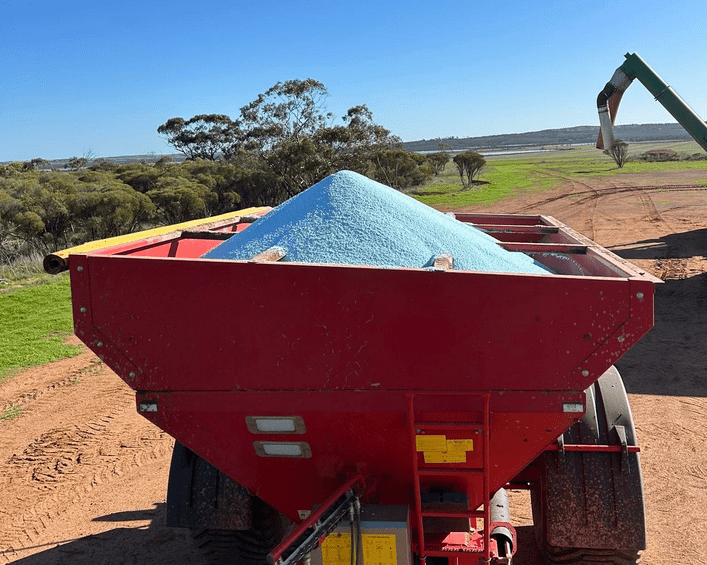
Whether fertiliser spreaders are filled with urea for top-dressing come winter remains to be seen as suppliers look beyond shipments from the Persian Gulf to fill Australia’s demand. File photo: Summit Fertilizers
GROWERS across Australia will next week find out how much urea the world market can send their way as the halt to shipping from the Persian Gulf enters its fourth week.
Grain Central understands the last of the boats laden with urea and ammonium phosphates to exit the Strait of Hormuz prior to armed conflict breaking out between Iran and US-Israeli will berth in Australian ports next week.
After that, sources other than the Persian Gulf, which supplies around 40 percent of global fertiliser requirements, will be relied upon until peace can return to the region to allow manufacturing and shipping to resume.
The price of urea is nominally $1300 per tonne, up 50pc on values prior to the first airstrikes on February 28, but sources say the supply rather than the cost is alarming growers most.
It has Western Australian growers looking to maximise returns, and ratcheting back on wheat and possibly canola to make way for more barley but, as ever, what gets planted will depend on the scale and timing of the autumn break.
WA area likely to dip
The Grain Industry of WA is expected to put out its initial estimate for WA’s 2026-27 winter crop next month, and expectations do not include a repeat of last season’s record area and production.
Ahead of the April figures being released, GIWA crop report author Michael Lamond said even before the latest Middle East conflict, barley was looking likely to crib some wheat area based on its comparatively stronger gross margin.
“Barley is an earlier crop…and you can manage it differently to wheat,” Mr Lamond said.
Its earlier maturity makes it unlikely to require as much in-crop nutrition as wheat, and therefore would make it a better fit if urea is in short supply.
“I don’t think the price of urea at $1400-$1500 would stop people growing canola; when you get to wheat, it’s a different story.”
Mr Lamond believes most WA growers have their fertiliser for planting on site, and what will be available for top dressing is where the concern lies.
He said noises coming out of fertiliser suppliers indicate that changes may have to be made for planting nutrition.
“A lot of growers thought they were okay [for fertiliser] last week, and now they’re not, particularly with urea.”
“Even with starter fertiliser, they might now be looking at different composition.”
Lupins are WA’s most widely grown pulse by far, and require less fertiliser than cereals and canola.
Despite this, Mr Lamond said a rise in lupin area seemed unlikely.
“Lupins aren’t that profitable and there weren’t a lot last year.
“You’ve still got to fertilise them, use fungicide, and get the weeds out out of them; they’re only a break-even crop at best.
“It’s probably unlikely lupin area will go up much.
“Canola’s the interesting one; it has higher nitrogen use, and it needs sulphur, but it’s our most profitable crop by a mile.
“What could happen in WA is there’ll just be less crop.”
If the break is late and/or patchy, and urea prices stay high amid limited availability, Mr Lamond said growers were likely to concentrate on their best paddocks.
“Any really sandy or heavy stuff they’ll keep away from, and in the medium to low-rainfall zones, there’ll be less crop,” he predicted.
Likewise, he cannot see an increase in oat area, based on Canada’s last crop being a big one, and concern about building pressure on the oaten hay market.
Haves and have nots
Liquid nitrogen, or urea ammonium nitrate, is a popular source of N for planting in WA.
It can be safely stored on farm for lengthy periods, and most that use it are fully stocked ahead of planting.
“You can store it for years and years, and we filled our tanks last year because the price was good,” one grower said.
However, the grower is concerned that urea for top dressing could be hard to get.
Grain Central has heard a small number of growers, including some large ones, have open positions for planting fertiliser, and they may have to go for something different like sulphate of ammonia to get some or all of their crop in if MAP, DAP, urea or UAN cannot be sourced.
Grain Producers Australia chair and WA grower Barry Large said he is covered for fertiliser required for planting.
“We ordered very early…but that doesn’t help everyone else,” Mr Large said.
“We’ve just got to hope other plants in other countries come back on line.
“The disappointing side to this is that we…need to have some supplies in this country.
“We all need a contingency plan.
“Saying you’ll get it in two weeks doesn’t solve the problem.
“Timing is everything in farming.”
Booked business looks okay
Fertilizer Australia has been contacted for comment on the current fertiliser supply situation, as have several of its member companies.
WA company CSBP on Friday emailed its customers advising that supply of some phosphate-based product from the Middle East had been interrupted due to the impact of conflict on the Strait of Hormuz.
“We have been able to source alternative supply and increase production of our locally manufactured products to address most of the shortfall,” it said.
“In some cases, this will involve a change in nutrient balance, with lower phosphorus levels offset by higher nitrogen and sulfur content.”
“We continue to manufacture Flexi-N locally, supported by a steady import program, to meet grower demand for liquid fertiliser at seeding and beyond.
“For granular nitrogen, we do not foresee challenges in meeting existing contracts.
In addition, there may be some potential changes to the timing of product collections, but we are confident we can work with growers to enable supply by the time it is required for use on-farm.”
Companies including CSBP offer no such surety to growers without contracts from their supplier/s, but Grain Central understands some product is available in the spot market ex ports across Australia.
Grain Central: Get our free news straight to your inbox – Click here
HAVE YOUR SAY