

Weather: Forecasts shifted wetter across key US Plains regions, with rainfall expected over the next 10–15 days across roughly half of the HRW belt. Earlier dryness concerns were partially alleviated, with eastern areas set to receive near-term relief and broader follow-up rain indicated in extended models.
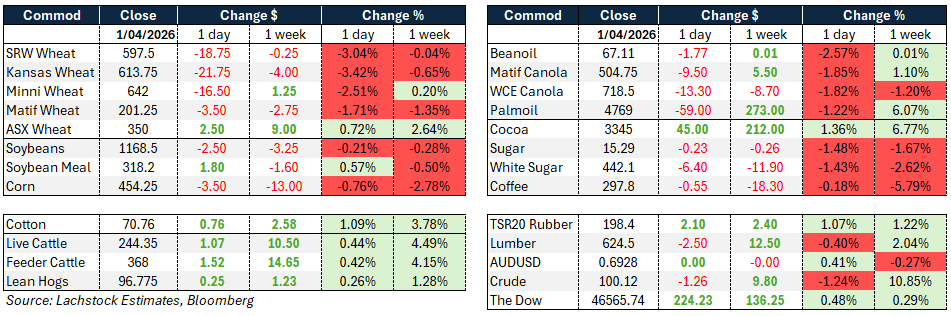
Markets: Grain markets were weaker across the board, led by wheat, as both war and weather premium came out. A wetter forecast across the US Plains eased production concerns, while improving sentiment around a potential Iran de-escalation saw funds reduce risk exposure. Corn and soybeans followed lower, with ongoing fund liquidation and a softer crude oil market removing support.
Macro sentiment shifted risk-on, with global equities higher and oil easing back toward ~$100/bbl on hopes the conflict could wind down. The USD softened slightly, while bond yields were mixed. Despite the improved tone, the Strait of Hormuz remains the key watchpoint, with energy flows and broader commodity direction still highly sensitive to developments there.
Day Ahead: Australia: Local markets softer to start following offshore weakness, with wheat leading declines on improved US weather and broader risk-off tone across grains. Canola also under pressure with veg oil markets weaker alongside crude, while barley likely to track wheat directionally. That said, domestic markets should still be supported by tight grower selling.
Global wheat: Wheat futures sold off sharply (CBOT ~2.5–3 percent lower) as both war and weather premium were stripped out, with wetter forecasts across the US Plains shifting sentiment quickly.
Rainfall outlook across ~50pc of HRW belt eased production concerns, triggering fund selling and stop-loss liquidation after recent strength.
Russian exports remain aggressive [~4.6 mullion tonnes (Mt) in March, more than double YoY], reinforcing global supply pressure and capping upside.
Demand side still solid (HRW ~98pc of USDA target), suggesting downside driven more by macro and weather than demand deterioration.
Egypt requiring mills to use imported wheat continues to underpin global trade flows, particularly for Black Sea and EU origin.
Overall tone softer with simultaneous removal of both geopolitical and weather risk premium, shifting focus back to underlying supply.
Other grains and oilseeds: Corn and soybeans eased with funds unwinding length as geopolitical risk premium faded and crude oil softened.
Corn balance sheet remains heavy (stocks ~2.1bn bu), with large managed money longs (~284k contracts) increasing downside risk if liquidation continues.
Fertiliser costs (urea +40pc, ammonia +20–25pc) are creating uncertainty around acreage mix, with potential shift toward soybeans at the margin.
Canola weakened alongside the broader veg oil complex, with soy oil, rapeseed and palm all softer as energy markets pulled back.
Palm oil remains structurally supported by Indonesia’s B50 mandate, lifting biodiesel feedstock demand toward ~15Mt annually.
Global flows mixed: EU soybean imports down ~10pc YoY while Brazil exports remain strong (~15.9Mt March), highlighting divergence in demand.
Macro: Market direction continues to be driven by Middle East developments, with optimism around a potential Iran war de-escalation pushing a risk-on tone.
Oil fell back toward ~$100/bbl on ceasefire hopes, removing a key inflationary and cost-support pillar for agricultural commodities.
Strait of Hormuz remains the critical uncertainty, with disruptions still impacting a significant share of global energy and LNG flows.
Equities rallied globally while USD softened and bond yields were mixed, reflecting improved sentiment but ongoing uncertainty.
Energy and LNG supply chains remain disrupted despite improved sentiment, suggesting underlying tightness may persist even if conflict eases.
Macro backdrop remains volatile, with geopolitics, energy pricing, and policy signals (Trump, NATO, ceasefire negotiations) continuing to drive short-term direction.
Local: WA current season canola reached $795 and new crop $832. Wheat was $336 and $368, while barley was $340 and $335 FIS Albany.
Through the east of the country bids improved yesterday, with 25/26 canola at $780 and new season at $804. Wheat was $335 and $375, while barley was $312 and $325 track Geelong.
Delivered canola markets continue to strengthen through the east, with GM at $720 and conventional at $800, while new crop markets are around $850 for Feb+ Geelong/Melbourne.
Protein wheat remains difficult to source, with H1 delivered Geelong/Melbourne bid at $384.
It is interesting to hear the trade is seeing some engagement on the new crop sell side over the last couple of days through Vic and SNSW. Despite higher input costs, larger growers appear comfortable getting a small percentage sold, with prices sitting around decile 7–8 over the last few years.
HAVE YOUR SAY