
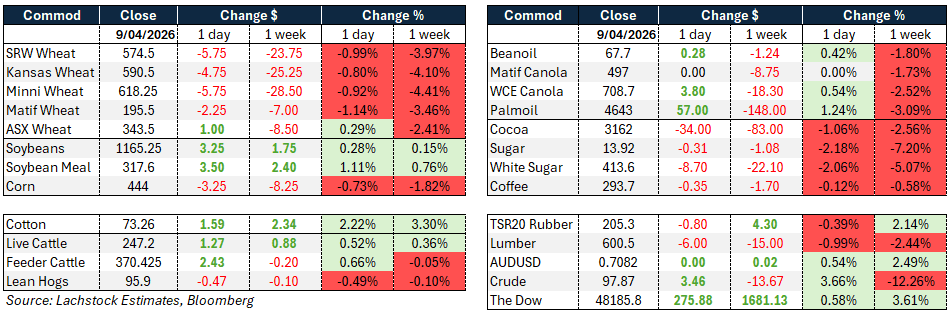

Weather: As far as I can tell, this pattern is going to miss western KS – Goodland looks like it may only get< 10mm which isn’t enough to stop the rot.
Europe and the BlackSea actually look pretty good – need to watch France as the western part of the growing belt looks a little dry.
Markets
The lack of risk premium in wheat markets is interesting but not as much as the positioning. The gross spec longs and shorts are huge – something that gets glossed over when just looking at the Spec net position. This feels like a game of chicken with both sides of the market digging in – history has shown that ag markets are easy to get into, hard to get out of – and this feels like Ags are one leg of a relative value trade. What forces either side out remains to be seen but US weather is at least creating a discussion. What does it look like if Western KS misses out this rain event?
Day Ahead – Australia
Albo is off to Singapore to ensure Australia doesn’t run out of Diesel – seems odd that he is flexing the Nat Gas supply given the press about just how little we now have a say over. Chris Bowen has indicated we are fine “well into May”
Feels like ground hog day today – more sound bites from the Iran conflict, more debate over fert and energy supply into Australia and little in the way of liquidity in cash markets. Interesting to see markets such as Hanwood continue to firm – bid side around the $360 level for Jan +.
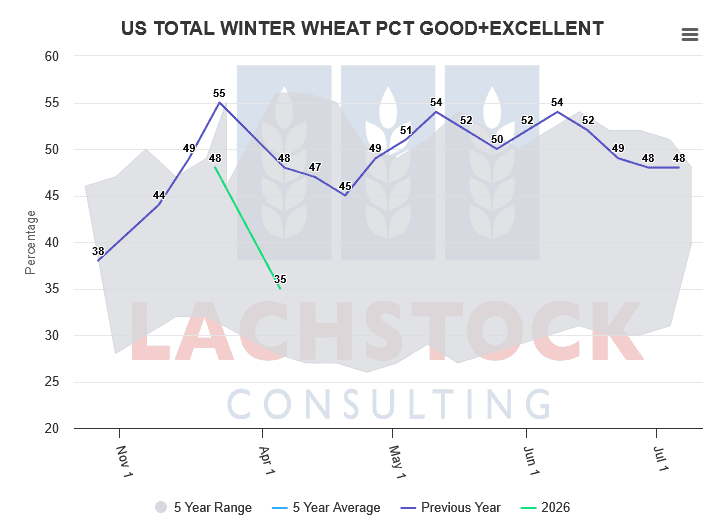
Global wheat: Chicago -$5.75 (-0.99%), Kansas -$4.75 (-0.80%), Matif -$2.25 (-1.14%)
The wheat market came under pressure on Thursday after the USDA’s April WASDE report delivered a bearish outcome for the complex.
US ending stocks were estimated at 938 million bushels, the highest since 2020 and above the range of analyst expectations, driven entirely by higher imports despite farmers planting the least amount of wheat since record-keeping began in 1919.
World supplies also came in above estimates, with increased production in the EU and Russia lifting global wheat production to 844.2 million tons and ending stocks jumping 6.2 million tons to 283.1 million tons.
Chicago wheat futures fell as much as 1.8% to their lowest level since March 5, with one analyst describing the report as neutral to slightly negative, noting the US carryout was bigger with very modest tweaks elsewhere.
The partial ceasefire between the US and Iran prompted some traders to unwind positions linked to food security concerns, after investment funds had recently flipped to their first net bullish position in wheat in nearly four years.
Export sales of US wheat came in on the low end of forecasts at 254,300 tons for the week ended April 2.
Dryness in the US Plains has seen only marginal improvement, with much of Nebraska, Oklahoma and Texas still in drought conditions.
Other grains and oilseeds: Corn -$3.25 (-0.73%), Soybeans +$3.25 (+0.28%), Matif Canola flat (0.00%)
Corn futures eased around 1% on the session despite a broadly supportive export sales figure, as the WASDE report lifted global corn production to 1.3 billion metric tons and ending stocks to 294.8 million tons, which analysts noted could see larger wheat supply cut into global corn feeding.
Export sales of US corn came in near the high end of analyst estimates at 1.37 million metric tons for the week ended April 2, offering some support against the bearish supply backdrop.
Soybeans were relatively resilient, finishing little changed to marginally higher as the WASDE left US ending stocks unchanged from March, with the report showing a shift in soybean demand away from exports toward domestic crushing, seen as a reaction to new EPA renewable fuel regulations directing a higher share of small-refinery exemption volumes to larger refineries. Improved biofuel sentiment underpinned the market.
Canola posted a modest correction on the ICE after sharp losses the prior session, finding support from gains in Chicago soyoil, European rapeseed and Malaysian palm oil, though upside was limited.
The broader oilseed complex was also supported by uncertainty surrounding the Strait of Hormuz ceasefire, which kept crude oil underpinned.
Macro: AUD 0.7082 (+0.54%), Dow +275.88 (+0.58%), Crude +$3.46 (+3.66%)
US equities recovered from an early selloff to finish higher, with the Dow adding around 276 points, as markets digested a mixed economic backdrop against the ongoing Iran war situation. Crude oil was volatile throughout the session, ultimately rising close to 4% to settle near $98 a barrel for WTI after reports that Saudi Arabia’s production capacity had been cut by more than half a million barrels a day due to attacks on energy infrastructure.
The Strait of Hormuz remains effectively shut, with only three ships observed leaving the region on Wednesday compared to the usual 135 daily crossings, and shipowners awaiting further clarification on safe transit.
Trump expressed optimism about a deal with Iran while simultaneously threatening Tehran over reports of fees being charged to tankers transiting Hormuz.
Netanyahu’s decision to open direct talks with Lebanon briefly pushed oil prices lower before the Saudi production news reversed the move.
On the US inflation front, core PCE rose 0.4% month on month in February, though strength was concentrated in goods prices with tariff impacts seen as the primary driver; core services PCE rose just 0.2%, the lowest since September, and annual supercore PCE inflation slowed to 3.2%. Consumer spending rose a modest 0.1% in real terms after stagnating in January, while jobless benefit continuing claims fell to their lowest level in nearly two years. March CPI data is due Friday, with economists expecting a 0.9% monthly increase.
Australian shares were set to open slightly higher, with the AUD little changed, while the federal government moved to secure petrol import agreements with South-East Asian nations, leveraging Australia’s LNG exports amid the global fuel crisis.
Local: Through the west of the country bids were steady yesterday, canola $765, wheat $328 and barley $336 FIS Albany.
In the east of the country canola was $746, wheat $330 and barley $314 track Geelong.
Northern markets remain resilient to macro influences, trading around $412 for both wheat and barley, while southern markets softened slightly with offers largely unchanged.
New crop VIC track barley is pushing $330 — historically around a decile 7 over the last five years — and with a strong moisture profile, wouldn’t be surprised to see growers start to nibble at these levels.
HAVE YOUR SAY