

Weather: Yes, No, Wait… sorry. US markets are trading around every weather update. Mid session rainfall put a wet blanket on the market but, when the EU model came out later in the day, a much of the rainfall was pulled out. The cold snap is also a concern with western KS flirting with sub freezing conditions – this feels like a non-event but one that warrants some risk premium all the same.
Could this be it?? Some forecasts are calling for moisture in the back end – although, as at typing, it isnt the concensus as yet.
Markets
We have seen this movie before – Don reckons its golden, then it isnt. However, there is a level of acceptance this time round with markets trading like he could be right.
HRW is still undervalued in my opinion – i get the global back drop remains heavy but, based on a conditions based yield model, HRW crop size will continue to fall.
Day Ahead – Australia
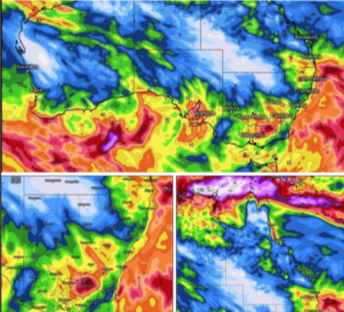
What would a rain event in NNSW and QLD do right now? depending on which forecaster you like, you will get a mixed outlook – Snodgrass was less than hopefull for that part of the world for the next month at least – but others are growing in confidence
.
Source: Under The Weather Australia
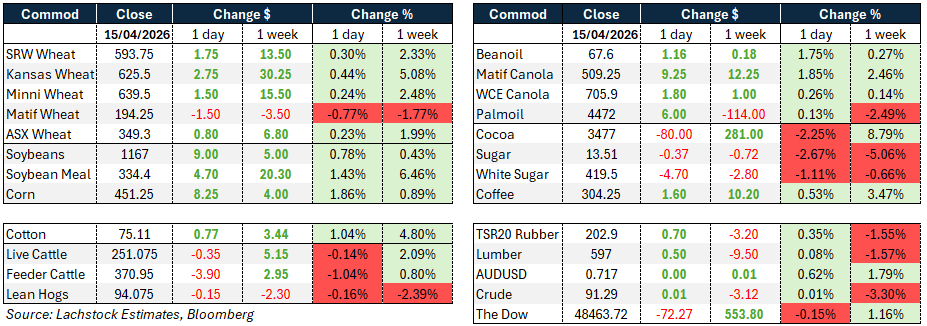
Global wheat: Chicago +4.75c, Kansas +17.25c, Matif -€0.25
Kansas City wheat was the standout performer, surging to new highs for the move before a midday reversal after the GFS model showed potential rain for the southern plains late next week.
The market recovered late when the European model proved less encouraging.
The HRW crop remains under significant stress with temperatures set to plunge through the weekend, lows reaching near zero as far south as northwest Kansas, and 68% of US winter wheat areas in drought.
The global supply picture is tightening, with the International Grain Council trimming projections and higher fertilizer costs adding pressure, while El Nino risks over summer add further uncertainty.
US wheat export sales were soft at 231,300 metric tons, landing at the low end of expectations.
On the demand side, Taiwan tendered for 106,000 tons of US milling wheat, Jordan sought 120,000 tons from optional origins, and Algeria purchased around 400,000 tons of durum.
In India, untimely rainfall, hail and cool winds have damaged an estimated 2.49 lakh hectares of rabi crops with final assessments still pending from key states.
According to northern hemisphere wires, Australia’s wheat area is forecast to shrink 7.5% to 11.5 million hectares, the smallest since 2019, while Matif slipped a quarter euro and Russian cash held around $238-239.
Other grains and oilseeds: Corn -2.75c, Soybeans -3.25c, Matif Canola +$7.50
Corn gave back yesterday’s gains, spending most of the session between the 50 and 100 day moving averages in a market that remains range-bound.
The disconnect between USDA and South American production estimates remains a key talking point, with BAGE and Rosario pegging Argentine corn at 61-67 million tons versus USDA’s 52, and CONAB at 139.5 million tons for Brazil against USDA’s 132.
US old crop corn export sales were solid at 1.4 million tons.
Soybeans continued to tread water with implied volatility at a historically low 12.05% and export sales disappointing across beans, meal and oil.
The bright spot was bean oil, surging on RIN generation data that validated low soyoil stocks from the NOPA report, which showed US crush hit a record for March at 226.2 million bushels, up 13% year to date. May crush finished at 330.75 cents.
Canola was a strong performer, gaining on soyoil spillover, firmer crude and strong Matif rapeseed gains.
Brazil’s Abiove raised its 2026 crushing forecast to a record 62.2 million tons while Malaysian palm oil eased on subdued demand and rising production expectations.
Macro: AUD 0.7160, Dow +115, Crude +3.40
The macro backdrop was dominated by Iran ceasefire developments, with Trump expressing optimism about a permanent deal ahead of the April 21 truce expiry. Trump claimed Iran had agreed to surrender nuclear ambitions and open the Strait of Hormuz, though Tehran has not publicly confirmed these concessions.
A 10-day Israel-Lebanon ceasefire was also announced.
Oil rallied on war risk before pulling back in Asian trade on peace optimism, with Brent slipping toward $98 and WTI around $93 in early Friday trade.
The Dow closed at record highs for a second consecutive session, supported by cooler than expected producer prices, better than expected jobless claims and solid bank earnings.
The Australian dollar was little changed around 71.6 US cents. IMF and World Bank delegates cautioned markets may be underestimating the war’s economic toll.
Panama Canal delays of three and a half days are emerging from war-related shipping surges, and US Agriculture Secretary Rollins indicated fertilizer prices may take a couple of months to ease.
India’s weather bureau forecast a below-average monsoon with El Nino expected to develop in the latter half of the June to September season.
Local: WA bids were softer yesterday, with canola at A$775/t current season and $806 new season, wheat at $330 and $355, and barley at $335 and $330 FIS Albany.
Through the east, canola was $745 current season and $775 new, wheat $335 and $365, and barley $315 and $328 track Geelong.
Domestic markets continue to strengthen through the east, switching off an already slow wheat export program and, somewhat counterintuitively, building carryout even in QLD and NSW.
Growers remain relatively slow sellers, particularly through Vic, where wheat is estimated to be 55–60% sold, barley 60–70%, and canola 90–95% sold.
HAVE YOUR SAY