
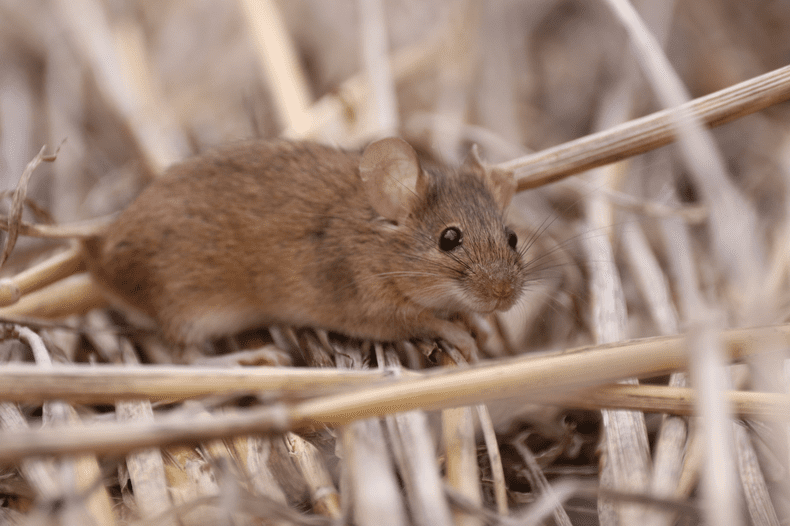
Mouse populations are doing damage in the SA and WA grainbelts, where winter-crop planting is under way. Photo: CSIRO
THE Australian Pesticides and Veterinary Medicines Authority has received an application for a permit to allow ZP50 to be used on mouse populations in South and Western Australia.
While the APVMA has not been able to divulge which entities have lodged the applications, Grain Central understands it is likely to be one with a commercial interest in selling baited grain.
The applications are understood to have come in response to booming mouse populations in the grainbelts of SA and WA, where seeding is off to a strong start ahead of Anzac Day tomorrow, traditionally seen as the opening of the planting window.
Under current APVMA ruling, only ZP25 can be administered at 25g of zinc phosphide to 1kg of wheat.
ZP50 doubles the dose, and growers in both SA and WA are being asked by representative organisations to document the success or otherwise they have had with baiting with ZP25 to date.
“The APVMA has received applications for an emergency-use permit for a higher-strength zinc phosphide product and is prioritising its assessment,” an APVMA spokesperson today said in a statement provided to Grain Central.
“As with all emergency permits, the assessment is progressing as a matter of high priority.
“Any decision will be based on a rigorous scientific assessment of safety, efficacy and trade, including consideration of impacts on human health, animals and the environment.
“The APVMA recognises that timely access to effective control options is critical in managing mice in outbreak conditions.”
Grain Producers Australia is currently working on an emergency-use permit for use of ZP50 mouse bait in both WA, as supported by two of its member organisations, WAFarmers and WA Grains Group, and SA, as well as a research permit.
Grain Producers SA last month cancelled its membership of GPA, and GPSA chief executive officer Brad Perry said SA may lodge its own application for an emergency-use ZP50 permit.
Both GPA and GPSA are working with CSIRO and the Grains Research and Development Corporation to quantify the extent of the mouse plague.
Went for a fox hunt tonight. Established that there is a pretty high level of food for them in the paddocks. Like I was astounded to see the mice numbers. pic.twitter.com/VZWJVME81s
— Leighton Wilksch (@agbyte_leet) April 9, 2026
Video showing a booming mouse population in a paddock of lentil stubble on SA’s northern Yorke Peninsula. Source: @agbyte_leet/Leighton Wilksch, Agbyte
ZP50 was last approved for use in the Australian grainbelt in May 2021, when New South Wales bore the brunt of a booming mouse population, and an extended emergency-use permit made its use legal up to December 2023.
Timing critical: GPA
In a GPA statement, Victorian grower and GPA research development and extension spokesperson Andrew Weidemann said growers needed access to ZP50 to ensure consistent control of mice.
“Mouse activity is building at a critical time for grain producers during seeding and early crop development,” Mr Weidemann said.
“Growers currently have access to ZP25, but feedback from growers and evidence from research is that this strength bait does not convert to adequate control in the paddock.
“ZP50 requires mice to consume less of the baited grains to ensure a lethal dose, which is particularly important when mice have high amounts of background food available.
“An emergency permit application supported by evidence from growers is important as we appeal to the APVMA.”
WAFarmers Grains Section president Mark Fowler said the strength of the application would depend on the quality of information coming directly from growers.
“Growers are seeing increasing mouse activity across key grain-growing regions, and there is real concern about what that means for early crop establishment, critical plant density, and grain loss later in the season,” Mr Fowler said.
“We need growers to go beyond general observations and provide specific details about what they are seeing and how current baiting is performing.
“That includes what’s happening in the paddock, what food sources are present, and whether ZP25 is achieving control.”
WA growers are being asked to submit structured information to support the application, including:
- Date of application or observed activity;
- Soil type and paddock history, including previous crop;
- Stubble levels and ground cover on harvested or bare ground;
- Estimated food availability on the ground, namely grain per m2 or equivalent;
- Mouse activity indicators, including chew card results where available;
- Any observed impacts on non-target or native animals; and,
- A comparison of control outcomes between ZP25 and ZP50 where relevant.
Concurrently, GPA is looking to prepare a research permit.
“Aside from this emergency situation, we are looking to get a research permit up in both states to look at current numbers…to get proof to say ZP50 works better,” GPA executive officer Rachael Oxborrow told Grain Central.
“Both processes are happening now,” Ms Oxborrow said.
“The long-term focus would be for a general-use permit [for ZP50] to be the standard.”
SA may apply separately
With the imprimatur of SA Primary Industries Clare Scriven, Mr Perry said GPSA has formed a working group with the Department of Primary Industries and Regions SA, or PIRSA, GRDC and CSIRO to evaluate the extent of SA’s compounding mouse problem.
“We’re trying to navigate some of the past challenges from previous applications that have been denied,” Mr Perry told Grain Central.
To ensure SA grain growers have the best chance to access ZP50 in the near term, Mr Perry said support from PIRSA may be sought to reassure APVMA that the compound would be used in accordance with the permit’s stipulations.
“To give confidence, the state regulator being PIRSA could apply.
“We’re trying to look at a way to do something differently.”
Despite some serious surges in mouse populations in pockets of the Australian grain belt in 2024 and 2025, ZP50 has not been permitted for use since 2023.
“Since then, there have been a few attempts, and nothing’s met the thresholds required by the APVMA.”
They include an unsuccessful GPA application for an emergency-use permit for use in Queensland last year,
“The APVMA is after more on-the-ground information, and GPSA has an extensive database that could support that.
“The initial feedback we got from the APVMA was that numbers hadn’t reached emergency levels in South Australia; now it’s about trying to set up as much evidence as we can.”
Producers are invited to submit their observations and data to GPA via its online survey, or via CSIRO’s MouseAlert webpage.
Grain Central: Get our free news straight to your inbox – Click here
Why is the same dead horse being flogged again? The APVMA withdrew the ZnP50 permit several years ago because the research data submitted by the CSIRO team was very inadequate and DID NOT prove efficacy at the higher application rate. I’m sure some of you were present in the National Mouse Working Party meeting when complaints were made about efficacy and the CSIRO could not justify their data. Which led to the APVMA rightfully taking action to cancel the permit. Nothing has changed. Time for the grain farmers to plan ahead and be proactive in their farm management and cropping options instead of being reactive. And no, I’m not bagging farmers – my father, grandfather & great grandfather grew grain in northern NSW and I’m on their side but time to get real & not rely so much on CSIRO who have achieved very little for the last $5 million investment via the GRDC. Time for the GRDC to put out mouse research to legitimate tender & give others a chance to show their research capabilities. Thankyou, JF