
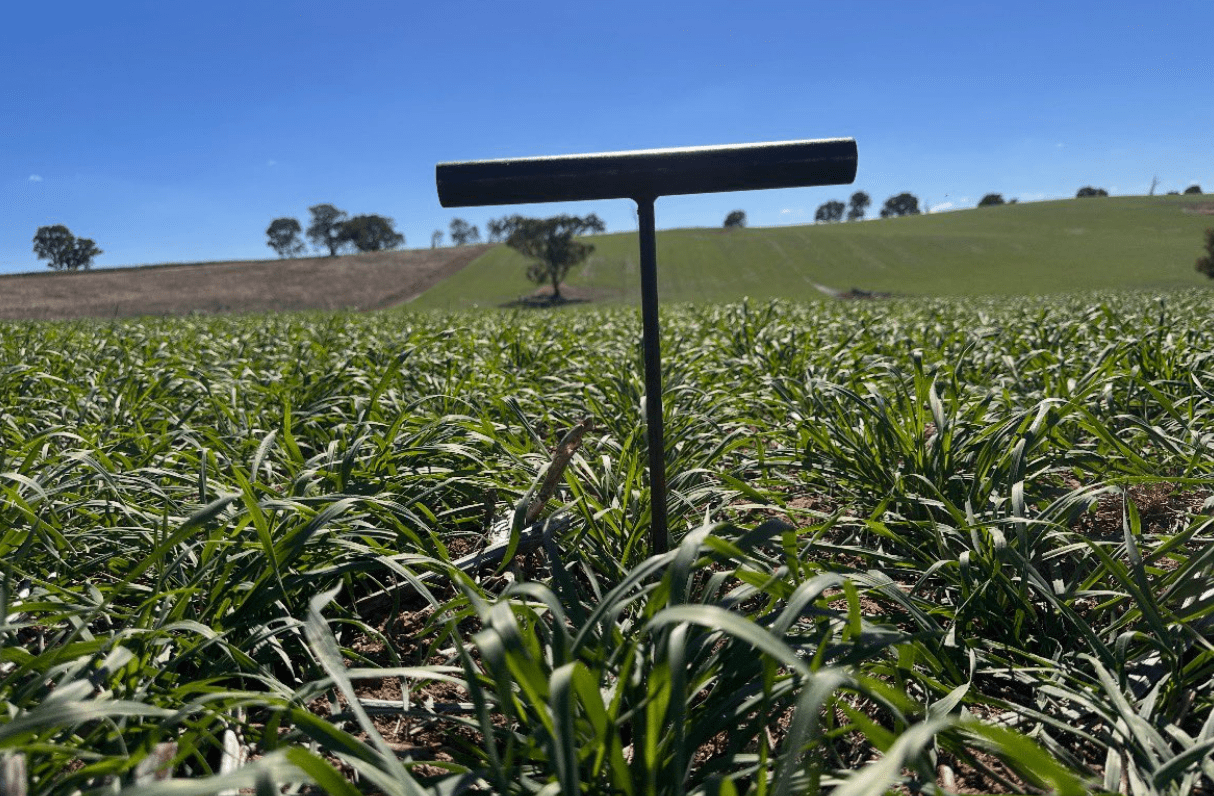
Dual-purpose Illabo wheat planted March 11-12 in the Cunningar district, and the easy push for the moisture probe as of April 20, exemplify the strong start March rain has given to the south-west slopes of NSW. Photo: Growmore Agronomy Services
AREA planted to winter crop in New South Wales could well be its smallest in years unless general rain falls in the next two weeks.
While prospects for at least 10mm of rain over the coming week have brightened for much of the NSW grainbelt, they will not be enough to spark a widespread planting in the state’s dry north.
In central NSW, rain into next week may be enough to join up topsoil and subsoil moisture, and will get planting of cereals and lupins going.
In southern NSW, where up to 30mm is on the forecast, growers are planting at pace to make the most of last month’s soaking rain, and crops on the inner slopes have gone in early and are off to a strong start.
ABARES data indicates NSW has not a winter-crop area below 5.5 million hectares since the drought years of 2017 to 2019, with 6.5Mha the average across the six seasons since.
While cereals and chickpeas can be planted into June in northern NSW, little to no subsoil moisture for vast tracts of cropping country stretching from roughly Nyngan to the Queensland border and east to the the Newell Highway are making a sizeable plant for the state’s far north-west unlikely.
Area cut in north
The Boolah Group typically crops more than 25,000ha in total of country in the Gunnedah and Pallamallawa districts, and east and west of the Newell Highway at Bellata.
Boolah chief executive officer Stuart Tighe said canola has already been dropped from the rotation because of the dry conditions, but barley and faba beans are being planted, and wheat is expected to follow.
“There’ll be no canola this year; we’ve missed that boat,” Mr Tighe said.
“We’ve got faba beans in really deep, and we’re dry sowing barley; we’re doing it where the moisture’s not too far away.”
While dry sowing is not common on heavier soils, Mr Tighe said Boolah was putting barley into dry topsoil in its Pallamallawa country, and east of the Newell at Bellata, where just 25mm of rain would get the crop going and into subsoil moisture.
“We’ve only got some country that’s got a pretty good profile.”
“Only 60 percent of our program will go in this year.”
Winter cropped area will not include Gunnedah, where conditions are shockingly dry.
“We won’t be sowing down there.”
Faba beans in Boolah country east of the Newell Highway are being planted at around 15cm, roughly double the normal depth, as has been successfully done in previous years when topsoil is dry.
Boolah’s urea needed for this year was secured prior to the urea squeeze caused by the cessation of exports from the Persian Gulf, and dryness rather than the urea situation are responsible for Boolah’s drop in intended winter-crop area this season.
“We had ours in the shed or in the ground already for winter and summer crop.”
On the hop in central NSW
At Tullamore, Mark Mortimer and family crop around 1600ha, including area for their commercial and Centre Plus Merino flocks.
They normally grow barley, canola, lupins, oats, and wheat, with canola and cereals having potential for dual-purpose use, and lupins grown for feed.
Ahead of rain forecast into next week, Mr Mortimer has halted his dry-sowing program after two paddocks of oats got 5mm of rain and a germination so patchy it may require resowing.
“That 5mm was just enough for it to put out a shoot and that was about it,” Mr Mortimer said.
His heavier country has subsoil moisture at a depth of about 40cm.
“In the red-soil paddocks, there is none.”
He said paddocks initially slated for canola may now go into wheat, but if rain in coming days comes in at closer to 10mm rather than 20mm, barley or oats may be a safer option.
“On lupins, I’ve only got two weeks and then I’ll pull the pin on them; it might be more barley and oats.”
Could do with a bit of moisture. pic.twitter.com/bYUY33uu7x
— Mark Mortimer (@sheepGeekCP) April 26, 2026
Mr Mortimer has been feeding his sheep on export-quality hay bought from a neighbour, and grain harvested last year that he has stored on farm.
“As I feed out more and more grain, I know I’ve got to replace it with something.”
With follow-up, the forecast rain could make for a reasonable season.
“I’m not sowing before this rain; with those two paddocks of oats, I’ve been burnt already.”
Sheep are the bright spot on the Mortimers’ landscape, and maximum 16-micron wool from their lambs being shorn this week is expected to fetch well in excess of 2000c/kg in the rallying market.
Mr Mortimer said traffic through the Tullamore district shows the contrast between the northern and southern season.
“Here in our little town, we can see it; there are non-stop cattle trucks going south, and non-stop hay trucks going north.”
Southern plans intact
At Henty on the southern slopes, Kellie Penfold and husband Rohan Bahr are in the middle of planting around 1200ha in their operation which runs sheep, so has dual-purpose as well as cash crops.
“We’ve finished canola, and we’re sowing vetch this week,” Ms Penfold said.
“We’re doing vetch instead of faba beans and lupins.
“Vetch you can turn into hay, or if you get late spring rain, you can take it through to harvest.
“We’re going to start barley next week.”
Anzac Day is traditionally the start date for sowing in NSW, but Ms Penfold said they got started early to make the most of last month’s soaking rain.
“Everyone’s saying it’s the earliest we’ve ever sown.
“We started with a full moisture profile, and if we get rain in the next week, it’ll set us up nicely.”
The couple also produce barley straw, and after selling it into the Kiewa Valley when feed was limited in north-east Victoria last year, they are now directing it into the Hunter Valley of NSW as conditions in the state’s north deteriorate.
They have all the fertiliser they need for planting “plus a bit”, and being roughly equidistant to Port Kembla and Geelong, feel comfortable about being able to source what they may need for top-dressing.
Grain Central: Get our free news straight to your inbox – Click here
HAVE YOUR SAY