

Finance Minister Katy Gallagher, Prime Minister Anthony Albanese and Treasurer Jim Chalmers with Budget 2026-27 summaries.
THE FEDERAL Government’s 2026-27 Budget has been met with a broadly positive response from agricultural groups after it exempted farmers from new trust tax reforms and ruled out changes to small business capital gains tax concessions.
There was also a welcome additional investment in the Australian Pesticides and Veterinary Medicines Authority of $8.7 million and a $387M boost to CSIRO and the Australian Centre for Disease Preparedness.
However, organisations have raised concerns about cuts to regional infrastructure, particularly Inland Rail, connectivity programs, and the Department of Agriculture, Fisheries and Forestry.
Mixed bag for DAFF
Budget documents show total DAFF resourcing will rise to $1.77 billion in 2026-27, more than $70M above 2025-26 levels.
Annual appropriations are also set to increase to $1.02B from $953.14M.
DAFF staffing is expected to increase in 2026-27, with employee numbers forecast to rise to 6654 from an estimated 6373 in 2025-26.
Despite the overall increase in funding, several programs that received support in the previous financial year appear to have been omitted from the latest budget.
These include:
- Agriculture 2030 biosecurity program, which received $5.77M last year for feral animal, pest and weed management;
- Improved Access to Agricultural and Veterinary Chemicals program, funded at $3.5M;
- Cultivating Australia’s Traceability – Promoting and Protecting Australian Premium Agriculture, which received $6.65M; and,
- Modernising Agricultural Trade – Protecting Australia’s Clean, Green Brand, funded at $2M.
The AGCAREERSTART and AgConnections programs also did not receive further appropriations after receiving $411,000 and $500,000 respectively last year.
The government has also touted just under $200M in savings to DAFF spending over five years from 2025-26, driven by a range of measures including:
- $104.6M from reducing uncommitted funding in a number of grant programs, including the Pest and Disease Preparedness and Response, Wine Tourism and Cellar Door, Agriculture and Land Sectors – low emissions future, Accelerated Adoption of Wood Processing Innovation, Support for Regional Trade Events, Empowering Australia – developing Australia’s seaweed farming and other trade‑related grant programs
- $52M over four years from 2026-27 and $13M per year ongoing by reducing uncommitted funding for the Future Drought Fund; and,
- $35M over two years from 2028-29 and $17.5M per year ongoing by reducing funding for the agriculture stream of the Natural Heritage Trust.
NFF sees positives with concerns
The National Farmers Federation welcomed changes ensuring primary production income will be exempt from the new 30 percent trust tax and confirmation there will be no changes to small business capital gains tax concessions.
“There are around 40,000 trusts used in agriculture so these are significant wins for family farm businesses and reflect the case we have consistently put to the Treasurer about how these changes would impacted succession,” NFF president Hamish McIntyre said.
“Family farms are generational businesses built over decades and often represent a family’s life savings and retirement plan.
“We are pleased the government has listened.”
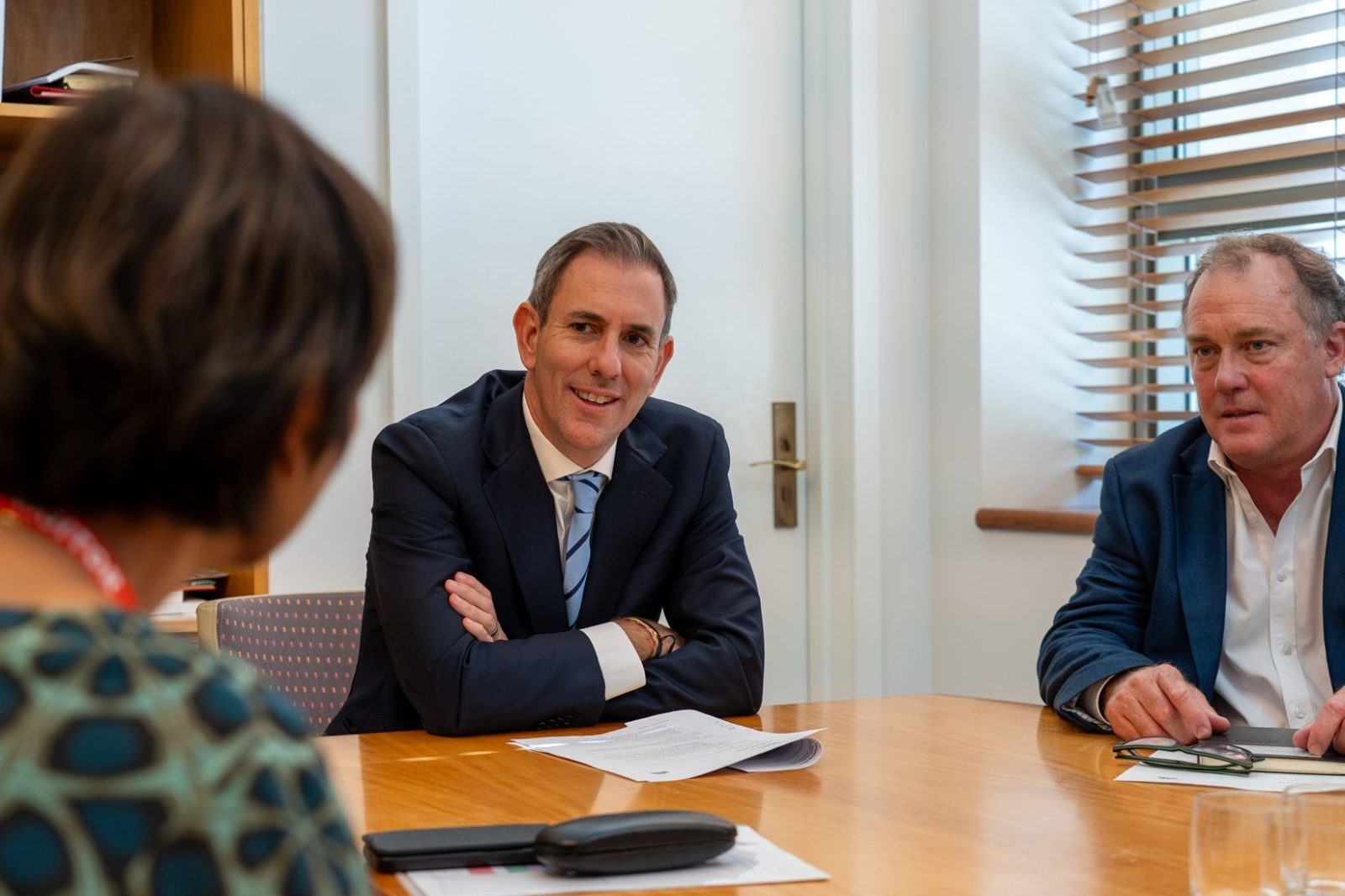
NFF president Hamish McIntyre (right) in a meeting with Treasurer Jim Chalmers and others at Parliament House in March.
Mr McIntyre also welcomed the government’s $10B fuel security package announced last week, designed to improve domestic fuel and fertiliser resilience with an emphasis on reducing the risk of supply shocks for essential users, including regional and agricultural industries.
The permanent extension of the instant asset write-off was also welcomed, providing certainty for farm businesses looking to invest in equipment and technology.
“We advocated hard for this to become a permanent feature of our tax system. It’s a simple and effective measure that helps farmers reduce costs and increase their productivity.”
The NFF also welcomed additional resourcing for implementing EPBC reforms with a focus on establishing new entities (National Environmental Protection Agency and Environmental Information Australia) and improving assessment timeframes.
However, Mr McIntyre said the NFF still required clarity on how this funding will support the difficult transition agriculture is experiencing under changes to continuous use provisions for agriculture.
“Farmers need clarity and consistency, particularly around changes to continuing use provisions.
“We’ll continue working closely with the Government to ensure these reforms deliver environmental outcomes without creating uncertainty or unnecessary compliance burdens for producers.”
The NFF has raised concerns about sweeping cuts across key areas impacting agriculture.
This includes DAFF, pests and weeds, Inland Rail Project and regional connectivity including the Regional Tech Hub.
“There could not be a worse time to pull back investment in supply chains and regional connectivity.
“The Inland Rail was designed to strengthen supply chains, ease pressure on our highways and reduce the cost of moving produce from farm gate to consumers.
“The Regional Tech Hub helped more than 75 regional people each day in 2025 alone.
“Without continued support for this service, regional Australians may lose a trusted service that has helped thousands navigate major technology changes and stay connected.
“This Budget contains some hard-won wins for agriculture, and we welcome them. We’ve had the opportunity to be at the centre of some of the most important discussions of this generation, around fuel and fertiliser supply and capability.
“But if Australia is serious about building a stronger, more productive economy, this must be the starting point, not the finish line.”
GrainGrowers, BA: Hope for LCLF
Industry body GrainGrowers supported the commitment by Treasurer Jim Chalmers in the budget speech to develop demand-side measures targeting the development of a low-carbon liquid fuels industry.
Although these measures weren’t explicitly detailed in the speech or budget documents, it does set a signal that this is a priority for the government.
“We’ll produce more fuel through our $1.1B Cleaner Fuels Program, backed with reforms to our low carbon liquid fuels market to support demand,” Mr Chalmers said.
GrainGrowers chief executive officer Shona Gawel said this was a “move in the right direction”.
“Long-term policy certainty for industry and investors is critical to help accelerate the growth of Australia’s low carbon liquid fuel sector,” Ms Gawel said.
“Expanding domestic processing and fuel production would provide an opportunity to retain more value, investment and strategic capability within Australia.
“Recent global disruptions have demonstrated how exposed Australia remains to international fuel shocks.
“GrainGrowers will continue to work with government and industry to ensure the interests of Australian grain growers, who produce a proven, scalable feedstock, are represented as this work progresses.”
Peak body Bioenergy Australia and Low Carbon Fuels Alliance of Australia and New Zealand (LCFAANZ) also saw this as a positive sign that demand-side measures were closer than ever to becoming legislation.
“This commitment represents positive progress for developing Australia’s homegrown low-carbon fuel industry and enhancing our energy security,” founder of the LCFAANZ and CEO of Bioenergy Australia Shahana McKenzie said.
“We welcome the Government’s commitment to work with industry in the design and development of this demand market measure and encourage the Government to move quickly.
“The Government has been consulting on the design of a demand side measure for over 12 months.
“It is time to fast track the work already done so that we can realise the benefits of increasing low carbon fuels into the fuel system now and into the future.”
GPA: Signals recognition for ag
Grain Producers Australia has outlined the key impacts of last night’s Budget on the grains sector, and has welcomed fuel security now being recognised as a national priority.
“This Budget reinforces that food production, fuel security and national resilience are becoming increasingly interconnected priorities for Australia,” GPA chair and Western Australian grower Barry Large said.
“For grain growers, that recognition matters because a strong grains indusry underpins regional communities, export earnings and the nation’s long-term food security.”
Government expenditure in fuel-security measures such as expanded diesel reserves, storage infrastructure and broader sovereign supply chain resilience initiatives have been welcomed by GPA.
So too are continued investment incentives, including instant asset write-offs, which assist ongoing outlays on machinery, storage, technology and operational efficiency at a time of rising production costs and tighter margins.
CropLife: More APVMA funds welcomed
As the national peak body for plant science, CropLife welcomed the announcement for an additional funding package for the APVMA.
CropLife Australia CEO Matthew Cossey said the funding was earmarked to bolster the Authority’s capacity to deliver its good public activities in support of the tens of millions of dollars that industry already provides and comes at a critical time to support an important regulator for the nation’s farming sector.
“We have long advocated for this support and welcome the Government’s recognition of the importance of investing in the public-good work of APVMA in line with all other regulators,” Mr Cossey said.
“I specifically commend Minister Julie Collins and Assistant Minister Anthony Chisholm for their commitment, leadership and hard work in trying to improve the performance of the APVMA.
“It’s now on the APVMA Board and Management to see real and genuine improvement in the APVMA’s operations and meeting its statutory time performance.”
NSW Farmers: ‘Practical productivity’ needed
NSW Farmers president Xavier Martin has urged the Australian Government to embrace primary production following the Treasurer’s Budget speech.
Mr Martin said Mr Chalmers mentioned “productivity” 19 times as he handed down the 2026-27 federal budget, talking about making the economy more productive.
“The people who grow the healthy plants and animals that literally feed and clothe our nation are ready to pull on their boots and get to work, but we need government to put in place policies and funding that unlocks that productivity,” Mr Martin said.
Mr Martin said while the Budget contained some positives such as the Instant Asset Write Off being made permanent, big questions remained about agricultural workforces, tax settings and where funding from productive investments such as Inland Rail has gone.
“These papers are very fresh and very dense, so the detail on capital gains and trusts needs to be worked through.
“But the government must remember farm businesses operate on razor thin margins, so we need an iron-clad guarantee that farming businesses and the critical issue of succession planning – the next generation of farmers – are also recognised.”
Source: Australian Government, GrainGrowers, GPA, NFF, CropLife, NSWFarmers, Bioenergy Australia
HAVE YOUR SAY