
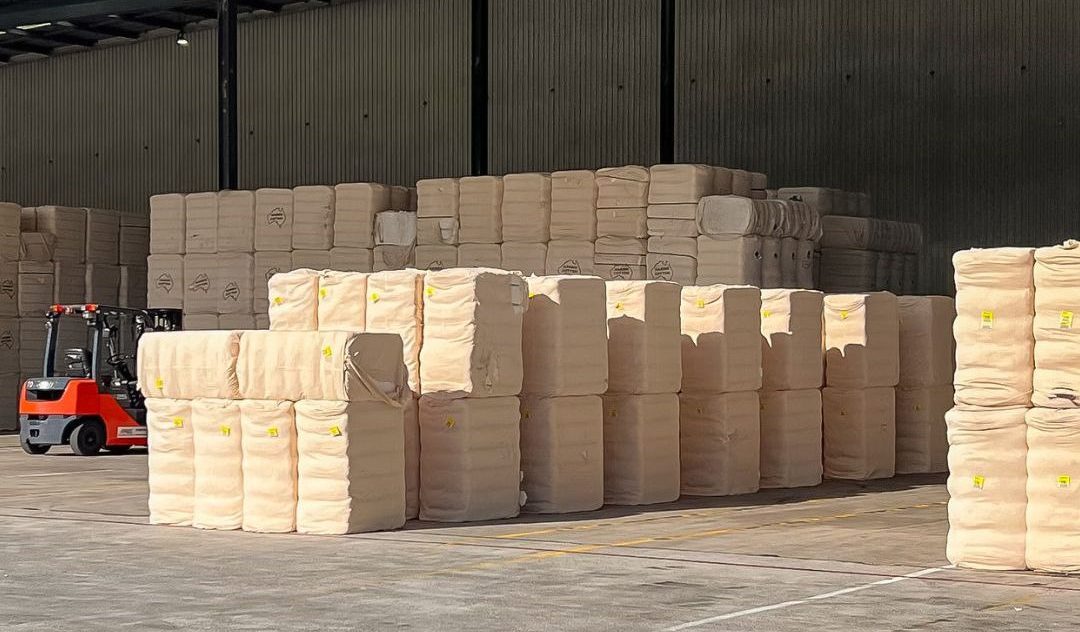
Ginned cotton ready to be transported for packing into containers for export. Photo: Hailie Dupikov via ACSA
THE 2025-26 cotton crop is showing early signs of high quality and standout fibre strength, with about 15 percent of the crop through ginning and 10pc through classing, according to industry estimates.
Pickers are estimated to be more than 80pc through the crop, while almost all gins are up and running.
Production appears on track to meet expectations of a 4.3-million-bale crop, well below the 2024-25 total of more than 5Mb.
Australian Cotton Shippers Association chair and ADM Trading Australia cotton manager Arthur Spellson said it had been “a very quick harvest” due to the dry finish with “solid” yields reported.
“I wouldn’t say we’ve had record yields; there have been some outstanding yields, but in general, averages have been around 12-14 bales per hectare,” Mr Spellson told a recent ACSA webinar.
“Shipping has started, it’s starting to pick up pace and, as we’ll see, we normally peak in about June-July but we’re starting to ramp up at the moment.”
Mr Spellson said the industry has been pleased with the early classing reports which would see results return to more “normal” levels after poor 2024 and 2025 crops.
“From a grade perspective, it probably is indicative of what we’re going to see for the rest of the crop, where we’ve got around 90 percent of the crop that’s Strict Middling colour and better.
“So, a big contrast from last year and the year before, where…we had only around 20pc of the crop that was Strict Middling colour and better.
“It’s good to see us back to what most of us would regard as a bit more normal in terms of grade, with having a very high percentage of the crop as high grade.”
He said staple length was as expected at “more than 90pc of the crop [at] 37 staple and longer”.
Mr Spellson said early signs were crop strength would be a “standout this year”.
“We’re seeing…more than 50pc of the crop is 32 grams per tex and stronger.
“Looking at it historically…the last five or six years, this is the largest percentage that we’ve had over 32g/tex.”
He said plant breeders had been enlisted by industry to help improve fibre strength.
“It’s not an easy thing to improve without sacrificing yield, so it’s great to see that we’ve made those really good strides in the strength of our fibre.”
China dominates, India in doubt
Mr Spellson said the 2025 crop saw “a pretty good spread on markets”, with 29pc of production exported to China and 19pc each to Vietnam and India.
He said that was a “a significant uptick for India in terms of market share” and “was largely driven by the removal of the 11pc import duty on cotton in India last year”.
He said there was also “healthy exports” to Bangladesh, Malaysia, Pakistan, and Thailand.
In terms of shipping, Mr Spellson said there was a “big uptick” in September and October last year, later than the general peak period, largely due to “a rush to get cotton into India before the duty came back on if cotton arrived after December 31”.
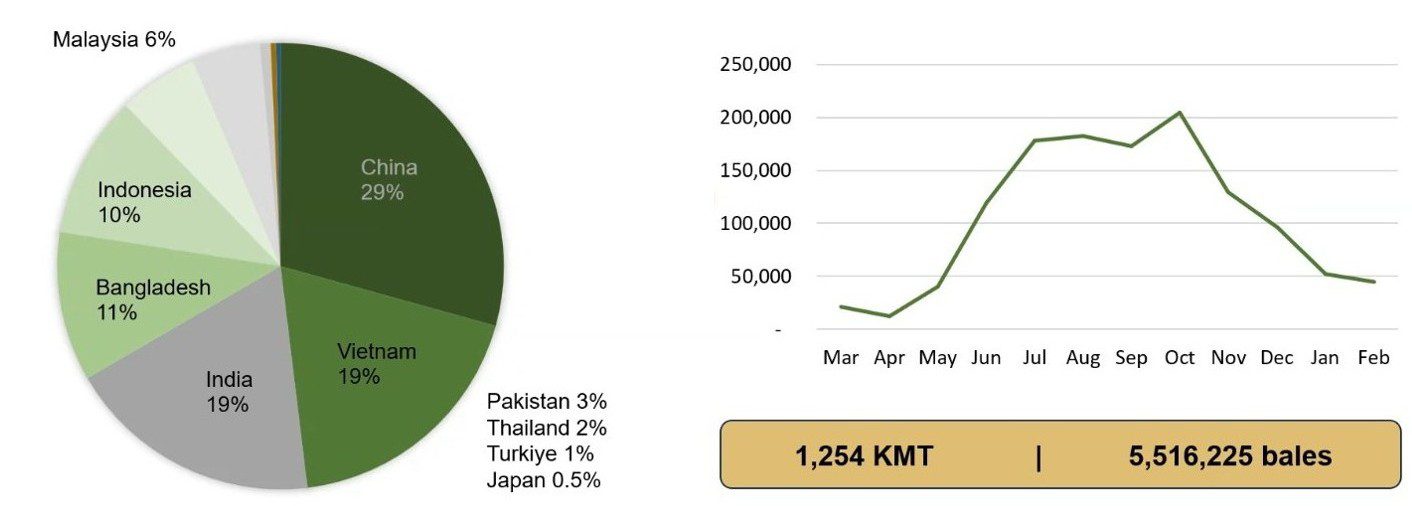
Cotton exports for the 2025 marketing year. Source: ACSA, Arthur Spellson
He said the only data for the 2026 marketing year was for March, and it was predominantly old-crop cotton “held back and shipped in March”.
The data shows cotton mainly going to Vietnam, Malaysia, Indonesia, China, and Bangladesh.
“Looking forward and in terms of where our crop will go in 2026, China has been a solid buyer up till now, and we have seen good early sales to China.
“A lot of the talk at the moment…is around geopolitics.
“We’ve obviously got the war in Iran, affecting some trade flows and everyone’s waiting with waited breath to see what happens with the meeting between the US and China…to see what happens in terms of tariffs and any changes to trade between the US and China.”
Mr Spellson said there was also calls for the Indian government to again remove the import duty with any policy change likely to affect imports into the country.
“Some sectors of the industry in India are pushing for that already.
“Time will tell as to whether that happens again in terms of that duty being removed.
“We’re hoping it is removed, to be honest, but we’ll wait and see if that happens.”
Outlook for 2027
The outlook for the 2027 crop remains closely tied to water storage levels in the Murray-Darling Basin, given an estimated 80-90pc of production relies on irrigation.
Mr Spellson said if there weren’t significant flows into the catchments between now and planting, it was estimated that the crop would be about 3Mb.
“Some of these areas are getting quite depleted and the water in storage across the Murray-Darling Basin, across all of these reservoirs is down to around 45pc.
“The outlook, it can change and what it will take is significant rains over winter, but, unfortunately, the current outlook is not for above average rainfall.
“So that doesn’t augur too well for the crop getting much bigger than the current forecast for 2027.
“In Australia, we tend to have these ebbs and flows in our crop, depending on water availability.”
Grain Central: Get our free news straight to your inbox – Click here
HAVE YOUR SAY