
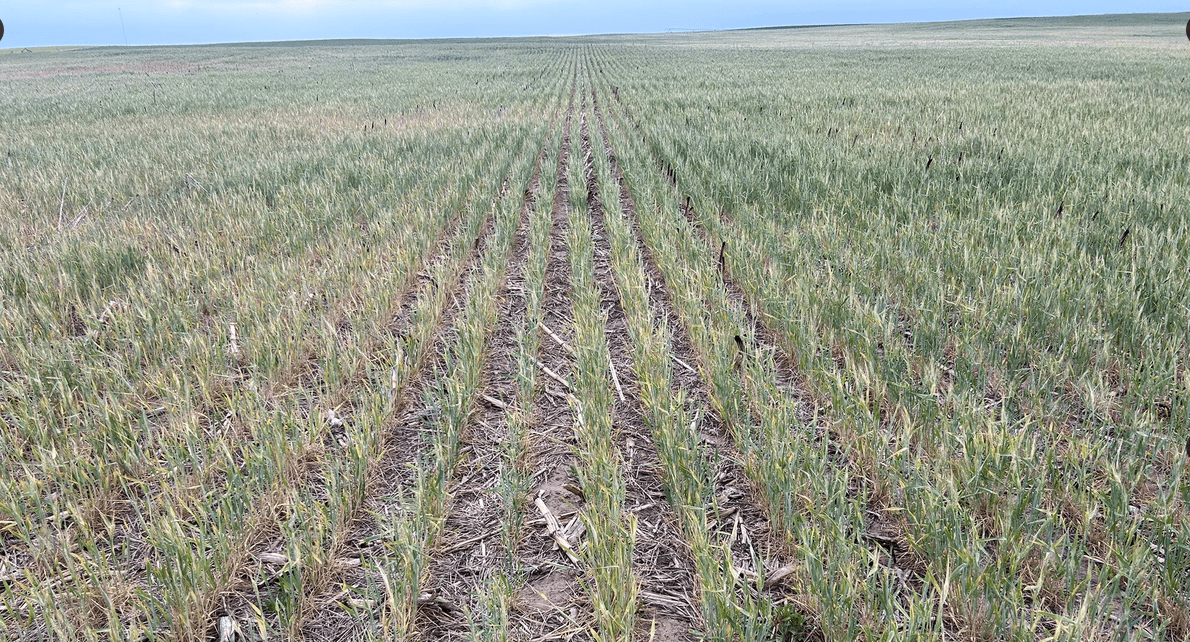
A troubled season for US Hard Red Wheat areas means HRW production is seen at its smallest since 1957. Photo: Alex Millershaski, Grey County, Kansas
THE United States Department of Agriculture took its first stab at production and consumption estimates for the 2026-27 marketing year to June in the May edition of the World Agricultural Supply and Demand Estimates, released last Tuesday.
The global wheat outlook for the new-crop season revealed a sizeable drop in supplies, marginally lower consumption, reduced trade, and decreased ending stocks compared with the 2025-26 marketing year. Worldwide wheat production is pegged at 819.1 million tonnes (Mt), 2.9 percent, or 24.7Mt lower than output in the current season. A significant proportion of the lower production is across the major wheat exporting countries, with the US, EU, Argentina, and Australia accounting for the largest reductions.
Lower supply all majors
The US harvest projection of 42.5Mt is 11.5Mt lower than last year’s harvest of 54Mt. One of the biggest surprises was the decline in harvested area from 15.1 million hectares (Mha) to 13.3Mha, with the abandonment rate rising from 25pc last year to 32pc this year. Persistent environmental challenges on the Plains are the primary driver, with the ongoing drought leaving a clear mark on the US balance sheet. At just 14Mt, the Hard Red Winter wheat estimate is down 7.9Mt year on year, making it the smallest HRW crop since 1957.
The EU crop has been trimmed by 9.1Mt from 145.1Mt in 2025-26 to 136Mt in 2026-27, but still 1pc above the five-year average. The declines are primarily in the Balkans, central Europe and the Baltics, but after a dry spring, rains this month have brought relief in many regions, reducing the risk of widespread yield losses this season.
A decrease in planted area and a normalisation of yields are expected to push Argentina’s wheat production down from a record of 27.9Mt last harvest to 21Mt this year. This is in line with the Buenos Aires Grain Exchange forecast of 21.3Mt, but above the 18-19Mt range provided by the Rosario Grain Exchange.
While planting of Australia’s winter crops is well advanced in many regions, dry conditions persist throughout southern Queensland, northern New South Wales and parts of Western Australia. After a run of poor seasons, the rains have returned to South Australia, boosting that state’s production outlook. The increased cost of fuel and uncertainty around fertiliser supplies later in the crop year are added challenges, which collectively are expected to lead to a decrease in the planted area and a fall in production from 36Mt last harvest to 30Mt at the end of 2026.
Wheat output in the Black Sea region is also forecast to fall, with the Russian crop decreased from 90.3Mt in 2025 to 86Mt, the Ukrainian harvest projection 1.1Mt lower at 23Mt, as well as 2Mt and 1Mt trimmed from output projections in Romania and Bulgaria respectively. The Russian crop comprises 61Mt of winter wheat, down from 63Mt last year, and 25Mt of spring wheat, down from 27.3Mt in 2025.
The USDA has pencilled Canada in for 35Mt of wheat in 2026-27, down from a record 40Mt this season. A 1pc decrease in the seeded area, coupled with a return to a more average yield projection, is behind the decrease. Seeding operations in most regions are gaining traction after a slow start to the season. Most of the country’s cropping districts received normal to well-above-normal precipitation in April, easing concerns in drought-affected areas across the south of Alberta and Saskatchewan.C
China on top for demand
On the demand side of the equation, the global wheat consumption forecast is almost unchanged at 823.2Mt in 2026-27, compared to 823.5Mt in 2025-26. Feed and residual demand is expected to drop in China, the EU, Russia, and Kazakhstan, partially offset by an increase in India. Food, seed, and industrial consumption is forecast to increase, much of it in India on the back of population growth and a very hungry public distribution system.
China remains the largest global consumer, although the USDA has the quantity 2Mt lower season on season at 148Mt. The EU is next at 113.8Mt, down from 115.5Mt in the current marketing year, followed by India at 111.1Mt, up from 107.7Mt in 2025-26, and Russia at 40.2Mt, down from 41.7Mt this season.
Decline in trade seen
Global wheat trade in the 2026-27 marketing year is projected to decline by 12Mt to 211.7Mt, primarily in the wake of lower import demand from North Africa and the Middle East. Imports by Morocco, Türkiye, Iran, Syria, Uzbekistan, Algeria, and the UK are expected to decline following significant rebounds in local production. Indonesia and Egypt are tied as the world’s largest wheat importers, with forecasts of 12.5Mt apiece.
Russia is expected to retain its mantle as the world’s largest exporter, followed by the EU, Canada, Australia, and the US. The USDA’s Russian export forecast of 47Mt is 1Mt higher than the current season, despite the 4.3Mt drop in production, with a 3.1Mt increase in opening stocks cushioning the supply equation.
The same scenario applies to the EU. Exports were bumped 500,000t higher, despite the harvest decrease, with a 5.6Mt increase in opening stocks maintaining a relatively stable supply scenario for the 2026-27 marketing year. The USDA has Australia slated for 23Mt of wheat exports next season, down from 26Mt this season, a fair assumption at this point in the cycle given the lower production outlook and buoyant domestic demand.
With the North American wheat supply scenario 16.5Mt to the worse season on season, and opening stock only 3.9Mt higher, it is quite surprising to see the USDA reduce exports by only 5.7Mt for Canada and the US combined. The Canadian task in 2026-27 is 28Mt, compared to 30Mt in the current marketing year, while the US program is 21.7Mt, compared to 24.8Mt.
Global wheat stocks at the end of the 2026-27 marketing year are forecast at 275Mt, down from 279.2Mt at the end of the current marketing year, and well below the recent peak of 299.4Mt in 2019-20. However, the drawdown is far more pronounced among the eight major exporters, falling from 77.7Mt at the end of next month to 65.8Mt on June 30 next year, but still well above 2019/20 ending stocks of 59.5Mt for the same group. The biggest decrease occurs in the US, with demand outstripping supply by 4.7Mt across the 2026-27 season.
HAVE YOUR SAY