
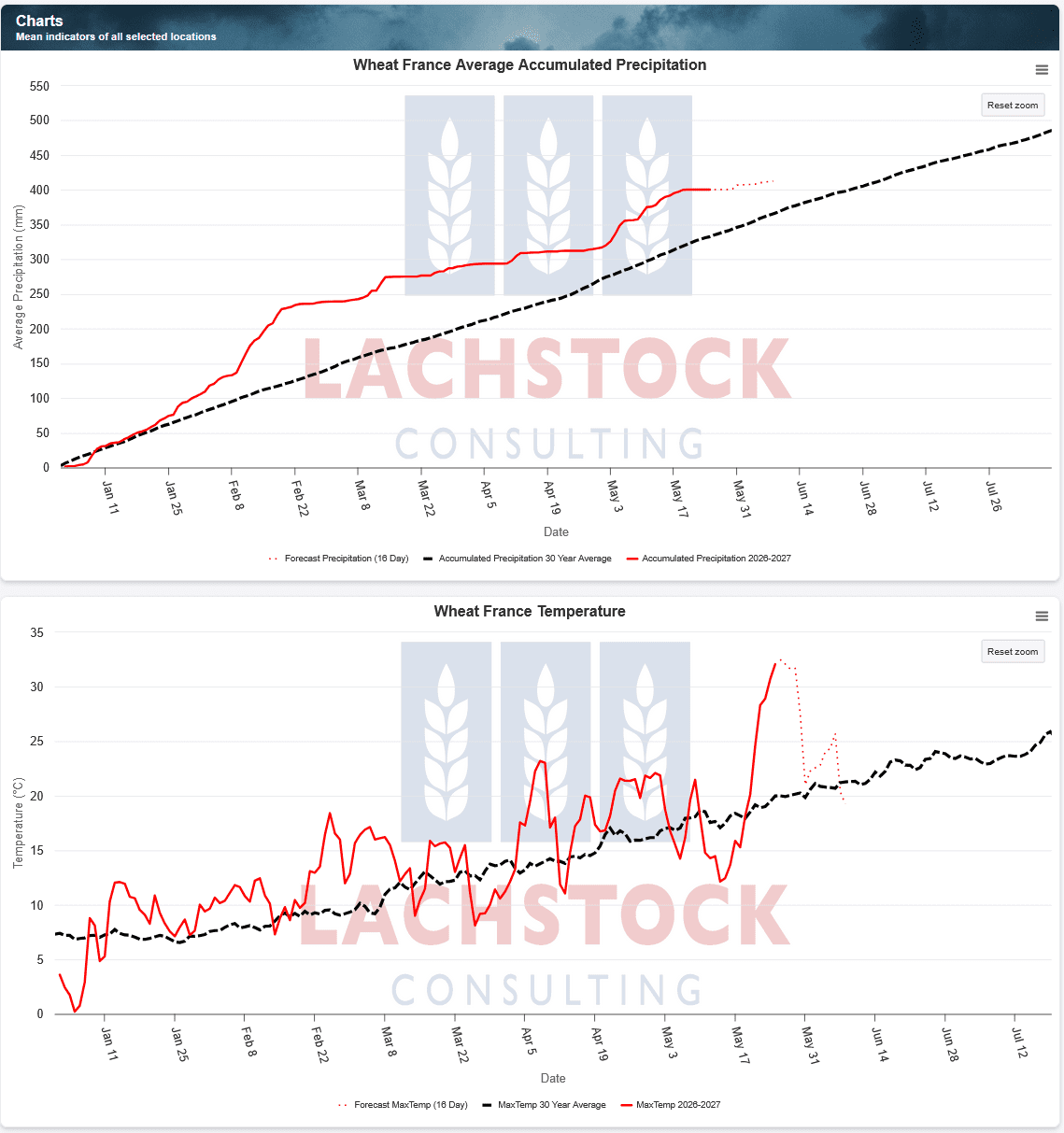
 Weather: French temps getting some attention – should have enough moisture underneath it to avoid damage but one to watch, especially given Matif v Chicago is at decile 3.
BOM showing a bunch of rain for the whole east coast, including SA.
Warm and wet through Canada.
Markets
Donald gives the energy market some comfort with a timeline and optimism that the end is near. If this gets solved the Strait of Hormuz will look like a Daytona start line with over 150 vessels estimated to still be in the actual strait.
Global wheat markets need a catalyst – I feel like we have traded the HRW crop, traded the Iran conflict, and traded the China trade deal – both sides of the market need something to grab hold of. Interesting to see the Ruble strength driving Russian FOB values.
Day Ahead – Australia
Feels like we have been trading these fundamentals for weeks – patchy rain coupled with a decent forecast, lack of export demand but “Super El Niño” mentioned more than CGT.
Looks like someone had another crack at taking out Donald – it’s unbelievable to think that the markets are getting used to these events.
Sideways for me today.
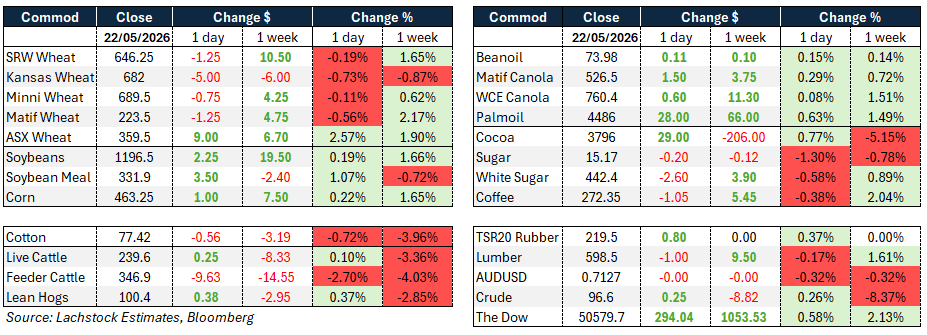
 Global wheat: Chicago -1.25c (-0.19%), Kansas -5.00c (-0.73%), Matif -1.25 (-0.56%)
A two-sided session saw wheat markets finish softer heading into the Memorial Day long weekend.
Chicago dropped 1.25c, Kansas shed 5c, and Matif eased €1.25, while Minneapolis slipped only fractionally.
Markets were initially pressured overnight after Argentina announced a reduction in wheat export taxes from 7.5 percent to 5.5pc effective June 2026, though prices recovered as the day session approached.
The session was broadly balanced, with weather concerns across multiple origins keeping a floor under prices.
Heat moving into Europe, excessively cold and wet conditions stalling Canadian seeding by weeks, and the need for Russian wheat areas to dry out were all noted, while potential El Niño consequences for Australia remained in the background.
Russian wheat prices hit a one-year high as a soaring ruble incentivised farmers to hold back sales, and Russian cash prices edged up US$1/t to $245.
On the demand side, Germany secured a phytosanitary agreement with Indonesia opening access to one of the world’s largest wheat import markets at roughly 11 million tonnes (Mt) per year.
Russia’s grain export forecast for the 2025/26 season was confirmed at 60Mt, while SovEcon flagged a sharp jump in Ukrainian wheat exports for 2026/27 to 21.2Mt, up from 13.2Mt, which could weigh on the market going forward.
France’s soft wheat crop condition held steady at 80pc good-to-very-good as of May 18, above last year’s 71pc.
The EU also moved to suspend customs tariffs on key nitrogen fertilisers for one year.
Other grains and oilseeds: Corn +1.00c (+0.22%), Soybeans +2.25c (+0.19%), Matif Canola +1.50 (+0.29%)
Corn and beans took a similarly cautious approach into the long weekend, finishing with modest gains after a two-sided session.
Corn added 1c in the July and 1.5c in the December, supported early by a USDA-confirmed daily sale of 493,700t to Mexico split across old and new crop, with an additional 110,000t sold to unknown destinations.
The prior week’s export inspections figure of 2.1Mt old crop also provided a constructive backdrop.
Argentina’s broader export tax reduction — including a cut on soybeans beginning January 2027 — was digested but did little to derail the session given China remains the dominant focus.
South Korea’s MFG and Nonghyup Feed purchased a combined estimated 203,000t feed corn through tender and private deal.
Soybeans firmed modestly, with nearby meal setting the pace after a daily sale of 252,000t to unknown destinations. July crush settled up 6.75c to 347.5. Bean oil continued to find support from the biofuel mandate, with the Australian government also flagging consultation on introducing domestic biofuel mandates.
The National Corn Growers Association noted that rising fertiliser and diesel costs have corn farmers losing around $100 per acre, with university crop budgets continuing to show negative returns for corn in Illinois while soybeans turned positive.
ICE canola finished narrowly mixed, with the front July contract settling just above its 20-day moving average as large old crop supplies capped gains, though seeding delays on the Canadian Prairies and strength in Chicago soy underpinned new crop.
Agriculture and Agri-Food Canada raised its 2026/27 canola ending stocks projection to 1.319Mt from 1.064Mt, while the 2025/26 carryout tightened slightly. Weekly canola exports came in at 247,500t, up sharply from 161,400t the prior week.
Macro: AUD 0.7160 (-0.32%), Dow +294.04 (+0.58%), Crude +0.25 (+0.26%)
The dominant macro theme heading into the weekend was the unresolved situation in the Middle East, with crude oil acting as the key barometer for the broader commodities complex.
Negotiations between the US and Iran over reopening the Strait of Hormuz were described as “95pc there” by officials, though meaningful sticking points remain — including enrichment limits, the disposal of highly enriched uranium, treatment of frozen assets, and the language around Iran’s nuclear stockpile.
President Trump indicated he did not want to rush a deal, with talks potentially extending several more days.
Regional players including the UAE, Saudi Arabia, and Qatar have urged Trump to give negotiations a chance, while Pakistan’s army chief travelled to Tehran signalling some diplomatic progress.
The broader risk is that a failure to reach agreement tightens oil supply sharply into the US summer driving season, with cascading effects across the commodities complex.
On the US economy, the final University of Michigan Consumer Sentiment Index for May fell to a fresh record low across the survey’s 70-plus-year history, dropping to 44.8 from 48.2, with both expectations and current conditions components also hitting record lows.
Federal Reserve Governor Waller, considered among the more dovish FOMC members, signalled he now supports removing the committee’s easing bias and can no longer rule out rate hikes, citing a more stable labour market and lingering inflation concerns — a notable broadening of hawkish sentiment beyond the regional presidents.
The overarching theme across the grain and oilseed complex remains China as the prospective catalyst, but toxic seasonals, crude volatility, and position nervousness ahead of the weekend are making it difficult to hold length in any direction.
Local markets: WA bids ended the week softer for cereals and steady for canola. Current season canola was bid A$815/t and new crop $850, wheat was $3 softer $355 and $373, barley was $342 and $341 FIS Albany.
In the east of the country softer across the board with canola $770 for current season and $810 for new, wheat was $341 and $365, barley $312 and $326 track Geelong.
More rainfall over the weekend with most cropping regions of SA recording between 5–20mm. The next week looks more promising for the entire country with 25–50mm forecast for most regions, including the areas that need it most through NSW, SQLD and WA. Seeding pressure has largely eased through the south although too much rain through parts of NSW and QLD could start to create some planting delays for later programs.
Northern feedlots are now well covered particularly for wheat with most out to September, throw in an inch+ of rain this week for most of the country and it will be interesting to see how these markets react, that’s without mentioning the potential for deescalation in the Middle East.
HAVE YOUR SAY