
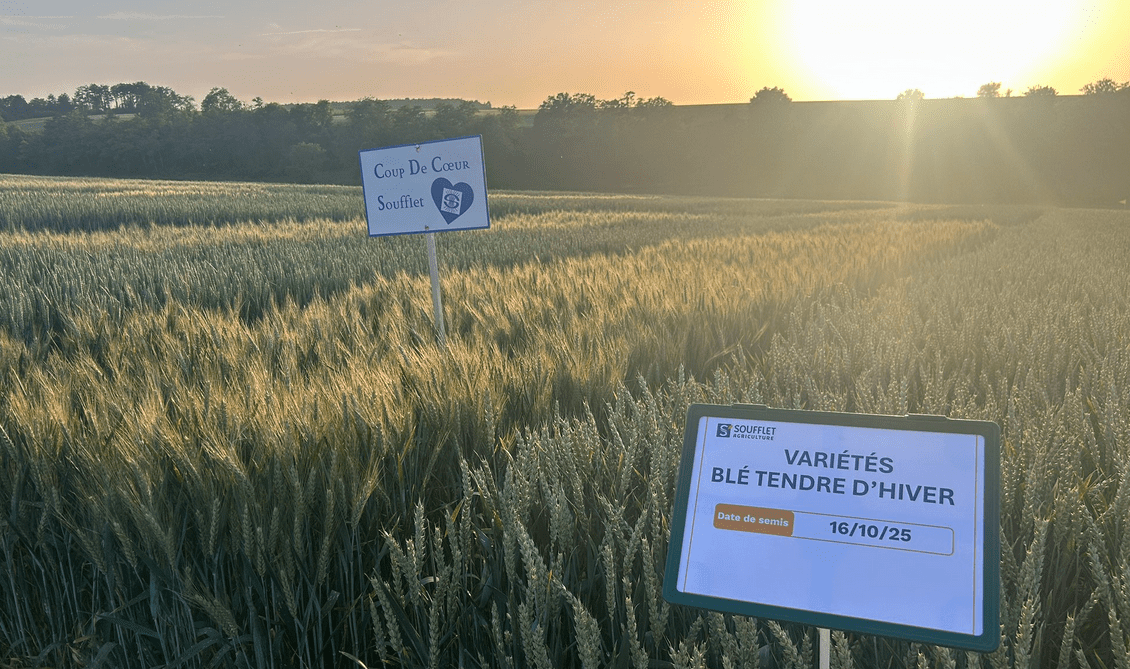
Wheat growing at a Soufflet Agri trial site at Burgundy in east-central France. Photo: Emmanuel Bonnin
WINTER crop conditions remain encouraging across most of Europe as the warmer summer months approach, with plant development progressing well despite some dryness and localised late frosts. The spring sowing campaign is also well progressed, although field operations have been delayed by wet conditions in some regions and crop emergence has been hampered by dryness and extreme cold in others.
While below-average April rainfall, particularly in central, eastern and northern Europe, delayed biomass accumulation, early May rains have provided widespread relief across much of the continent, replenishing soil-moisture reserves and increasing water flows in river systems vital to the efficient and orderly movement of European trade. However, regular rainfall will be required to sustain plant development during the peak growth period ahead.
Cold spells late last month and early this month brought frost events in some regions, with localised crop damage, particularly to rapeseed, reported in Poland, Czechia, Lithuania, Hungary, Slovakia, and Romania. Rapeseed production expectations have dropped below the long-term average in some regions as a result, although late-season recovery remains possible in districts where available moisture permits.
Yield outlook approximately average
The European Commission has reduced yield forecasts slightly in the May 18 crop update from the Joint Research Centre, but they remain largely in line with or above the five-year average. Even so, crop conditions in several regions still require close monitoring, especially where soil moisture deficits have built up since early spring. Likewise for the later-planted spring crops, which could be left exposed later in the summer.
The total cereal yield across the 27 EU member states now stands at 5.6 tonnes per hectare (t/ha), down from 5.61t/ha last month but comfortably above the five-year average of 5.47t/ha. The soft wheat yield fell from 6.05t/ha in April to 6.01t/ha this month, 0.14t/ha above the five-year average.
Similar story for barley, with the yield forecast down from 5.15t/ha to 5.06t/ha month on month, but above the 5t/ha average over the past five years. The corn yield projection of 7.3t/ha is also fractionally lower than the 7.33t/ha forecast in April, but above the longer-term mean of 7.09t/ha.
On the oilseed front, the JRC MARS bulletin pegged the EU rapeseed yield at 3.19t/ha, compared to 3.25t/ha last month and a five-year average of 3.2t/ha. Sunflowers are the other oilseed crop of note in the EU, with the May yield projection of 1.96t/ha, up from 1.94t/ha in April but below the longer-term mean of 1.99t/ha.
According to the European Commission, total cereal production across the EU-27 in 2026-27 is expected to be 277.6 million tonnes (Mt), 4.5 percent, or 13Mt lower than the 2025-26 output of 290.6Mt. Nevertheless, this is still fractionally above the 274.4Mt average for the past five production cycles.
Wheat
Wheat is the biggest contributor each season, with the new-crop output projection of 135.2Mt falling 10Mt short of current season production. This is made up of 127.3Mt and 7.8Mt of soft and durum wheat, down from 135.1Mt and 8.1Mt respectively.
France remains the trading bloc’s primary soft wheat producer, with the 2026-27 forecast of 33Mt on par with last season’s crop of 33.1Mt. Germany is a comfortable second at 22Mt, down from 22.6Mt last harvest, followed by Poland at 13.2Mt, compared to 13.4Mt in 2025. Wheat production in Romania has been gradually increasing in recent years, primarily at the expense of corn. The 2026 harvest forecast of 11.1Mt is down from a record of 12.5Mt in 2025 but will still be the Black Sea nation’s second biggest wheat crop ever.
Coarse grains
Corn is generally the second-largest cereal crop in the EU each season, and 2026-27 is no exception. This year’s harvest is expected to total 61.2Mt across the Eurozone, up from 60.7Mt last year and very close to the five-year average of 61.5Mt.
France is the biggest producer, with the 2026 harvest forecast of 13.8Mt on par with last season, followed by Poland, with a year-on-year decrease of 1.4Mt to 9.1Mt, and Romania, where the crop is expected to be 7.7Mt compared to 7.8Mt in 2025.
Barley is the other major EU cereal crop each season, with JRC MARS putting 2026-27 output at 52.8Mt. This is down from 55.6Mt in the current season but still lies above the five-year average of 50.8Mt. France is projected to narrowly hold on to top producer status with a harvest projection of 11.3Mt, followed by Germany with 11.2Mt and Spain with 6.8Mt. These harvests compare to 11.8Mt, 11.2Mt and 9.1Mt in 2025, respectively.
Oilseeds
Total oilseed production is pegged at 32.4Mt, up from the 2025 harvest of 31.8Mt. This year’s rapeseed harvest is forecast to be 20.8Mt, slightly higher than the 20.2Mt reaped in 2025, but well ahead of the 18.7Mt average since 2021. France, Germany, Poland and Romania dominate the production outlook, accounting for three-quarters of projected EU output. The French and German harvests are expected to be slightly bigger than last season, while the Polish and Romanian crops are unchanged.
JRC MARS has sunflower seed output pencilled in at 8.8Mt in the May update, marginally higher than the 8.7Mt harvest in 2025. Romania is expected to be the leading EU producer in 2026-27, followed by France, Hungary and Bulgaria. The same culprits featured in 2025-26, but France was in fourth spot after a poor season.
Unlike in Canada and Australia, pulse crops do not feature prominently in EU crop rotations, with total production of 4.4Mt expected in 2026, the same as last year. Field peas are the main pulse planted each season, with production generally accounting for around 55pc of total pulse output. The 2026 crop is forecast to be unchanged year on year at 2.4Mt, with France, Germany, Spain and Lithuania the key growers.
HAVE YOUR SAY