
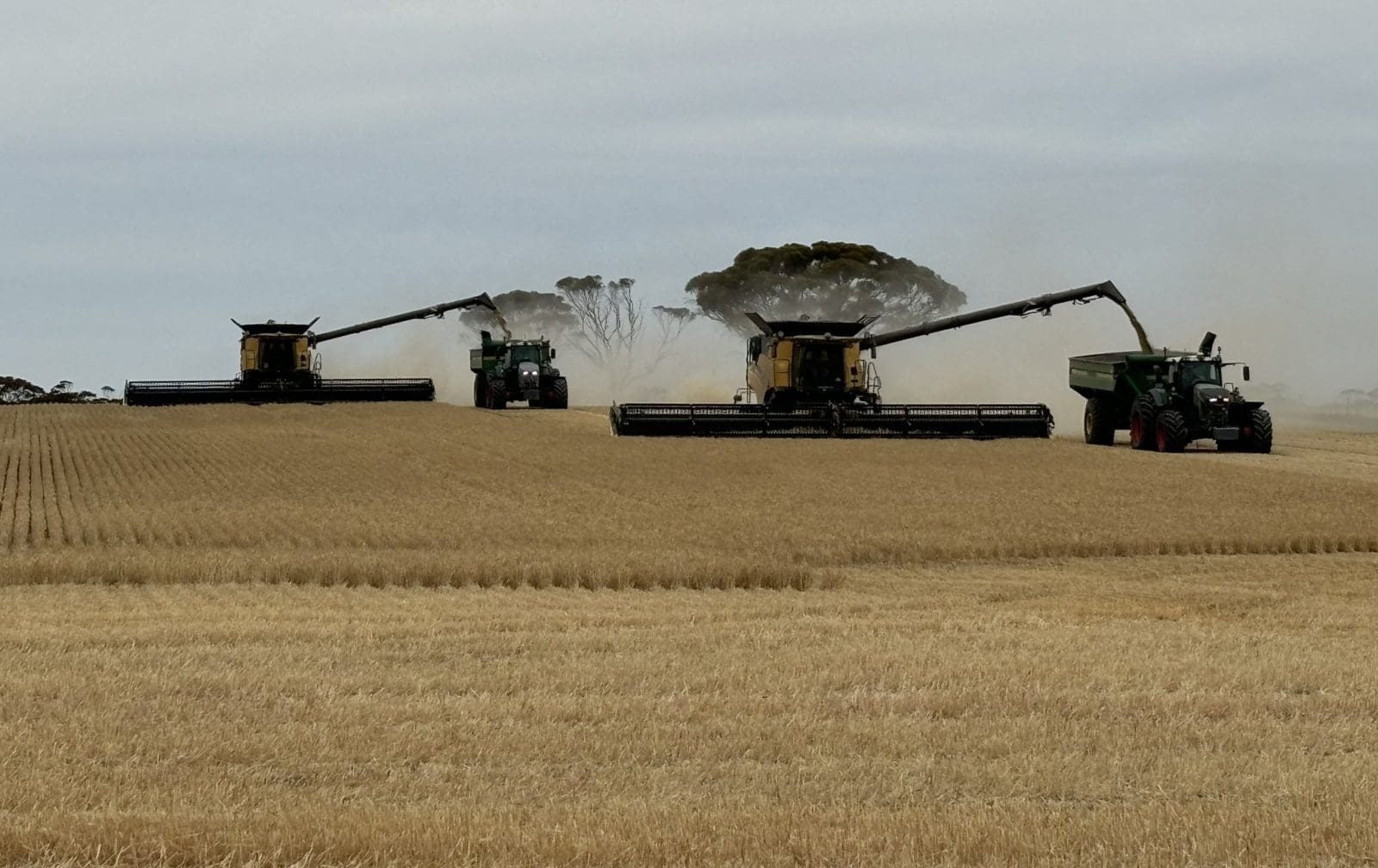
Barley harvesting at Mindarabin in WA’s Great Southern region. Photo: Kelvin Hams, Wemyss Estate
WESTERN Australian grain groups, alongside WA farmer and consultant Paul McKenzie have launched a survey canvassing grower views on cutting R&D levies for three years and replacing the current Grains Research and Development Corporation structure with a farmer-owned model.
WAFarmers, WA Grains Group, and the Pastoralists and Graziers Association of WA and Mr McKenzie are jointly calling for a three-year reduction in compulsory R&D levies from 0.99 percent to 0.01pc.
They are also pushing for a farmer-owned R&D organisation with grower-elected, skills-based directors to replace the current GRDC framework which operates as a corporate Commonwealth entity.
The proposal would not alter the non-R&D components of the levy, which for most leviable grain crops include:
- 0.01pc of its value for biosecurity activity;
- 0.005pc of the value for biosecurity response; and,
- 0.015pc of the value for the National Residue Survey.
Mr McKenzie said this temporary reduction in levies would save Australian grain growers more than $600 million over three years, based on an extra $3/t each year for cereals and $7/t for canola.
He said severe adverse terms of trade means risk from having only breakeven crop yields is at a record high, and the outlook is not expected to improve amid the ongoing Middle East conflict.
He said farmers have “already prepaid three years of levies” and there was “no justifiable need” for growers to be levied at the present level, considering GRDC’s cash reserves, which are expected to rise to $836.4 million in 2026-27.
The appropriate level of reserves is 40 percent of research spending, or less than $150 million.
“Inaction by the unelected GRDC Board and unelected responsible organisations is causing harm to farming families.
“They have lost sight of who they are meant to serve”.
“The magnitude of levy cash that’s extracted from farm businesses presently is having a negative impact on farmers’ ability to invest in their own on-farm initiatives,” Mr McKenzie said.
“It could be something as important as boarding school fees, a new shed, it could be irrigation, it could be soil amelioration, or yield-enhancing technology.”
Mr McKenzie said he had conducted forward modelling showing a reduction in levies would pose “no risk whatsoever” to the liquidity of the organisation’s five-year R&D plan.
“This is about the proper governance of other people’s money.
It’s not about research, which would continue as planned, and the five-year R&D plan will continue to be implemented.”
“The funding is there; the plan is in place.”
WA Grains Group chair Alastair Falconer said the self-funded group had long called for a reduction in levies to support the long-term financial sustainability of the industry.
“We’ve been trying to get a proper review on the levy done for quite some time,” Mr Falconer said.
“We fully support the levy being dropped because the size of the reserves essentially comes off our bottom line and adds to our peak debt each year.”
“We’re paying all this money just to have it sit on a government balance sheet, which is no use to anybody.”
He said this was particularly relevant at a time when growers in Australia, and especially WA, were facing major increases in costs for inputs including fertiliser, and dealing with the impact of the mouse plague.
“We’ve had just about…everything thrown at us.
“There’s been…fuel shortages, fertiliser shortages, fertiliser cutbacks, fertiliser bloody force majeures, we’ve had a mouse plague; you name it.
Mr Falconer said despite WA’s big crop last year, growers did not make as much money as he had expected due to production costs being so high and grain prices so low.
Survey process
The survey is open now and the groups envisage it will remain open until around the end of June.
Mr McKenzie said the poll differed from previous levy surveys by giving growers a voice based on tonnes produced.
“This survey looks at the intentions of farmers on a tonnage basis rather than an individual business basis.
“The principle is no taxation without representation, and if the tonne must pay, the tonne must have a say.”
He said there were also questions about a shift to a farmer-owned organisation to improve governance, reduce costs, and achieve better R&D outcomes.
Mr McKenzie said the three-year reduction in levies would be a “short-term” measure to deal with what he said were GRDC’s excessive levies.
He said the next step would involve “an independent review that recommends changes to be implemented in the medium term”.
This could be followed by longer-term governance reforms, including transitioning GRDC to a farmer-owned body.
To access the grains industry levy survey click here.
Grain Central: Get our free news straight to your inbox – Click here
This survey is advocacy dressed up as research, and anyone tempted to treat its results as representative of Australian grain farmers should look carefully at the methodology before doing so. Spoiler: there isn’t much to look at.
The purpose statement at the top essentially tells respondents what conclusions to reach before they answer a single question. Question 8, the most important in the survey, embeds a contested policy position as established fact inside the question itself, informing respondents the levy reduction “will save farmers approximately $3/t” as if that is settled science. That is not a survey question, it is a press release with a tick box stapled to it.
The importance scales in questions 8, 13 and 17 are scrambled, running “Extremely important / Important / Neutral / Moderately important / Not important,” which places Moderately important below Neutral. Any first-year statistics student would fail an assignment with that error. A Year 10 maths teacher would hand it back with red pen. The data it produces will be worthless regardless of how many farmers respond, which is a remarkable achievement in its own right.
The survey asks respondents to rate the effectiveness of GPA, GGL and the GRDC board without first establishing whether they have any informed basis to do so. Uninformed Neutral responses will be aggregated and reported as dissatisfaction. That is not research, that is asking someone who has never watched cricket to rate the Australian selectors and then publishing the results as a crisis.
There is no mechanism to verify respondents are actual levy payers. There is no independent oversight. It is being run by a WA-based coalition but presented as a national survey. A Crown weekend as an incentive is hardly the hallmark of rigorous independent research, though it does explain some of the enthusiasm.
This matters because rigorous, methodologically sound levy surveys have already been conducted. Farmers have already had proper opportunities to have their views recorded through instruments that would actually withstand scrutiny. This effort does not meet that bar, and the Federal Government and the Department of Agriculture will know that the moment it lands on a desk. Ministerial advisers are well versed in distinguishing credible survey evidence from a campaign petition wearing a questionnaire as a costume, and this one forgot to tuck in the label.
The tragedy is that the underlying grievances about reserve levels and governance may well be legitimate and deserving of serious attention. Attaching them to this methodology does not advance the cause, it hands ammunition to exactly the people who benefit most from the status quo. If you are going to pick a fight with a billion dollar organisation, it is probably worth bringing a properly designed survey to it.