
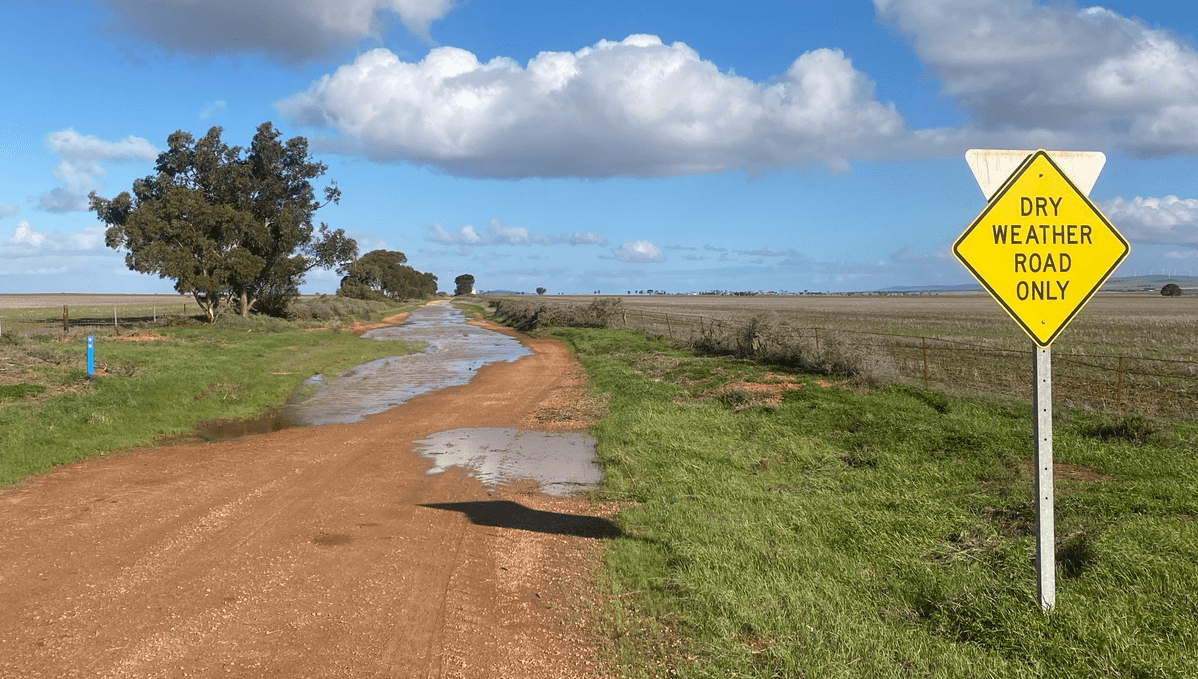
South Australia has had some handy rain in the past week. Photo: Chris Davey, YP Ag
GRAIN prices have dropped another $3-$10 per tonne this week to reflect export parity and improved production prospects for the northern region.
Recent rain has enabled many growers in northern New South Wales and southern Queensland to plant at least some winter crop, but has failed to push large amounts of grain stored on farm into the market.
In the southern market, the export market has put a floor in barley values as both the southern and northern regions absorb the shutting off of demand from drought feeders.
Trade sources report urea has dropped $200/t in the past fortnight to around $1200/t ex port, the first major easing since values skyrocketed in early March in response to the closure of the Strait of Hormuz.
The drop has prompted growers to book up loads for top-dressing as the southern season consolidates.
| May 28 | Today | |
| Downs barley | $400 | $390 |
| Downs SFW | $388 | $385 |
| Downs sorghum | $360 | $360 |
| Mel barley | $345 | $340 |
| Mel ASW | $363 | $355 |
Table 1: Indicative prices in Australian dollars per tonne.
North gets planting
Northern wheat and barley values have eased in the past week, despite steady buying from feedlots and poultry mills looking to write contracts to get them through to new crop.
“A lot of the boys are trying to buy for late August out to October,” one trader said.
“They got some dear coverage for June-July…and they want to lower their averages.”
Chickpea values have risen at least $20/t since the rain to around $700/t delivered Downs, making chickpeas rather than wheat the cash on-farm sell.
“With [cereal] prices dropping so drastically, growers are digging their heels in.”
Patchy rain fell throughout central and northern NSW, with higher registrations in the week to 9am today including: Coonamble 18mm; Gunnedah 32mm; Moree 29mm; Mungindi 11mm; Narrabri 27mm; Peak Hill 26mm; Quirindi 25mm, and Walgett 17mm.
In Qld, registrations in the grainbelt were mostly single digit.
Throughout northern NSW and into southern Qld, some farm roads will remain closed to trucks into next week because of recent rain.
This will coincide with many growers around the Newell Highway especially in northern NSW being flat out with planting.
“Execution out of north-west NSW might be a little bit hard over the next few weeks if growers don’t want to see trucks turning up.”
South looks stable
Much of Victoria’s Wimmera region received 10-30mm of rain in the week to today, while falls in the Mallee were mostly under 10mm, if any.
In southern NSW, handy falls recorded include: Cootamundra 26mm; Temora 22mm; West Wyalong 24mm, and Young 33mm.
“Recent rain has topped things right up,” one broker said.
Crops in the eastern Riverina and on the southern slopes of NSW, as well as those in Vic and South Australia, are mostly in good stead, and have piled on significant growth prior to the official start of winter this week.
Some crops on the outer slopes of NSW and into the western Riverina could do with a drink.
After the market’s tumble of the past fortnight, the broker said prices seemed like they were “finding a bit of a level”, and growers were at least considering meeting the market.
“There are more guys touching base [and] willing to sell.”
Canola and vetch were the first winter crops to be planted following rain in March, and both have generally gotten off to a flying start.
Canola and cereals and being top-dressed with urea.
“Prices are looking like the low $1200s for prompt stuff, and cheaper for July and August.”
Grain Central: Get our free news straight to your inbox – Click here
HAVE YOUR SAY