
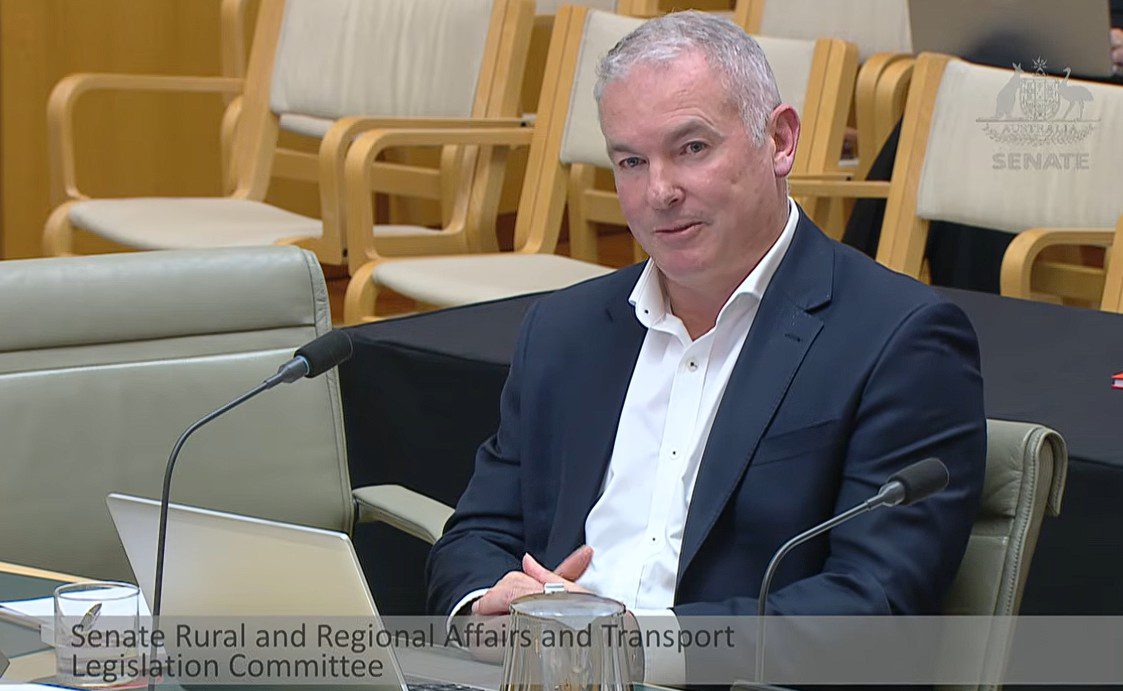
APVMA chief executive officer Scott Hansen appeared at Senate Estimates last week.
THE Australian Pesticides and Veterinary Medicines Authority last week provided insights into its recent approval of ZP50 mouse bait and confirmed the closeness of its paraquat and diquat decision as details emerged of incoming cost-recovery arrangements.
Commercial solution to ZP50 access
Senate Estimates last week canvassed the three-week timeline between the initial ZP50 mouse bait application from Grain Producers Australia on Anzac Day and its approval on May 18.
APVMA chief executive officer Scott Hansen said two key elements not available for previous applications sat behind the permit.
Australia’s previous ZP50 permit, issued for New South Wales in 2021, required the bait to be spread only at early evening or nighttime, which was “really impractical for a lot of producers, especially those doing aerial application”.
He said the Grains Research and Development Corporation and CSIRO stepped up monitoring work from quarterly to fortnightly, which changed the data set and application process.
“So that gives us a great deal of confidence about the competition for any of the poison bait on the ground by the high density of mice population in that area, reducing the amount of it that might be available for birds to pick up, for example, and then also the ongoing monitoring and surveillance of the potential impacts of it,” Mr Hansen said.
He said both organisations on May 5 submitted research findings to the APVMA examining “avian risks of toxicity due to phosphide”, with the work completed in the Adelaide Plains region two weeks earlier, and influencing the application process.
Mr Hansen was asked whether the process would allow future applications to be assessed more quickly.
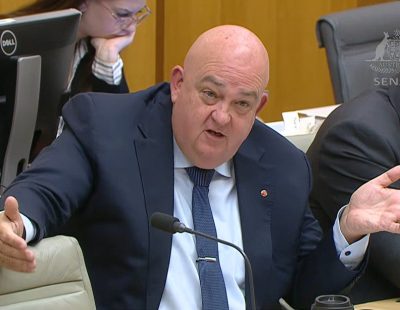
WA Senator Slade Brockman.
He said it was difficult to determine because the process relied heavily on GRDC-funded research that was not necessarily ongoing.
“The reason we can do this permit at the moment with the data we’ve got is because of the fortnightly in-field surveillance work that GRDC is funding and we haven’t had conversations about how long they might continue that funding and whether that goes multi-year or how that gets set up in the future.”
Mr Hansen said the best option going forward would be for a company to apply to permanently register a ZP50 mouse bait for use only “in agro-ecological zones that have moderate or high mouse populations”.
“There’re 20 products registered at the 25-grams per kilogram-strength zinc phosphide mouse bait, and they obviously can be used and are used on an annual basis in areas that are needed to try to keep a lid on populations before they get out of control.
“We would be hoping, in an ideal world, we’d get an application for a [ZP50] registered product.
“It’s able to use data and information collected out of this current period of use and further trial work out of research permits that have been issued.”
Mr Hansen said it was “obviously a tricky commercial proposition”, given the product would rarely be used; however, it would be the quickest way to get the bait to growers when required.
Paraquat decision due in weeks
During a tense back-and-forth with Senator David Pocock in Senate Estimates, Mr Hansen reiterated that the APVMA would be releasing its final decision on paraquat and diquat in the coming weeks. Senator Pocock questioned why the decision was not published in December last year as initially reported.
“About two weeks before we were meant to finalise our report, the US EPA released new information that they had just gathered with regards to the volatility of the chemical in the field,” Mr Hansen said.
“It set a new volatility number of factor for paraquat.
“Out of an abundance of caution, we ran those numbers back through our assessments and have been finalising and addressing what that means in terms of the outcomes over the last couple of months.”
Mr Hansen said the report is finished and is “getting its final work over”.
“The actual report itself is one piece of work.
“There are 179 products that need their labels adjusted, changed, and the owners of those products to be notified at the time that we release the report; that’s where a lot of the legwork goes into making the behind-the-scenes work that goes into a chemical review.”
Mr Hansen said the paraquat review commenced in 1997 and this report would be the first that featured an “overall assessment” of the chemical including health and environmental risks.
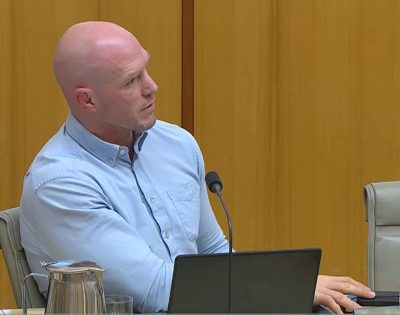
Senator David Pocock.
Senator Pocock questioned why the chemical was still permitted in Australia, given it was “being banned left, right and centre” including last week by US state of Vermont.
He named several of these countries and regions including the UK, EU, Malaysia, South Korea and Saudi Arabia.
“I guess I find it concerning that we have the APVMA reviewing paraquat for 30 years and within that 30 years we have over 70 countries around the world saying this is not a chemical that is allowed to be used in our country because we deem it a hazard to our citizens and/or the environment,” Senator Pocock said.
“Yet here in Australia, we’re just sort of allowing it to happen on golf courses, on farms, and we have all sorts of groups and farmers raising concerns about what that means for their health.”
Mr Hansen said if the APVMA “didn’t think it was safe, we wouldn’t be looking to make a decision that would allow it to continue to be used”.
“If we thought it wasn’t safe, we would be making a decision that looks to ban it; our legislation is very clear.
“The scientists that we have working on this, looking at the data that they have available to them, are the very best that exist around the globe, so I’m going to be comforted by the quality of the science we’ve got working on the assessments.”
APVMA cost-recovery model
During Estimates week, the Federal Government released information on a new sustainable funding policy for the APVMA to be implemented from the 2027-28 financial year.
Under the policy, applicants seeking to register chemical products in Australia, like pesticides or new veterinary medicines, will pay the full cost of the APVMA’s fee-for-service activities upfront, so costs are recovered directly.
The increase in upfront fees will be offset by the 40-percent decrease in the sales levies applied to the sale of agricultural and veterinary chemical products.
This means all applicants pay a fair price to enter the market, and products sold in Australia pay a fair levy to support our domestic regulatory system.
Previously, thousands of products were registered under discounted fees and not sold in Australia.
This resulted in application costs being subsidised by companies selling products in Australia for Australian farmers.
The government has provided $8.7 million in new funding to support the APVMA through the financial year while it works with industry stakeholders on implementation of a new sustainable funding policy.
The government will also contribute $3.2M annually for the APVMA’s permit programs which enable products to enter the Australian market that are required for emergency responses or to support small, emerging industries.
The new funding arrangements are expected to commence from 1 July 2027, after the APVMA undertakes consultation on implementation with stakeholders across the agvet sector.
Consultation with industry is scheduled to begin later this year, through the APVMA’s Cost Recovery Implementation Statement (CRIS), which will set out the proposed changes to specific fees and levies.
Grain Central: Get our free news straight to your inbox – Click here
HAVE YOUR SAY