
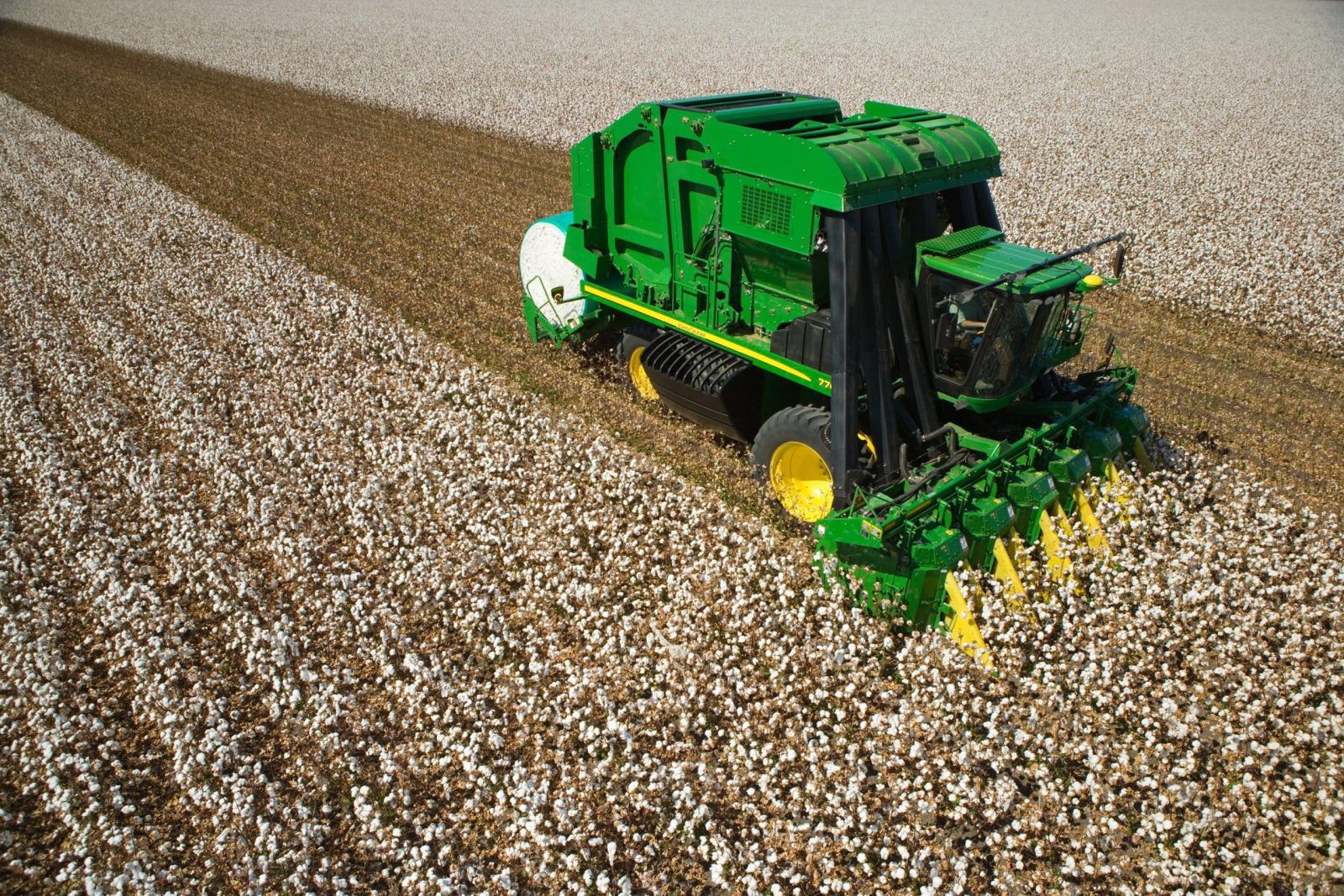
Picking is almost complete across traditional cotton growing areas. Photo: Port of Brisbane
FOLLOWING a challenging 2025-26 growing season marked by constrained water availability and rising input costs, conditions are beginning to improve for Australian cotton farmers after some positive pricing momentum emerged through late autumn.
According to ANZ’s Winter Commodity InFocus report, prices rebounded strongly through Autumn, reaching levels not recorded since the harvest of 2024.
In early May, the benchmark price of spot cotton on the international market rose above US 90 cents per pound, staging a greater than 25-percent recovery after bottoming out at 73c/lb for the growing season last December.
While the market lost some gains in recent days, ANZ state director Ben Barrett said several factors were driving a more positive outlook.
“The rebound appears to be a combination of things,” Mr Barrett said.
“Firstly, despite conditions now starting to improve, there had been some production concerns due to dry conditions in key US growing regions.
“There was also an increase in immediate demand from cotton mills, on top of improved consumer demand signals from large consuming nations such as the US and China.”
According to the United States Department of Agriculture, retail apparel sales in China finished 2025 strongly, as household spending was encouraged through government stimulus measures.
Mr Barrett said the price difference between cotton and synthetic may also have been a factor in increasing demand for cotton, as the price and availability of oil pose threats to synthetic fibre production, supply and prices.
“Despite this, there remains significant uncertainty over demand estimates over the next 12 months.
“The overall impact of increasing and prolonged global inflation on consumer demand for all textile and apparel products remains yet to be seen.”
Looking ahead to the 2026-27 crop, the first official forecasts suggest a sizable 6.6-million-bale reduction in global production to around 116Mb, with declines in production in China, Brazil, the US and Australia.
Mr Barrett said ABARES expects planted area in Australia for the new season to reach just a little over 400,000 hectares – the lowest since the drought-impacted years of 2020 to 2022.
“A smaller Australian crop, amongst the backdrop of smaller global supply, should increase competition for exports and in theory, indicate a favourable future for prices.”
ANZ director of ginning marketing solutions Ross Brown agrees growers are feeling upbeat about future prices.
“Local cotton prices have made up some ground over recent months, largely post the start of the US-Iran conflict,” Mr Brown said.
“Back in early March prices were sub $550/bale before hitting recent highs of $645/bale.
“Cover crops were planted by some growers in recent weeks, while others held to reevaluate water allocations and cost of production.
“Many growers now expect $650-plus/bale to be the starting target for the upcoming season, however, enduring inflationary pressures and tighter consumer spending may still have something to say about forward consumption numbers.”
Port movements rising
The positive momentum in prices has been mirrored in the cotton shipping program out of Port of Brisbane.
According to an update provided last week, picking is almost complete, with shipments through the port from growers in Queensland and north-west NSW anticipated to increase from June.
“To date in FY26, over 47,000 TEU of cotton exports have moved through the port,” the Port of Brisbane update said.
“On average, around 50pc of the national cotton crop is exported through Port of Brisbane to global markets including China, Vietnam, Bangladesh, and Indonesia.
“Geopolitical uncertainty has significantly influenced commodity markets, with the cost of synthetic materials rising, enhancing the competitiveness of cotton for the industry.”
Source: ANZ, Port of Brisbane
HAVE YOUR SAY