
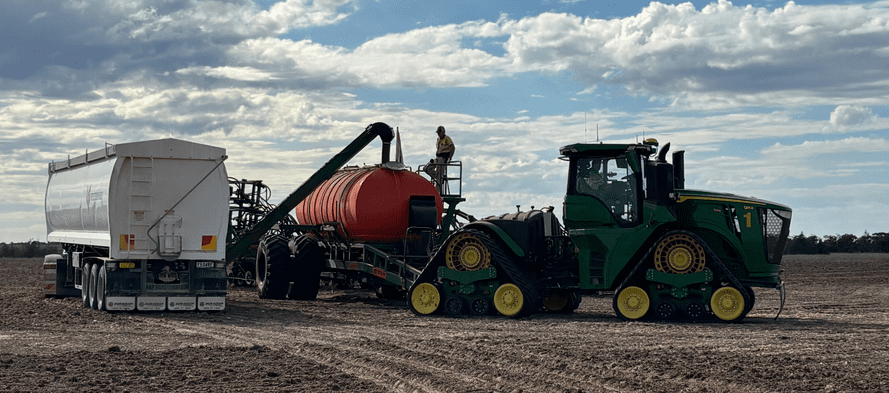
Sowing winter crop at Yeelanna on SA’s Lower Eyre Peninsula. Photo: Bunge Australia
THE SOUTH Australian Government’s Primary Industries and Regions SA is tipping the state will produce a winter crop of 9.01 million tonnes (Mt) as seeding progresses at pace in good conditions.
Based on the assumption that yield potential is close to the 10-year average, the figure is up 1.7 percent on last year’s estimated production of 8.79Mt, and will make the crop the biggest since the record 12.79Mt harvested in 2022-23.
PIRSA’s first estimate for the season has come out in its 2026-27 Seeding Intentions report, which puts wheat at 2.16Mt, up from 2.12Mt last season, and barley unchanged at 2.13Mt.
At 846,405t, lentils are forecast to break last season’s record of 776,099t, and lentil area is forecast to do the same with a 12pc increase year on year.
“This firmly establishes lentils as the third-largest crop area behind wheat and barley.”
In some Mallee districts, pulse areas have been trimmed due to a need to maintain ground cover on erosion prone areas.
The report said ongoing uncertainty due to supply chain disruptions has created considerable concern among growers for the upcoming season.
“Unknown availability of fuel, fertiliser and other inputs such as pesticides, coupled with increasing freight and other costs, are a concern.
“Despite this, there have not been major changes to cropping program plans.:
Good early rainfall in 2026 has set up the season well by building subsoil moisture for the first time in several years, and by allowing growers to get on top of weed populations ahead of seeding.
Rain has also reduced the risk of herbicide residue carryover in many paddocks and will provide better conditions for pre-emergent herbicide activity.
Supplementary feeding not over yet
Recent rain has significantly improved pasture growth and feed availability, supporting a return to near-average feed on offer in many areas.
As a result, livestock condition has improved with reduced pressure on producers.
Follow-up rainfall will be critical to maintain pasture persistence, particularly for annual species.
Despite the improvement, supplementary feeding remains important in some regions as producers cautiously manage recovery following earlier dry conditions.
Recent conditions have been characterised by above-average early season rainfall, delivering widespread soaking events and constituting a well-timed season break for many districts.
Since then, warmer and more settled weather has dominated, allowing seeding to progress, with minimal paddock trafficability issues, although producers in many areas were monitoring forecasts closely for the next significant rain event before continuing.
The sought-after follow-up rain occurred in late April and early May, and was concentrated across southern agricultural regions, with 15-35mm recorded across Eyre Peninsula, Yorke Peninsula, Kangaroo Island and the Adelaide Plains.
Central districts received more moderate totals of around 10-25 mm, and generally 2-10mm in the Upper North.
After early rains, warm, dry conditions have supported good paddock access and efficient operations.
Watchful eye for pests
Establishment pests including red legged earth mite and lucerne flea are present at typical levels in early-sown crops but are not yet widespread.
Earlier in autumn, high populations of budworm caterpillars were noted in pastures and unsprayed paddocks.
Mice remain a key risk in several SA cropping regions, particularly the Adelaide Plains, Yorke Peninsula and parts of the Mid North, where CSIRO monitoring indicates moderate to high and increasing activity.
Australian plague locusts have been reported across several SA regions, including the Riverland, Mallee, Eyre Peninsula and parts of Yorke Peninsula, with adult locusts observed in early emerging crops.
Growers are actively monitoring and enquiring about control options.
Adequate summer/autumn weed management ahead of sowing, has meant that the “green bridge” has been generally well controlled in cropping paddocks.
Ryegrass control has proven a challenge in some areas, with increased incidences of herbicide resistant populations suspected.
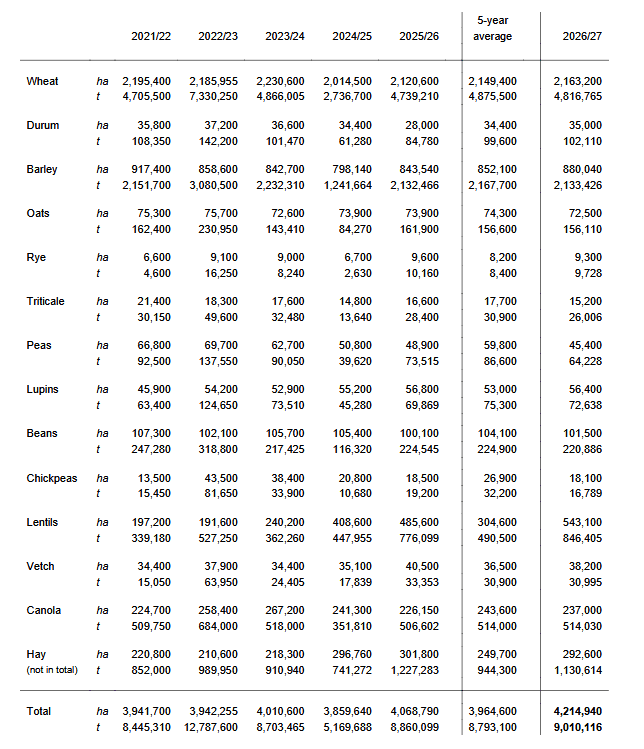
Source: PIRSA
HAVE YOUR SAY