
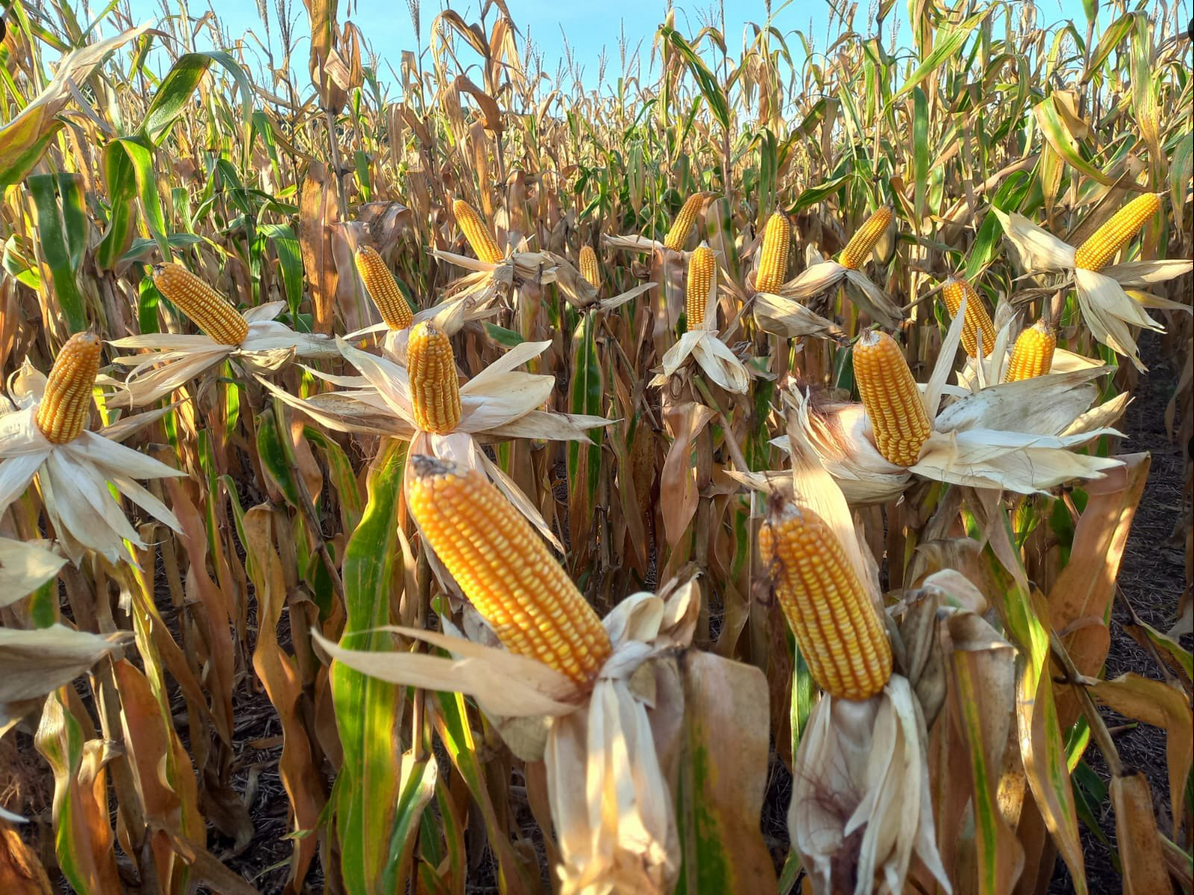
A corn crop dries down in Brazil’s Mato Grosso do Sul region. Photo: SLE AGRO
BRAZIL’S grain output in the 2025-26 marketing year is expected to set a new record, according to the latest production update from CONAB (Companhia Nacional de Abastecimento), Brazil’s National Supply Company, primarily due to a higher planted area.
Released on June 11, the ninth grain harvest survey for the season pegged total production at 358.6 million tonnes (Mt), 1.8 percent higher than the 352.3Mt harvested across the 2024-25 season, and 200,000t more than the May estimate. The forecast includes corn, soybeans, sorghum, cotton, peanuts, rice, a variety of beans, sesame seed and sunflowers, plus winter-cultivated crops such as wheat, barley, oats, rye, triticale and canola. The contribution of soybeans and corn collectively is 320.7Mt, or 89.4pc of total grain output, up from 312.6Mt, or 88.8pc of the total crop last year.
The nation’s farmers are projected to have seeded 83.5 million hectares (Mha) to grain crops this season, 2.2pc, or 1.8Mt higher than in 2024-25. Significant increases were seen in corn, soybeans and sorghum, while the wheat and oats areas dropped dramatically.
The average yield of most grains is expected to fall season on season, with soybeans the primary exception. Consequently, the national yield average across all grains is expected to fall by 0.3pc to 4.295t/ha, with corn, wheat and sorghum all down significantly.
Ideal season for soybeans
The weather conditions have been ideal for soybeans across most of Brazil this season. With the harvest virtually complete, CONAB is putting output at a record 180.3Mt. This is 5.1pc higher than the then-record of 171.5Mt reaped in 2025. In the nine growing seasons since the 2017 harvest of 115Mt, Brazil’s soybean production has grown by 56.7pc, making it by far the world’s biggest producer and exporter each year. The United States Department of Agriculture pencilled Brazil in for 180Mt of soybeans in its June World Agricultural Supply and Demand Estimates.
The bigger crop is the result of both higher yields and a larger seeded area. The nation’s farmers allocated a record 48.6Mha to soybeans in 2025-26, 2.6pc more than the 47.3Mha planted last season, itself a record at the time. The average yield of 3.71t/ha in 2026, another record, is up from 3.62t/ha last year.
Bahia stands out among the states, with the highest average yield this season, a feat accomplished in five of the past 10 harvests. Even in Rio Grande do Sul, which experienced several periods of water stress, productivity was higher than that achieved last year.
With increased production and the extremely strong pace of early-season shipping comes a higher export estimate. CONAB maintained its May forecast of 116.1Mt for the 2025-26 season, 1.1Mt more than the USDA’s June forecast, but more notably, 13Mt more than last season’s international sales. China will continue to be the primary destination, accounting for around 75pc of the total. Brazilian port data put May soybean shipments at 14.83Mt, up from 14.1Mt a year ago, with China purchasing for the bulk of the cargoes.
The domestic crush estimate for 2026 remains conditional on the implementation of the mandatory 16pc biodiesel blend in diesel (B16). However, in past instances of postponement or non-ratification of this percentage, lower internal demand for soybean oil tends to be offset by increased exports of the product. Amongst the uncertainty, CONAB left the crush unchanged but increased soybean oil exports at the expense of domestic use.
Slight drop for corn
This season’s corn crop is expected to be slightly lower than last year, despite a 3.4pc increase in the total planted area. CONAB expects production of 140.5Mt, down from 141.2Mt last year, with poor yield forecasts for this season’s second corn crop the primary culprit. The total area sown to corn in 2026/26 is 22.6Mha, up 3.7pc or 800,000ha from last season, while the average yield across all three crops is expected to be 6.22t/ha compared to 6.46t/ha in 2024/25.
Harvest of the first corn crop had reached 87.7pc of the planted area by early June. It is still underway in the so-called Matopiba region and is nearing completion in Minas Gerais and Goiás. The lack of precipitation through May was favourable for harvest, keeping moisture levels in the grain low. Harvested yields remain high across all states, especially in Goiás, Minas Gerais, and Paraná, with estimates pointing to record productivity in those states.
First corn crop production is expected to be 29.3Mt, up 17.7pc or 4.4Mt compared to the 2025 harvest. The production hike comes as a result of a 9.4pc increase in the planted area to 4.1Mha, and a 7.6pc hike in the average yield to 7.11t/ha.
Harvest of the earliest second corn crop plantings in Mato Grosso, Pará, and Tocantins has commenced. Rainfall in May was below average, decreasing the yield potential of those crops seeded after the ideal planting window, mainly in the states of Goiás and Minas Gerais. Weather conditions have been generally favourable in other states, although there were some localised losses in Paraná due to unseasonal gales and hailstorms.
Brazil’s second corn crop is the biggest of the three, with CONAB estimating production at 107.9Mt, 4.7pc lower than the record of 113.2Mt produced in 2024/25. The planted area is 2.0pc higher at 17.8Mha, but the average yield of 6.1t/ha is down 6.6pc year-on-year.
Planting of the third corn crop is completed or nearing completion in most regions. This year’s harvest is expected to be 3.3Mt, up from 3.0Mt in 2025, on the back of increases in both the planted area and yield of 6.7pc and 2.0pc, respectively.
Domestic consumption of corn is forecast at 94.9Mt, 4.6pc more than the previous year. This growth is mainly attributed to the increased use of corn in ethanol production, which is gaining increasing relevance in the renewable energy sector.
CONAB’s corn export projection for 2025-26 is 46.5Mt, driven by ample domestic supply and buoyant international demand. The forecast is up from 41.6Mt last season but is well down on the record of 54.6Mt set in 2022-23. The CONAB estimate is significantly higher than the USDA’s current export forecast of 43Mt.
HAVE YOUR SAY