
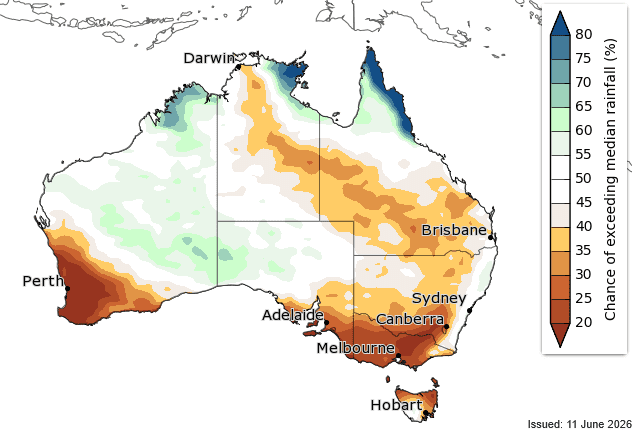
Chance of above-median rainfall for July to September 2026. Source: BoM
THE Bureau of Meteorology on Tuesday announced the El Niño-Southern Oscillation is now in an El Niño phase.
With the BoM since March reporting signs of its development, and the US’ National Oceanic and Atmospheric Administration on Thursday announcing its arrival, it comes as no surprise to Australian growers.
The phase indicates the likelihood of below-average rainfall for key Australian grain-growing areas in coming months, which would reverse the trend seen across much of southern Australia since March.
It makes the strategy of many growers in limiting urea applied at planting and in first top-dress look like a wise decision that will enable cereals to carry through all the tillers they have set, and fill all the heads they should be able to push out, based on mostly ample subsoil moisture.
Driven by cost
Barring northern New South Wales and southern Queensland, Australia’s winter crops generally got off to an early and flying start.
The opener was a major rain event over southeastern Australia around February 28, just before conflict between the US and Iran closed the Strait of Hormuz to crude oil and urea exports.
The closure had an immediate effect on Australian agriculture, with urea prices ex port almost doubling to $1400 per tonne free on truck, and farmers reacted by tempering their target yields for cereals, based on the expense of urea against relatively depressed grain values.
Agronomists indicate growers have trimmed their urea requirements for cereals by 30 percent, which means that if El Niño turns off the tap in spring, cereals will be well placed to adapt to a dry finish without the biomass which would have been promoted by a full complement of urea and in-crop rainfall.
As Platinum Ag agronomist Phil Holmes explained, the pull-back in urea purchasing would not necessarily have been seen in South Australia’s Mid North had wheat and barley prices been higher.
“Urea’s expensive, and growers lost money on it in ’24,” Mr Holmes said.
“They broke even in ‘25, but there’s not a huge amount of buoyancy, and farmers are just getting by.”
Mr Holmes said he has increased his soil testing for nitrate levels, and is using software to help farmers tailor their nitrogen budgets in the current season.
He said while some wheat and barley varieties give growers “big bang for your buck” when it comes to yield response to nitrogen, others do not.
It means growers this season are not using urea to push the yield curve across the board on cereals, despite the opportunity offered by current soil-moisture reserves.
“We’ve been ratcheting up these [urea] rates… but they’ll be close to what they were 20 years ago, so back about 30 percent.”
Riverina Independent Agronomy principal and senior agronomist and Collingullie farmer Neil Durning said his clients too have cut back the volume of urea purchased based on its expense.
“We’d be doing 70 percent of what we’d normally do,” Mr Durning said.
In parts of Western Australia, a similar strategy may be in place.
In the June Grain Industry of WA crop report, author Michael Lamond said fertiliser has been hardest to source in the Esperance Zone, and the region’s growers have used “whatever they could access”.
“Despite the excellent start, top-end grain-yield potential may be capped by constrained nitrogen applications due to the sky-high nitrogen price,” Mr Lamond said in the report.
Warm already
Frosts have been few and far between across the grainbelt so far this winter, and some cold weather would be welcome in some districts to moderate crop development.
“We’re fresh as a bell and the crops are huge; I’m a bit worried about how advanced they are and how mild the season is,” Mr Durning said.
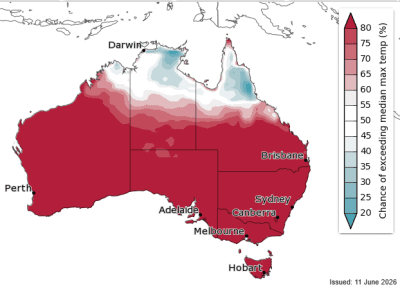
Chance of above-median maximum temperature for July to September 2026. Image: BoM
“We’re tracking two weeks early from temperatures alone.”
However, alarm bells for an impending drought are yet to ring.
“There remains some uncertainty in the likely strength of this El Niño event,” the BoM said in its long-range forecast issued last Thursday.
“Models indicate it will be at least moderate in strength, with the possibility of a strong event, based on the extent of warming in the central tropical Pacific.
“A strong El Niño signal in the Niño3.4 region does not necessarily mean strong impacts on Australia’s climate.”
BoM’s July-September rainfall outlook does, however, point to a 60-80 percent chance of below-average rainfall for the Western Australian grainbelt, much of southern Queensland, and most of south-east Australia, including Tasmania.
In line with that, there is a 40-60pc chance of unusually low rainfall across much of south-west WA and south-eastern Australia, which would reverse the rainfall pattern of recent weeks.
Grain Central: Get our free news straight to your inbox – Click here
HAVE YOUR SAY