
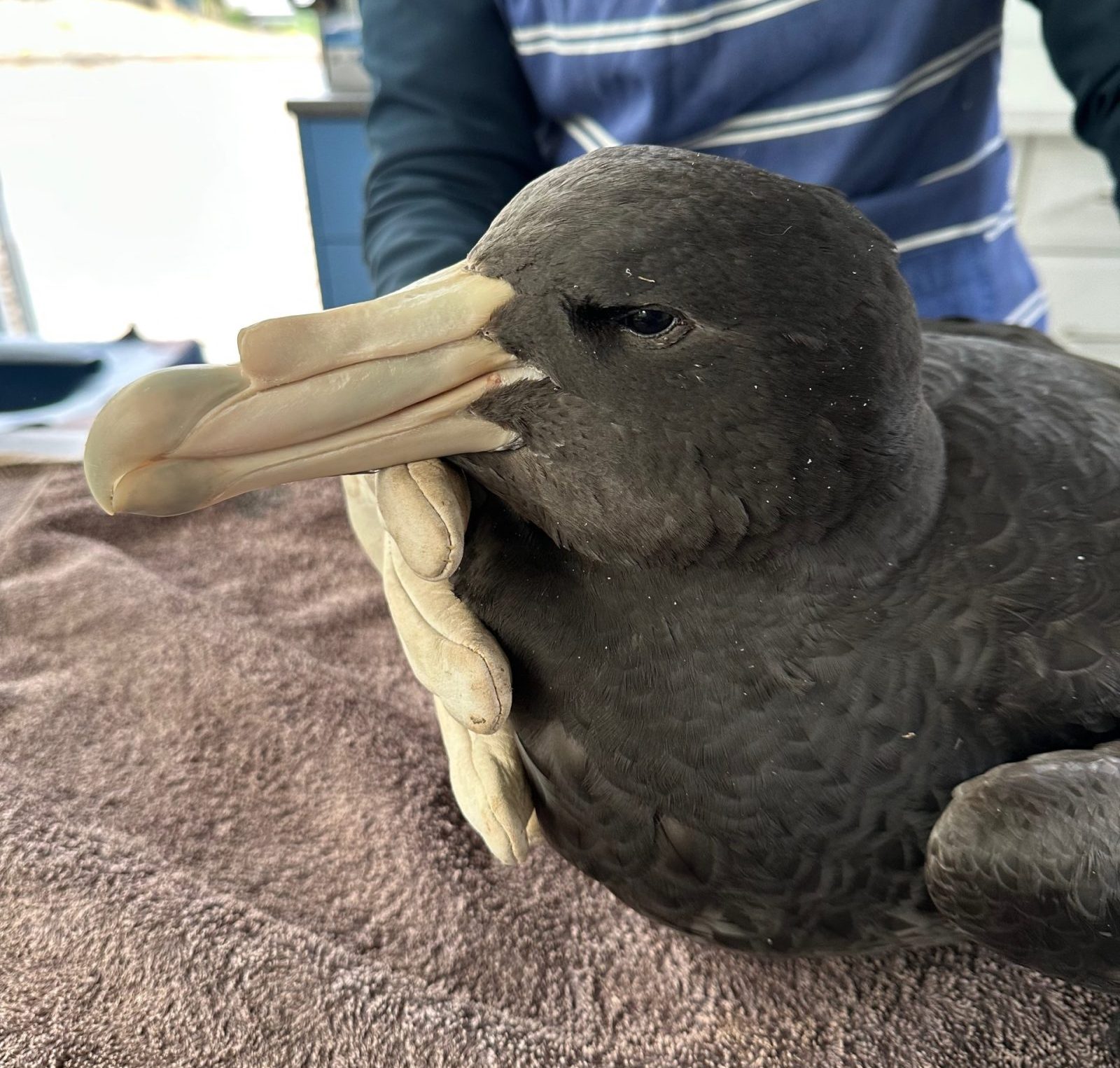
The Giant Northern Petrel was found on Wylie Bay Beach and brought into care on June 18. Photo: Lori-Ann Shibish, Esperance Wildlife Hospital and Sanctuary
AUSTRALIA has lost its status as the only continent free of H5N1 avian influenza following the detection of the disease in southern Western Australia.
The first cases came from a giant petrel found at Wylie Bay Beach and a migratory brown skua found on a beach at Cape Le Grande National Park.
The detections have sparked calls for vigilance with regard to wildlife, and also throughout the agricultural sector, as authorities look to manage the arrival of the strain on Australian shores.
H5N1 has already had significant impact on seal and seabird populations, including on the Australian sub-Antarctic territories of Heard Island and McDonald Island.
Esperance Wildlife Hospital and Sanctuary received the sick birds, the skua on June 14, and the petrel on June 18; both have since died.
Sanctuary co-founder and director Lori-Ann Shibish said sick seabirds often die at sea, and the arrivals of the ailing skua and petrel may have been tied to a “block low”, an intense and slow-moving low-pressure system often associated with strong and prolonged winds.
“Weather may have been a factor in these palegic seabirds being blown ashore,” Ms Shibish said.
Fast responses
An outbreak of the H7N8 virus hit Victoria in 2024, and cases were also detected in New South Wales.
The outbreak resulted in the culling of many thousands of birds in commercial operations, and a short-term shortage of eggs at the wholesale and retail level.
Any such impact is not expected at this stage, as state and federal authorities work to limit the impact of H5N1.
University of Sydney Professor Sonia Liu said H5N1 differs because it is an exotic disease, whereas the strain responsible for the 2024 response was a virus already present in Australia’s wild bird population.
“The very first hit will be in wildlife,” Prof Liu said of H5N1.
“At this stage, it is premature to think about a disastrous impact on industry.”
“All I can say at the moment is that industry and the government are both aware of potential risk; that’s why we have these mechanisms in place.
“At this stage there is no need to panic; this is just a watch and see.”
Ingham’s this morning issued a statement based on its broiler operations in WA.
This involves chicken breeder farms and grower networks located primarily in the Muchea, Gingin and Mogumber regions, north of Perth, approximately 690-770km north-west of Esperance.
“There has been no detection in commercial poultry, which includes Ingham’s operations and its supply chain,” the Ingham’s statement said with regard to the H5 strain.
As a precaution, Ingham’s said it has moved to a state of “heightened biosecurity vigilance to mitigate against any potential risks”.
“This includes the implementation of a complete lock-down, preventing all non-essential access, across all the company’s WA farms and processing operations.
Ingham’s has sought a regional housing order from the Federal Government’s Chief Veterinary Officer to allow WA free-range poultry to be kept indoors.
“Should this be enacted, an exemption order from the Australian Competition and Consumer Commission is in place to protect the continuation of free-range product supply and labelling.”
Increased surveillance
The Federal Government on Saturday confirmed the detection of H5 high-pathogenicity avian influenza in migratory seabird species that occasionally visit southern Australia.
A statement from the Department of Agriculture, Fisheries and Forestry said it was prioritising surveillance to determine the extent of the infection in wildlife.
“There have been no detections in poultry and there is no evidence of mass mortality at this time,” the DAFF statement said.
“Australia’s response is designed to manage the risks of H5 bird flu, to protect poultry production, and reduce impacts on wildlife and communities.”
The DAFF statement said the disease can cause sudden death in birds, a sharp drop in egg production, swelling of the head and neck, breathing difficulties, and neurological signs such as loss of co-ordination.
“The community is encouraged to report any dead or sick birds or animals showing signs of bird flu.
“If you see multiple sick or dead birds or other animals, do not touch them.”
Members of the public are asked to avoid contact with potentially affected birds and animals, to record what they see, and to report their observations to the Emergency Animal Disease Hotline on 1800 675 888 from anywhere in Australia.
Detailed and up-to-date information is available via the dedicated portal on the DAFF website.
NFF response
The National Farmers’ Federation is working closely with the Federal Government and members following the detection of H5 avian influenza in recent days.
“Australia has successfully managed other avian influenza strains in recent years, and the risk to humans remains low,” NFF president Hamish McIntyre said.
“This will undoubtedly be a stressful time for farmers and has the potential to create significant impacts across the sector.
“Australia has worked hard to maintain its status as the only continent free from the H5N1 strain that has spread globally since 2020, which is why vigilance is so important.”
In light of the H5 detection, NFF has advised farmers to review their on-farm biosecurity plans and ensure all staff and visitors are made aware of their biosecurity obligations.
Mr McIntyre said the detection reinforced the importance of strong biosecurity, particularly given cross-species risks across livestock industries.
“Australian farmers are world leaders in biosecurity, not only to protect our animals and environment, but to ensure if a situation arises, the impact to our food supply chain is minimised.
“It’s important to prepare for the worst and hope for the best.
“Right now, preparedness and vigilance are our strongest tools.”
Advice for those in WA
WA’s Department of Primary Industries and Regional Development is leading the state’s response to H5.
In a statement released on Saturday, it said the strain detected in both the brown skua and the giant petrel were consistent with the strain of virus detected in the Southern Indian Ocean Sub-Antarctic Territories including Heard Island.
“Surveillance for H5 bird flu will be enhanced together with targeted engagement with the poultry industry, veterinarians and wildlife carers,” WA DPIRD said in a statement issued in response to the detection and released on Saturday.
WA DPIRD has advised steps should be taken to keep pets away from wildlife, including preventing cats from roaming and keeping dogs on leads in wildlife areas.
It also recommends:
- Preventing wild birds from accessing feed and water that may cause them to mingle with birds you may own, care for, or work with;
- Keeping pens, aviaries, feeders, and equipment clean;
- Washing hands thoroughly with soap before and after handling birds; and,
- Monitoring birds for signs of disease or sudden deaths.
“We all have an important role in protecting our wildlife, poultry and other animals against H5 bird flu,” WA Agriculture Minister Jackie Jarvis said in a statement.
“Our poultry producers understand that on-farm biosecurity practices are crucial to protect the health of their flocks and are well prepared to minimise any impact on production.
HAVE YOUR SAY