
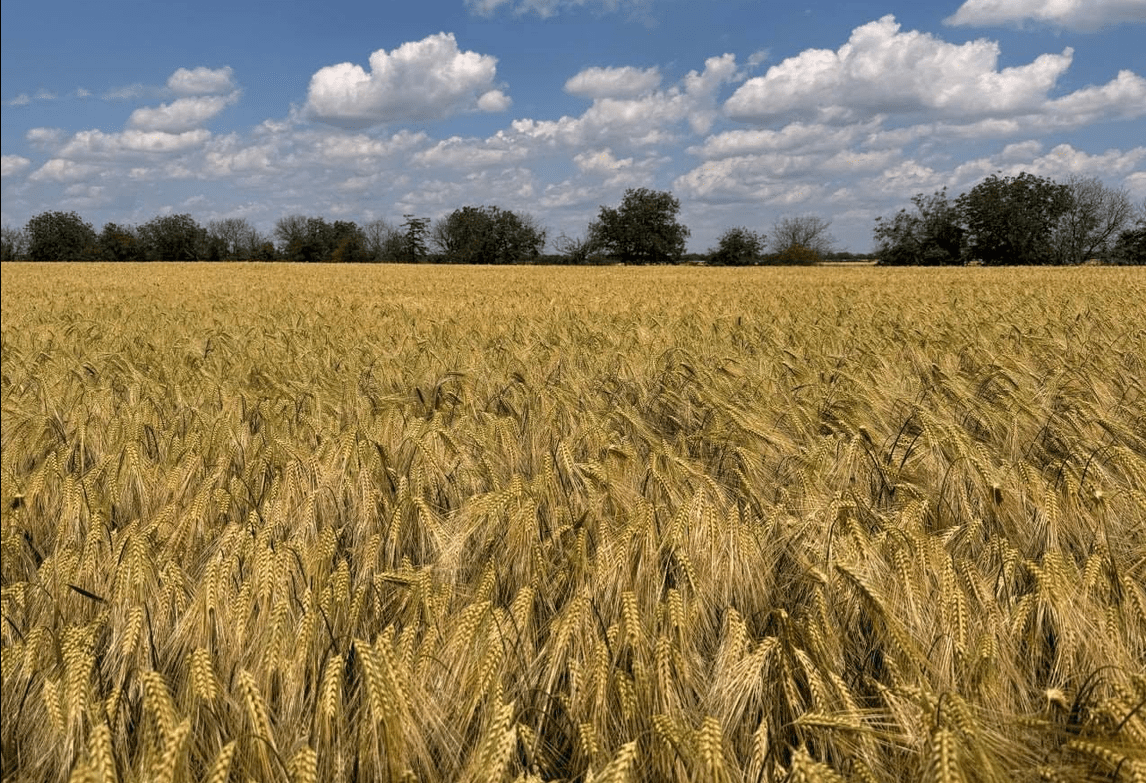
A ripening barley crop in Ukraine photographed mid-June. Photo: A-GRAIN
UKRAINE’S winter-crop harvest campaign has officially begun, with farmers in the south of the country threshing early planted barley and pea crops last week. While field survey results provide grounds for an optimistic production outlook this season, the harvest opens amid a challenging security situation and some weather-related issues.
Favourable weather throughout the autumn planting window and the early winter months enabled generally good crop establishment and overwintering conditions across most of the country. However, rainfall deficits did develop in the western regions from February onwards, leading to periods of moisture stress in cereals.
Rainfall deficits persisted throughout spring in the western oblasts after an exceptionally dry March, increasing plant moisture stress during the reproductive stages of winter cereals. Conversely, winter crops in the central, southern and eastern parts of the country benefited from favourable precipitation throughout the growing season. Rapeseed crops entered spring in good condition in most regions, but cold spells in February and April damaged plants and hindered early pod development in some districts, reducing yield potential.
Cereals area flat, rapeseed up
According to the latest bulletin from the European Commission’s Joint Research Centre, soft wheat and barley production remains close to the five-year average, despite the favourable yield prospects, due to the continued decline in cereal plantings, particularly in non-government-controlled areas and regions close to the front line. In contrast, the rapeseed area has expanded substantially, resulting in production above both last year’s level and the five-year average.
The spring seeding program is winding down in most regions, although sunflower seed and soybean planting progress has lagged the long-term average, raising concerns that area targets in some oblasts may not be met. According to the Ministry of Economy, Environment and Agriculture, total plantings of grains, pulses and oilseeds across the winter and spring seeding programs will be 20.3 million hectares (Mha) on Ukraine-controlled territory.
The area planted to grains and pulses is expected to be around 11.5Mha. Projections for the winter wheat sowing campaign sit at 5.2Mha, down from 5.7Mha a year earlier. The national corn target is 4.4Mha, on par with the 2025 area. The winter and spring barley plantings are estimated to be 600,000ha and 800,000ha respectively. The spring wheat and pea area are expected to be around 200,000ha each, with smaller allocations to oats, rye, buckwheat and millet.
The total oilseed area is currently forecast at 8.8Mha, slightly higher than the five-year average of 8.6Mha. Sunflower seed makes up the largest proportion at 5.4Mha, a year-on-year increase of 6 percent, followed by soybeans at 2Mha, similar to the previous season, and rapeseed at 1.4Mha, slightly higher than early-season estimates and up 16pc on the previous campaign.
UGA flags bigger crops
Earlier this month, the Ukraine Grain Association released a production forecast of 83.6 million tonnes (Mt) for the nation’s 2026 grain, pulse and oilseed harvest, up from last season’s 80Mt crop. The association pegged export potential in the 2026-27 marketing year (July to June) at 50.8Mt, subject to logistical stability and substantially higher than the 42.3Mt estimate for the current season.
The UGA expects the wheat harvest to come in at 22.8Mt, up from 22.5Mt in 2025. Wheat export potential in 2026-27 is said to be 17Mt, up from 13.5Mt in the soon-to-be-concluded 2025-26 export year. The USDA’s latest global supply-and-demand update put Ukraine’s wheat production at 23.5Mt, down from 24.1Mt last year, while its export forecast of 14Mt is unchanged season-on-season.
Barley production is pegged at 5.2Mt by UGA, 300,000t higher than the 2025 harvest, with export potential of 2.2Mt, against the 1.6Mt forecast for the 2025-26 marketing year. The USDA is more optimistic, calling the barley crop 5.5Mt, up from 5.3Mt last harvest, with an export projection 700,000t higher year on year at 2.3Mt.
Supported by favourable weather conditions since planting, the 2026 corn harvest is expected to reach 32.1Mt, 3.2pc, or 1Mt higher than in 2025. UGA is extremely optimistic about demand for Ukraine’s corn in 2026-27, suggesting export could be as high as 27Mt, compared to 22Mt in the current season. The USDA is calling production and exports 30Mt and 23Mt respectively, against 31Mt and 22Mt in 2025-26.
This year’s sunflower seed crop is forecast at 13.3Mt, a jump of 19.8pc, or 2.2Mt on the 2025 harvest. This compares to the USDA projection of 13.5Mt, up from 11Mt in 2025. Almost all of the seed will be processed domestically, with exports of the meal and oil by-products forecast at 5.4Mt and 5.6Mt, respectively.
The early-season optimism around rapeseed output has faded as a result of the April cold spells, with the UGA currently sitting on 3.5Mt, up from the 2025 harvest of 3.2Mt. With an increase in domestic processing capacity, rapeseed exports are expected to total only 1.9Mt. The USDA holds on to a 4Mt production forecast, 25pc higher than last year, with an export forecast of 2Mt, down 5pc year on year.
Ukraine’s soybean output is expected to come in at 4.9Mt, against 5Mt last year, with exports decreasing from 2.9Mt in the current season to 2.3Mt in 2026-27 as domestic processing increases. The USDA shares the UGA production forecast, but has exports significantly lower at 1.7Mt, against the 2025-26 estimate of 2Mt.
Logistics challenge
The aforementioned export forecasts from UGA represent the best-case scenario and assume that Ukraine’s logistical challenges do not worsen due to the ongoing war with Russia. Ukrainian officials and industry executives recently reported that intensified Russian missile and drone attacks on Black Sea ports, vessels, railways, and energy infrastructure are threatening the flow of cargoes and could reduce monthly grain exports by up to one-third. Ukraine relies heavily on its Black Sea ports, which handle more than 90pc of the nation’s agricultural exports annually.
A fall in shipping over the key summer months would pose a significant challenge for exporters as Ukraine enters the new marketing year with large carryover stocks, putting downward pressure on domestic prices and reducing farmer income. Export disruptions would also have broader consequences for the nation’s wartime economy, where agricultural exports are a primary source of foreign currency revenue.
HAVE YOUR SAY