
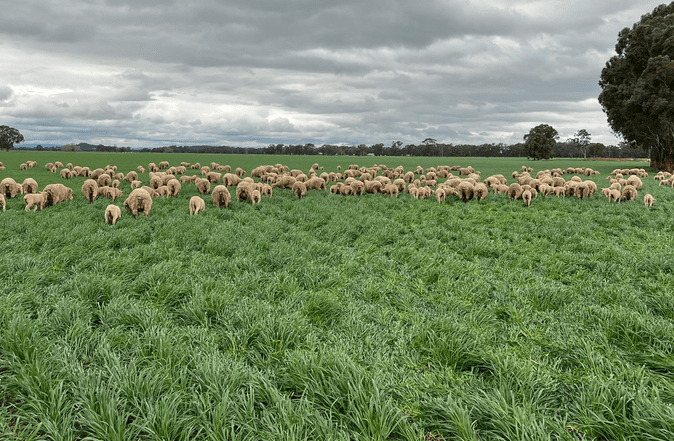
Ewes and lambs last week grazing Illabo wheat sown in southern NSW on April 7 as some of the paddock’s early wheat heads go up. Photo: Tim Coyle, Walbundrie
WHEAT and barley have traded sideways to slightly higher in the north this week as the planting window for winter crops nears its close.
In the south, wheat prices are under pressure from a crop growing in yield potential, and able to capture the benefit of a falling urea market.
Consumers have ratcheted back their buying to match the reticence of growers who in the south are aware of the early crop’s susceptibly to frost, and in the north are aware of the threat of El Niño.
| June 18 | Today | |
| Downs barley | $388 | $390 |
| Downs SFW | $380 | $380 |
| Downs sorghum | $360 | $355 |
| Mel barley | $335 | $335 |
| Mel ASW | $351 | $345 |
Table 1: Indicative prices in Australian dollars per tonne.
Northern planting slows
After a solid run on getting barley, wheat and chickpeas into the ground, some northern growers have stopped planting winter crop, and will hold over subsoil moisture for a summer crop.
Not all of the winter-crop area intended has been planted.
“People were saying early on it was too dry to plant, then it got too wet, and now it’s getting too late for some,” AMPS Moree-based agronomist and Crop Consultants Australia president Tony Lockrey said.
The week to 9am today has brought very little rain to southern and Central Queensland, where some growers are still planting, and patchy falls to New South Wales.
In central and northern NSW, higher registrations for the week include: Dubbo 15mm; Forbes 22mm; Peak Hill 23mm, and Quirindi 19mm.
AgVantage Commodities broker Brendon Warnock, Narrabri, said growers have found planting “a bit of a challenge” on heavy country with thick stubble.
“The calendar keeps marching on, and they’re outside the ideal window for wheat,” Mr Warnock said, adding that growers who can access country are planting as much as they can before the rain forecast for next week.
“People are saying: ‘After that, we’ll call it on the winter crop’.”
Mr Warnock and others said a premium for protein wheat has developed, possibly in response to the south’s soft season to date which at this early stage looks like producing a sea of ASW and APW.
“We are seeing spreads for H2 and APH2 develop.”
H2 is trading at roughly $5/t over APW, and APH2 at $10/t above H2.
“When we were trading high delivered-Downs values, they weren’t there; now in northern NSW, there’s a bit of a market for high-protein wheat.”
Mr Warnock said a “fair bit of trading is going on in warehousing…prior to the first of July”, when paid warehousing kicks in from bulk handlers including GrainCorp.
“It’s a funny sort of market; there’s not a lot of fizz.
“I think there’s still fill-in demand for wheat and barley, but there’s not much urgency on the buy side.”
On the sell side, Mr Warnock said growers were still thinking about high prices on offer in the first half of May, prior to rain enabling the north to start planting winter crop.
Since then, wheat and barley markets have fallen at least $50/t.
“They’re pretty comfortable on the buy side.”
Mr Warnock said the expense of this crop, based on pricey fuel and fertiliser as a result of the Middle East conflict, means growers are looking to recoup their expenses, and are in no hurry to sell at current rates.
“This El Niño doesn’t peak until spring-summer, and that forecast is keeping caution in the sell side.
“There are crops getting planted on marginal moisture.”
Mr Warnock said the relatively late start for the northern winter crop means it will mature late too, and be exposed to the impact of a potentially hot and harsh spring.
“We could see a position where more vulnerable crops are getting cut for hay.
“I think that’s probably holding back offering and selling.”
Mr Warnock said some demand was still coming out of the New England for northern NSW grain as graziers on the tablelands look forward to getting stock on to pasture once the weather warms up and makes use of recent rainfall.
“Rain and green grass gives them confidence to keep feeding.”
South’s season rockets along
Parts of the Victorian grainbelt have had more rain in the past week to set up the season for bumper yields.
Registrations in the week to 9am today include: Dimboola and Rupanyup 9mm; Lismore 16mm; St Arnaud 15mm, and Swan Hill and Ultima 11mm.
In southern NSW, registrations for the week include: Cootamundra 18mm; Deniliquin and West Wyalong 9mm; Temora 17mm, and Young 33mm.
“Crops are powering along,” Mygrain managing director and broker Andy Brown said.
Growers are busy applying herbicides prior to canopy closure, and top-dressing with urea, the price for which is now down to as little as $950/t ex port from some sheds.
Early rain and warm weather means the peak top-dressing period has come forward to June instead of July-August for many Mallee and northern Wimmera growers.
“With top-dressing, north of Horsham is around 95-percent done.
“Especially with barley, you’ve got to get [urea] on early to get it to tiller; some wheat they might do later if the protein spread is there.”
Confirmation that H5N1 avian influenza has arrived on Australia’s southern coast is not seen as impacting feedgrain demand from the poultry sector as producers take steps to keep birds indoors in susceptible areas.
Grain Central: Get our free news straight to your inbox – Click here
HAVE YOUR SAY