
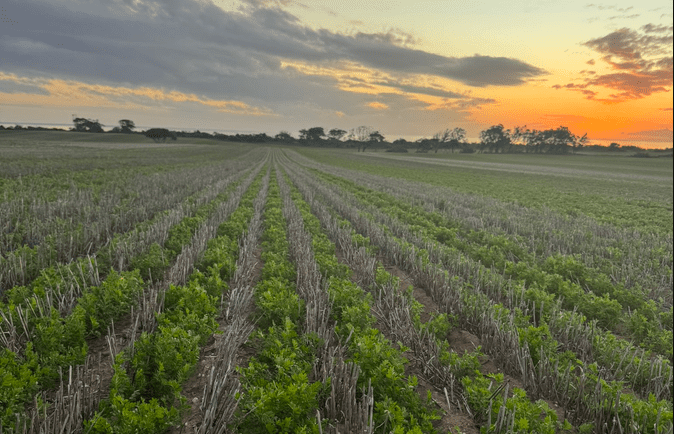
A crop of lentils sown at Port Broughton, SA, in April and photographed June 10. Photo: Matt McDonald
AUSTRALIA’S winter pulse crop is in and powering ahead in all regions as mixed signals filter through from export markets.
Lentils values have softened in response to the potential of bumper and possibly record crops out of Australia and Canada, and faba bean demand is in the doldrums.
Chickpeas markets are the bright spot, with glimmers of a demand lift coming out of India.
On the agronomy front, last week’s ruling by the Australian regulator around paraquat and diquat will see the withholding period between spraying and harvest doubled to 14 days.
This is expected to see growers using alternative chemistries and different management options to finish crops.
All prices quoted are in Australian dollars per tonne unless stated otherwise.
Chickpeas
Chickpea values have firmed in recent weeks, with current bids at around $710-$715/t for prompt delivery, up from $700/t last month.
This indicates some near-term bulk demand, although shipping stems are not showing any vessels due to load in Brisbane in coming weeks.
Sunrise Commodities managing director Scott Merson said he expects grower selling to pick up once values hit an equivalent of $700/t delivered Darling Downs packer.
“Bids are sitting at $690/t on the Downs now, so they’re not that far away,” Mr Merson said.
“There’s a little bit of engagement.”
Many growers in northern New South Wales and southern Queensland have finished planting chickpeas in the past week, and into good soil-moisture profiles following up to six weeks of consecutive rain events.
Mr Merson said that has prompted growers to look at clearing out storages ahead of the sizeable new crop now expected after a turnaround in the season from very dry conditions up to mid-May.
Some growers who feel they have run out of time to plant cereals or chickpeas are now holding over country to plant for summer crops, mainly sorghum, which can go in from August.
The Australian market is eyeing a positive demand signal gleaned from the Indian Government’s recent auction to release tonnage into the domestic market to cap prices.
“Bangladesh drove the most recent price spike [in Australia], but the Indian Government stocks auction tells me their own supply is not coming to market… and they’re having to step in for price control.”
In its quarterly Australian Crop Report released June 2, ABARES forecast Australia’s chickpea crop at 1.08 million tonnes (Mt) from 732,000ha, down from a near-record 2.19Mt from 1.12Mha in 2025-26.
Faba beans
Faba beans are trading sideways at around $400/t delivered Wimmera packer, unchanged from May.
Due to ample feed conditions across southern Australia, and limited demand from graziers in northern NSW and southern Qld now that the season has turned, domestic demand is doing nothing to support prices.
Egypt buys most of Australia’s faba beans, and its demand is minimal at present.
However, extreme heat currently being experienced in northern Europe may impact production in the United Kingdom and the Baltic, two of Australia’s major competitors into Egypt.
ABARES on June 2 forecast Australia’s 2026-27 faba bean crop at 875,000t from 443,000ha versus the 441,000ha planting that produced a record 1.02Mt in 2025-26.
Lentils
ABARES on June 2 forecast Australia’s 2026-27 lentil crop and area at 2.21Mt from 1.23Mha to break the 2025-26 records of 2.15Mt from 1.2Mha.
The potential for the crop now in the ground, and enjoying an ideal start in the major producing states of South Australia and Victoria, is weighing on the market.
The May peak in prompt lentil prices came at around $670/t delivered port early in the month, and values are more like $630/t.
ETG’s Horsham-based trader Todd Krahe said values are softening in response to the size of stocks still in Australia, and potentially record crops for Canada as well as Australia.
Tempering Australia’s bumper outlook is the risk of frost damage on flowering or podding plants, and the potential for a harsh spring.
“We’re all mindful of the super El Niño,” Mr Krahe said.
“I worry about these early crops with frost risk, and what a couple of hot days could do to them.”
Australia’s new financial year starts on Wednesday, and Mr Krahe said that could generate some sales from growers, but only as a last resort given the weakness of the market.
“If a grower’s got something else to sell, they’ll sell it.”
Eastern India appears to be in the market for November-December shipment Australian lentils at US $510/t cfr, down $60/t from values last month to reflect the potential weight of the Australian and Canadian offering.
“It’s only the trade doing anything right now; the grower’s not doing anything.”
Reduced options for desiccation
Last week’s Australian Pesticides and Veterinary Medicines Authority long-awaited review of Australia’s use of paraquat and diquat has doubled their withholding periods.
That means growers will have to wait 14 instead of the current seven days between spraying their pulse crops and harvesting them.
Grain Producers Australia southern region director Mark Schilling is a large-scale lentil grower on SA’s Yorke Peninsula and said the lengthened withholding period for paraquat is likely to see glyphosate used for desiccation.
“We use paraquat and diquat chemistry to brown out faster so we can harvest on time and stop the plant being exposed to elements.”
That includes winds that can shatter or drop pods, and rain which can impact pulse quality.
“Normally the crop is ripening at a rapid pace, and within seven days [of spraying], you’ll be harvesting with no problems.”
Mr Schilling has been a regular user of paraquat to shut down lentils prior to harvest, and said the APVMA ruling is likely to make glyphosate the herbicide used for desiccation.
“At the end of the day, it will prolong harvest if you use paraquat.”
Swathing for pulses may also be adopted as a practice to terminate crops prior to harvest, but Mr Schilling doubts it will be done on Yorke Peninsula, or other areas close to the coast.
“We live in the windiest part of Australia, and where most of the lentils are grown, you get strong southerly or northerly winds.
“If you get a bad wind in one or two days, you’ll be harvesting along the fencelines.”
Also, the architecture of chickpea and lentil plants makes them less than ideal candidates for swathing in current thinking.
APMVA’s ruling gives growers until June 2028 to use up existing stocks of diquat and paraquat under conditions printed on their labels.
Mr Schilling said the doubled withholding period was not good news for pulse growers, but this and the following harvest can be used to ponder or investigate new options.
“We’ve got two years to adapt.”
Pulse crops across southern Australia are generally in excellent shape but, like Mr Krahe, Mr Schilling said there was no guarantee the end of the growing season would be as favourable as the start.
“We’re cautiously optimistic.”
Grain Central: Get our free news straight to your inbox – Click here
HAVE YOUR SAY