
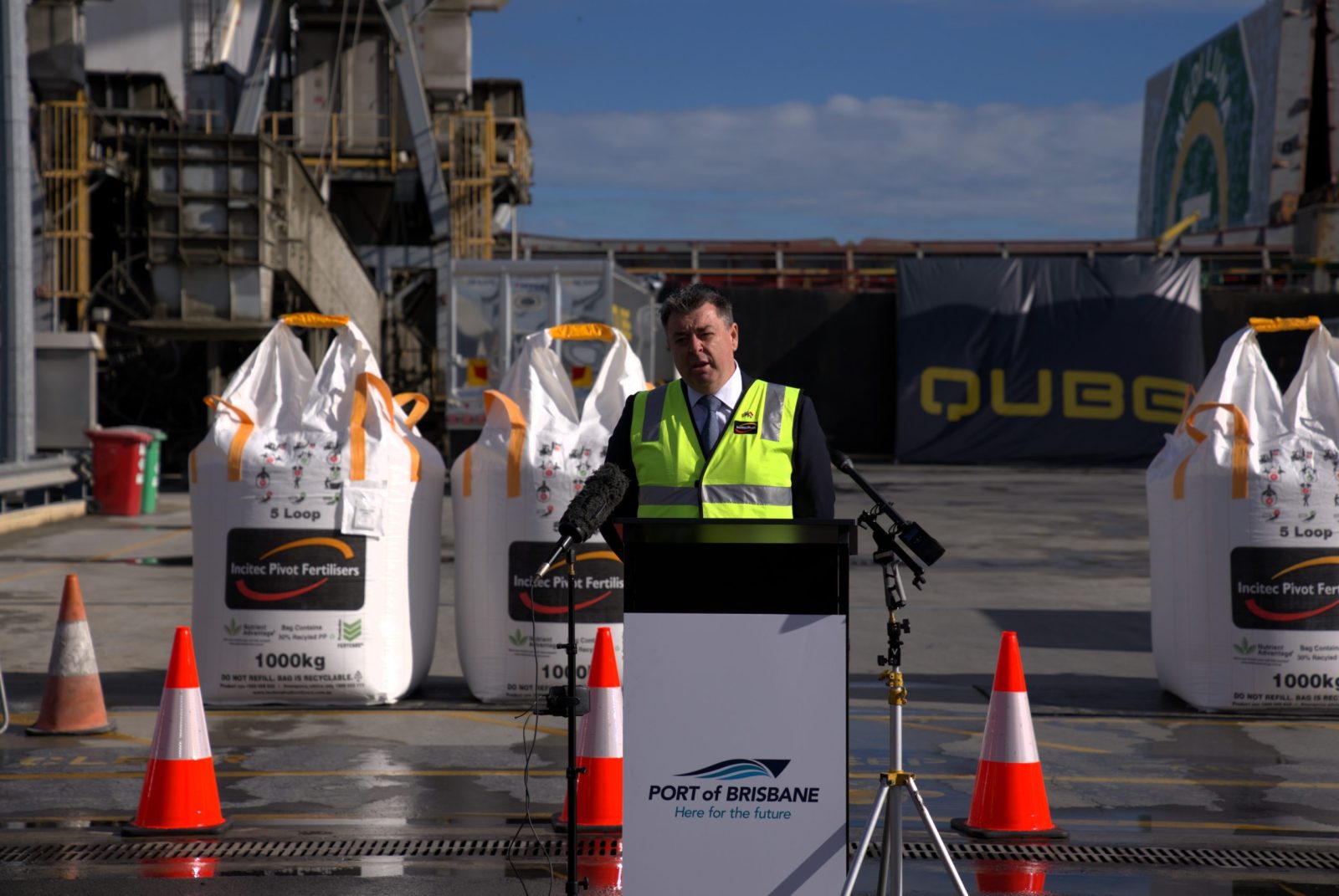
Incitec Pivot Fertilisers’ president Scott Bowman at the welcoming ceremony for the 47,250t cargo from Indonesia at the Port of Brisbane on June 22. Photo: Incitec Pivot Fertilisers
THE FIRST shipment of urea under the Federal Government’s Fuel and Fertiliser Security Facility arrived in Australia last week.
Manufactured in Indonesia, the 47,250-tonne cargo is part of the 250,000t supply deal, supported by the Australian and Indonesian governments, between Incitec Pivot Fertilisers and PT Pupuk Indonesia.
Announced in April, the deal came about in response to escalating prices and concerns about supply for Australia’s peak demand period, its winter-crop plant, following the closure of the Strait of Hormuz in early March.
Through Export Finance Australia, the deal is partially underwriting cargoes of urea being imported by Ridley’s Incitec Pivot Fertilisers in eastern and South Australia, and Wesfarmers’ CSBP and Sumitomo’s Summit Fertilizers in Western Australia.
Meanwhile, the many other companies bringing urea into Australia are having to absorb their loss without access to what is effectively a gap payment between their purchase price and what the domestic market is paying as global prices tumble in response to demand destruction, and an upswing in offerings from origins outside the Persian Gulf.
Two-tiered market
The well-intended move is said to be creating a two-tiered market, and Australian Fertiliser Services Association president Heath Boseley has outlined the pain it is causing.
“Every reseller from Elders and Nutrien all the way down to mum-and-dad sellers had to take ‘decile 12’ pricing to get supply; we’re now losing two, three or $400 a tonne,” Mr Boseley said.
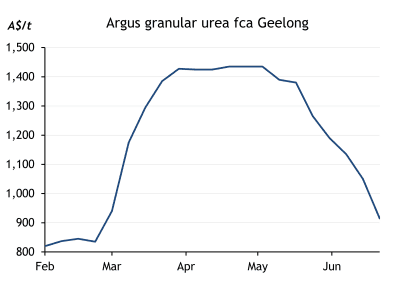
Source: Argus Media
As the second-generation proprietor of Pinnaroo Fertilisers in SA’s Murray-Mallee, he sources product from Geelong, Portland and Port Adelaide.
He said the closure of the Strait of Hormuz made price but not supply the issue in March.
“Once Donald threw his toys out of the cot and they shut the strait…we had to deal with that pricing to get supply.
“We were trying to work together to make sure everyone’s clients had enough nitrogen in the [crop’s] growth stage, then all of a sudden the government jumped in and gave a ‘favourite son’ award to a few suppliers.
“That’s where your two tiers come in; those that aren’t getting support are carrying all the loss.”
Prior to the war between the US and Iran breaking out in late February, urea ex port in Australia cost a little over $800 per tonne.
The market peaked at around $1450/t in April, and is now below $1000/t; price drops of up to $20 a day have occurred in the past week or two.
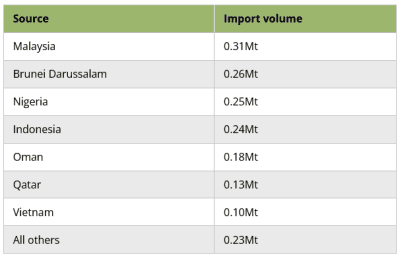
Import source of urea between 1 March and 22 June 2026. Source: ICS via DAFF Fertiliser dashboard
Stocks of urea are now believed to be ample.
This premise is bolstered by the Department of Agriculture, Fisheries and Forestry’s fertiliser dashboard, which states Australia has imported 78 percent of the urea it requires for the cropping year to October 31.
Grain Central has asked DAFF to provide details of any payment made to Incitec upon discharge of the first vessel, but these are not available because of contract provisions.
“The government and every supplier had indicated back in March that we needed to take fertiliser, and that’s what we did.”
“I’m not sure why the government intervened…and only supported 35 percent of the market and left the rest of the market swinging.
“All the resellers have contracted at higher pricing [and] everyone’s trying to get expensive product out now.”
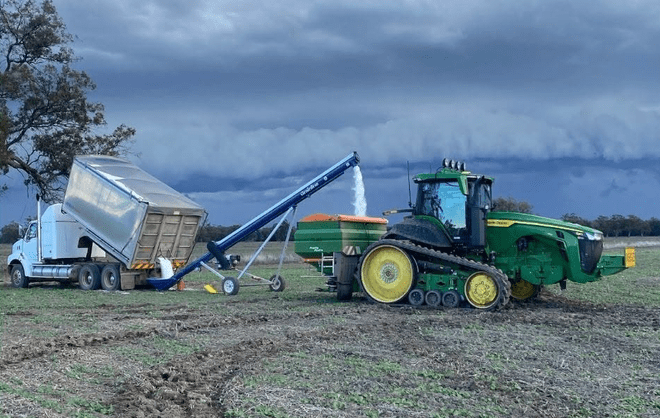
Top-dressing of canola and other crops with urea has continued at pace in recent weeks thanks to successive rain events across the southern Australian grainbelt. Photo: Australian Fertiliser Services Association
Growers without binding contracts have been able to take advantage of cheaper product, but many growers, wholesalers and others further up the supply chain are locked in at uncompetitive rates now that top-dressing demand is peaking in southern Australia.
“Survival is going to be key for the mum-and-dad companies that don’t have a balance sheet to help them out.
“It’s ripping millions of dollars off every resellers bottom line; the only place the loss sits is on the reseller.”
Competition lacking in SA, east
Along with the National Farmers Federation, Fertilizer Australia has been an industry presence in the Fertiliser Supply Working Group established in April in response to the US-Iran conflict’s impact on Australian fertiliser supply and pricing.
Grain Central’s sources in the fertiliser industry have not leveled criticism at Fertilizer Australia, which represents importers, manufacturers and distributors at a government and industry level, for the shape of the Federal Government’s response.
However, sources have acknowledged the awkward optics of Fertilizer Australia’s chair, Scott Bowman, also being the president of Incitec Pivot Fertilisers.
Grain Producers Australia southern region director and South Australian grower Mark Schilling said while WA has two companies, the Wesfarmers-owned CSBP and Sumitomo’s Summit Fertilizers, receiving government support, Incitec is the one and only in SA and the east.
“At least in WA there’s competition; in eastern and South Australia, where’s the competition? Where’s the ACCC?” Mr Schilling asked.
“All these second-tier fertiliser stockists are sitting on high-value stocks.
“The government’s intention was to support the farmer…and cover losses when fertiliser prices fall to support the market.
“What you don’t know is how far [they] will fall; is there a shut-off point?”
He said taxpayers look to be footing the difference.
Grain Central understands an online meeting on June 18 allowed AFSA members to voice their concerns about the struggling terms of trade to Federal Government officers from DAFF and the Department of Industry, Science and Resources.
In a post ahead of the meeting, Mr Boseley encouraged members to “jump online and voice their concerns and illustrate the strain current conditions are placing on business”.
Senator for Queensland Matt Canavan raised the issue of pain being felt by fertiliser companies not receiving underwriting from Export Finance Australia in Senate Estimates last month.
Marnco managing director Mark Been has also been active in raising the seriousness of the issue, including through a letter to Prime Minister Anthony Albanese.
Mr Boseley said AFSA was working “through the Federal Government, and anyone who will listen” to get through this challenging period.
Why not the farmer?
In hindsight, sources including Mr Boseley said a rebate to growers as the end users of urea would have been a better mechanism to help the Australian grain industry weather the peak in pricing caused by the closure of the Strait of Hormuz.
“It was great idea but it wasn’t thought out; it should have gone back to the farm-gate level,” Mr Boseley said of Federal Government support to three of Australia’s many fertiliser importers.
“The instrument the government brought in…provided Incitec with downside protection,” one source said.
“There’s an inequity there that wouldn’t have occurred if the government hadn’t acted.
“The real problem is the government interfered in an efficient market.”
“Incitec has been supported, and the others are swinging in the breeze.”
The source said Incitec’s competitors have had no option but to buy imported product at or near the top of the market.
“If they didn’t take a position, they wouldn’t have had any business to transact.”
Grain Central: Get our free news straight to your inbox – Click here
HAVE YOUR SAY