
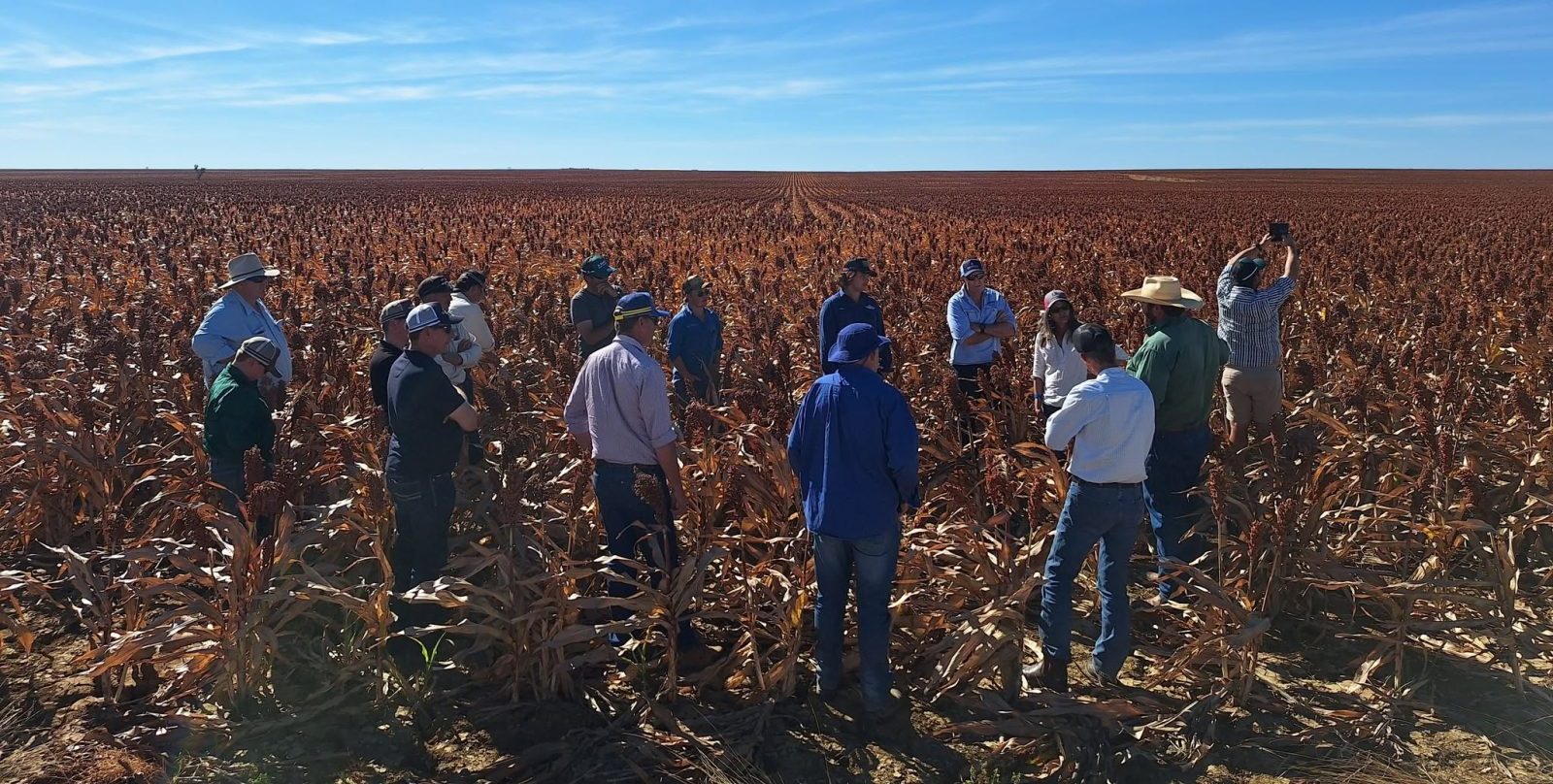
Nutrien Ag Cloncurry hosted a field day at the Maxwelton Common earlier this month. Source: FNQ Sustainable Cropping Inc
NORTH-WEST Queensland’s sorghum harvest is under way, with a big wet season causing waterlogging and yield losses in some crops, but higher yields on well-drained country.
At about 18,000ha, the region’s sorghum area is a new record, being slightly higher than last season’s.
The region’s chickpea harvest is expected to get under way in August-September across an area estimated at 14,000-15,000ha, down slightly from last year.
Nutrien Ag Solutions agronomist Angus Dalgliesh said sorghum yields had varied, depending on the level of waterlogging.
“The yields probably reflect the year that was just because it was a just a massive wet season,” Mr Dalgliesh said.
“For the season, we had over a metre of rainfall and some crops…got severe waterlogging.
“Yields at the moment are looking around that 2.5 tonne to the hectare, with some of the better, more drained country doing 4-5t/ha.”
Mr Dalgliesh said the rain arrived just after planting in January, with 300mm recorded in February and 200mm in March.
“They did recover but they were still very wet, so they never really got going.”
Richmond Shire Council recently harvested 1300ha of sorghum after last year’s chickpea crop at its Maxwelton Common.
“We got about one tonne to the acre, or 2.5t/ha,” Richmond Shire Council mayor John Wharton said .
“We’re very happy with it and we’ve got it in silos stored it away and ready to sell.”
“We’re going try to sell it locally because we’ve had a fair bit of inquiry for people to buy to use in their own smaller little feedlots.
“It we can support the local cattle industry…without having to export it to a port, well, we’ll give that a shot.”
Cr Wharton said selling locally eliminated freight costs, enabling more of the proceeds to stay in the district.
He said chickpeas looked like being the next crop for the Maxwelton Common cropped area.
“We’ll probably go back to chickpeas next year and it all…depends on our wet season.”
Locusts active
Beyond the region’s typical annual pests and diseases, Mr Dalgleish said locust activity was an outlier this year.
He said locusts appeared to be behaving differently to those seen in traditional northern cropping regions, with the locusts eating the grain head.
“We’ve been doing a fair bit of spraying for locusts.
“We’ve got a couple of isolated populations out in the middle of thousands of hectares of sorghum.
“They’re just eaten all the leaf off the sorghum and then they’ve actually gone and they’re chewing the grain up in the head.
“I hadn’t seen it, and no-one else had really seen it.”
Maxwelton field day
The grain harvest coincides with the region’s first field day, held at the Maxwelton Common.
Organised by Mr Dalgliesh, the Maxwelton Field Demonstration and Drought Resilience Trial Site event attached agronomists, industry representatives and growers from across Qld and New South Wales.
The event covered topics including forage sorghum and legume management, planter set-up options, soil nutrition and weed management, grain sorghum variety discussions, and opportunities in other legumes and grain crops.
Mr Dalgliesh said interest in crops from sorghum and chickpeas was evident at the event.
“Hopefully we start to grow a few more grain crops such as mungbeans, [which] is probably one that I’m certainly interested in, and then there is a bit of talk about pigeon pea as well.
“We just need a couple more grain crops; we’ve got cotton, obviously, but just a few more grain crops to fit into the rotation just to expand it and give us a few more options.”
He said there was scope to expand productivity in the region significantly.
“Down south, you’re looking at making small changes to try and improve your yield, maybe 2, 3 or 4 percent if you can, or maybe 1pc in some cases, whereas up here, we’re making small changes to try and, with the potential, to increase 10-20pc.”
Grain Central: Get our free news straight to your inbox – Click here
HAVE YOUR SAY