
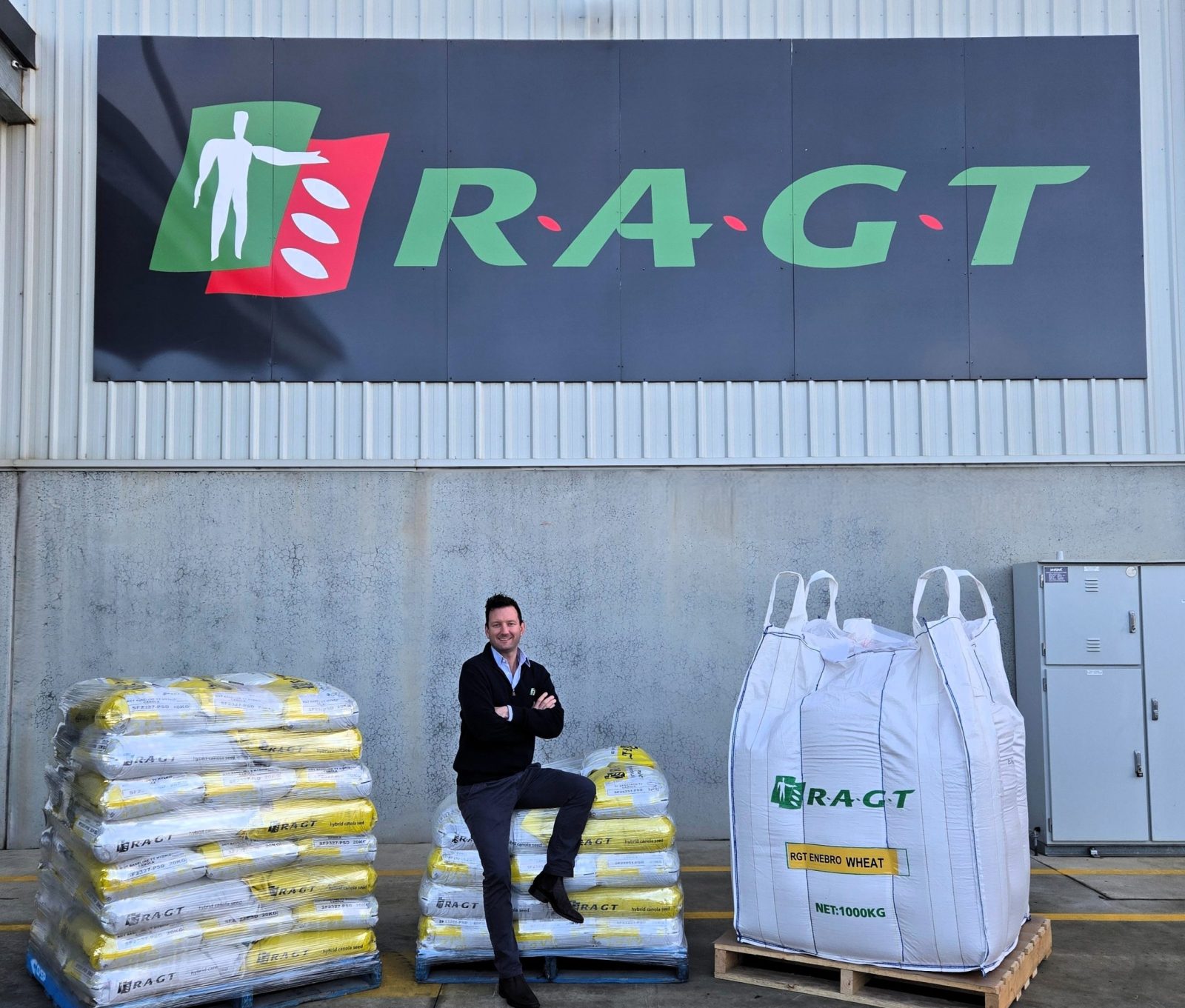
Graham Girdwood at RAGT Australia’s headquarters in Shepparton, Vic. Photo: RAGT
A CROP-PROTECTION product that offers a seasonal payout for RAGT cereal and canola varieties planted where rainfall during establishment is insufficient has received a grant of $982,049 from the Federal Government.
Launched as a pilot this year and knowns as SowSure, it couples at no extra cost with eligible RAGT wheat, barley and canola seed varieties sold in South Australia, Victoria, New South Wales and Queensland, and canola seed varieties sold in Western Australia.
Administered by RAGT’s Seed Force, SowSure has been selected under the Future Drought Fund’s Drought Resilience Innovation Challenges Pilot Program as being a farmer-led national trial of crop establishment protection for drought resilience.
It is one of 13 projects to this week receive a total of $ 19.3 million in grants from the program.
In partnership with five farmer-led organisations, the funding will support grower engagement, extension and field-based validation trials in 2027 and 2028.
The trials will examine crop establishment, seasonal rainfall and the impact of time of sowing on yield outcomes while comparing the SowSure approach with traditional sowing practices to evaluate its potential economic benefits for growers.
Counter to seasonal variability
RAGT Australia supply chain lead Graham Girdwood said the funding represented a significant endorsement of the SowSure concept and the value it could deliver to Australian growers.
“The government’s support will allow us to work alongside growers, researchers and farming systems groups to further test, validate and refine the concept across a range of environments and farming systems,” Mr Girdwood said.
“This funding provides independent recognition of the potential value SowSure can deliver to Australian farming businesses.”
Mr Girdwood said Australian growers were facing increased seasonal variability, particularly during crop establishment.
“SowSure was developed to help address that challenge by giving growers greater confidence at sowing and helping share some of the risk associated with poor early-season rainfall.”
RAGT Australia has engaged with five grower groups across southern Australia to carry out the research, supported by the federal grant.
Those groups are: Southern Farming Systems and Birchip Cropping Group in Vic; Hart Field-Site Group in SA; Central West Farming Systems in NSW, and the South East Premium Wheatgrowers Association in WA.
“Working directly with resellers, agronomists and growers ensures the outcomes remain relevant to real-world farming decisions and seasonal challenges.
“Ultimately, our objective is to contribute to a more resilient Australian grains industry by providing growers with additional tools and knowledge to manage seasonal uncertainty.”
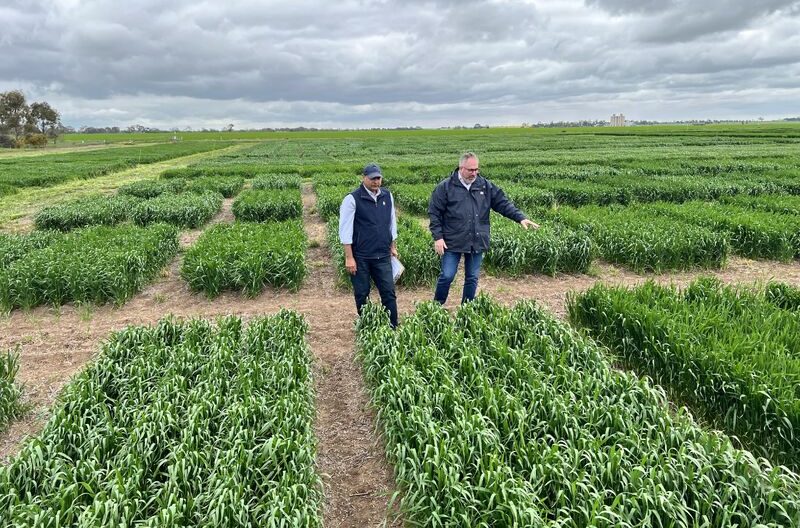
RAGT Australia senior plant breeder Maqbool Ahmad with RAGT’s Western Europe and Australasia business director Simon Howell at RAGT’s Wheat and Broadacre Breeding Facility in Longerenong, Vic. Photo: RAGT Australia
Clear-cut criteria
Mr Girdwood said the company has worked with insurance providers to develop SowSure as a bundled product based around parametric insurance and on clear-cut criteria that pays to a fixed amount when a pre-defined event occurs.
“Most farmers are pretty savvy and participate in crop insurance at the end of the growing season for threats like hail, but not many are taking up insurance on establishment.”
Under SowSure, growers can receive up to $300/ha if cumulative rainfall in a defined period over the sowing window falls below a threshold.
This year, growers in Vic and WA have taken part in the SowSure program, and their rainfall measurement period started April 15 and ended June 15.
The strong start to the season across southern Australia means no claims have been made, but had they been, the rainfall deficit would have been calculated and verified on July 15, with payouts occurring soon after.
To take part in SowSure, growers can purchase RAGT seed varieties through the traditional agricultural reseller network and register their crop by providing location data and the area of their crop.
The program’s rainfall threshold is calculated using 20 years of historical rainfall data and is determined by reference to the nearest SILO grid cell measuring around 5km x 5km.
If the cumulative rainfall recorded for the applicable grid cell and predefined establishment period is below the 20th percentile rainfall threshold for the respective SILO weather grid, a payment is triggered on a sliding scale.
“That rainfall data is all public, so it’s black and white and not grey in terms of whether a payment is made, and you don’t need an assessor to see the crop.
“What happens after the pre-defined establishment period is irrelevant and growers could get a payout ahead of the season changing and them still harvesting a crop.”
Mr Girdwood said the hope is that SowSure will build grower and industry productivity by encouraging growers to plant at the optimal time for their seed variety.
“People will often wait for an autumn break before they plant, and sometimes they wait and wait and wait.
“That waiting can bring a yield penalty, and the idea is that if you sow to the date which will give you the best yield for that variety, it will give you peace of mind.”
RAGT Australia is part of a global group founded in France in 1919 as a grower cooperative.
RAGT arrived in Australia through its acquisition of Seed Force in 2020.
The parent company is involved in the breeding, sale and distribution of cereal, oilseed, pulse, pastures, maize and sugar beet varieties, and is a market leader in European cereals.
Other recipients
The Future Drought Fund was established by the Australian Government to help Australian farmers and rural communities prepare for, manage and become more resilient to drought.
Alongside SowSure, Drought Resilience and Innovation Challenges Pilot Program grant recipients announced this week are:
Arca Sustainability, WA: Farm Forward, Building Drought and Climate Resilience in Western Australia’s Broadacre Sector – $286,605;
Australian Fodder Industry Association, NSW and Vic: Transforming Australia’s Fodder System. A Collaborative Network for Tough Times – $1,690,000;
Berries Australia, NSW, Qld, Vic and WA: Bioreactors – Turning runoff into a resource for the protected cropping berry industry – $813,006;
Deakin University, Vic: Building Drought Resilience Through Simulation-Based Learning for Farmers and Rural Communities – $1,186,850
Department of Energy Environment and Climate Action, Vic: Optimisation of production and on farm demonstration of beneficial microbes to alleviate drought stress in cereal crops – $1,624,436;
Desert Channels Queensland, Qld: Resilient Agriculture through Innovation in Native Seeds – $1,401,500;
James Cook University, Qld: CLOVER – Climate-smart Optimisation for Valuable & Efficient Irrigation – $1,599,407;
Mallee Sustainable Farming, NSW, SA and Vic: Accelerating the adoption of farmer-led intercropping and multi-species innovations in southern Australia’s fragile low-rainfall environments – $1,997,000;
Mollongghip and District Enterprises, NSW, Qld, SA and Vic: Transformative AI-Driven Soil Microbiome Analysis and Customised Biofertiliser Development – $1,972,625;
Outback Academy Australia, NSW, SA, Tas, Vic and WA: Thriving Country Thriving Communities – Traditional Ecological Knowledge Meets New Science and Technologies to Support Drought Resilience – $1,943,000;
Riverine Plains Incorporated, NSW, SA, Vic and WA: WaterSmart Decisions – Scaling Farmer Confidence in Water Use Efficiency Technologies – $1,986,020;
Seed Force, NSW, SA, Vic and WA: SowSure – A Farmer-Led National Trial of Crop Establishment Protection for Drought Resilience – $982,049; and,
The University of Newcastle, NSW & WA: Hydro Harvester Pilot Program – $1,904,166.
Grain Central: Get our free news straight to your inbox – Click here
HAVE YOUR SAY