
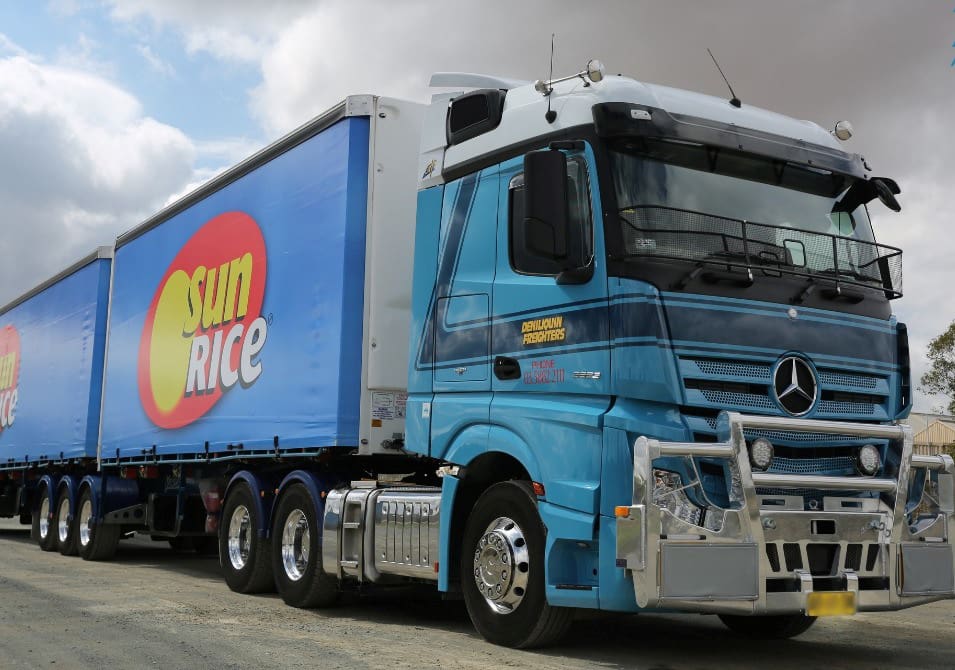
SunRice is consulting with staff following reduced crop production. Photo: Deniliquin Freighters
SUNRICE has announced changes to milling operations at its two Riverina sites, including a reduction in shift structures, with staff now being consulted on the proposed workplace changes.
The company said the changes were driven by a prolonged reduction in crop supplies.
The ABARES June Crop report has the rice harvested this year at 178,000 tonnes, the smallest since 2019-20, and 66 percent down from 2025.
Industry has pointed to structural changes to water availability under the Murray-Darling Basin Plan, along with drier seasonal conditions, as key drivers of the smaller crop.
SunRice Group chief executive officer Paul Serra was in the Riverina region to deliver the message in person.
“SunRice Group has announced changes to its current Riverina milling operations in response to a sustained reduction in rice supply, driven by ongoing dry conditions and current water policy settings,” Mr Serra said.
“These changes include revised shift structures at our Deniliquin and Leeton milling sites to better align operations with current and forecast rice supply levels.”
“As a result of these changes, we have commenced consultation with employees on the proposed workforce impacts across Deniliquin, Leeton and AGS operations.
“We acknowledge the significance of this announcement for our people and the local communities.
“Our focus is on retaining as many employees as possible, including exploring redeployment opportunities where feasible.
“As always, we are committed to engaging openly, constructively and transparently with our people throughout the consultation process.
“We continue to advocate to government on the adverse impacts of water policy settings on the Riverina rice industry, while closely monitoring seasonal conditions and crop outlook.”
MDB policy impacts
Ricegrowers’ Association of Australia responded by linking the news to the Murray-Darling Basin policy of water buybacks.
RGA president Peter Hermann said this was evidence that water buybacks “impact jobs in rural communities”.
“Jobs that were done by people who were active contributors to this country are lost,” Mr Hermann said.
“This government puts our people on welfare.
“Who’s going to benefit from that?”
RGA executive director Graeme Kruger said the Australian rice industry was highly vulnerable to water buybacks.
“The government’s own advice predicted continued water buybacks would see rice production decrease by 11.3 percent, which has to influence rice processing due to reduced scale,” Mr Kruger said.
“We acknowledge rice production is highly variable due to seasonal conditions, but our industry analysis shows rice production has never returned to pre-Basin Plan water recovery levels, even in wet years which shows the long-term structural impact water recovery has had on the industry.”
Shadow Minister for Water and Federal Member for Riverina Michael McCormack backed the view of industry.
“Behind every lost shift is a worker, a family and a community paying the price for bad government policy,” Mr McCormack said.
“Bad water decision-making by Labor – buybacks – hollows out irrigation communities and that’s what is happening.
“The small business sector suffers, schools lose students and towns wither.
“It is madness based on poor policy and lazy politics.”
NSW Government Shadow Minister for Water and Nationals Member for Cootamundra Steph Cooke supported her Federal counterpart.
“The Riverina rice industry is part of the social and economic fabric of southern NSW, supporting growers, mill workers, transport operators, small businesses and families across generations,” Ms Cooke said.
“This is a stark reminder that water policy decisions do not stop at the farm gate.
“They flow through our mills, processors, main streets, schools, sporting clubs and regional economies.”
Ms Cooke said SunRice has made it clear that reduced Australian rice supply, recent dry conditions, and structural changes to water availability under the Murray-Darling Basin Plan have driven this decision.
“That should ring alarm bells in Sydney and Canberra.
“The NSW and Federal Governments must do more than acknowledge the impact of water recovery on Basin communities.
“They must urgently step up with practical support for affected workers, genuine investment in regional industry, and a clear plan to protect food and fibre production in the southern Basin.”
Grain Central: Get our free news straight to your inbox – Click here
HAVE YOUR SAY