
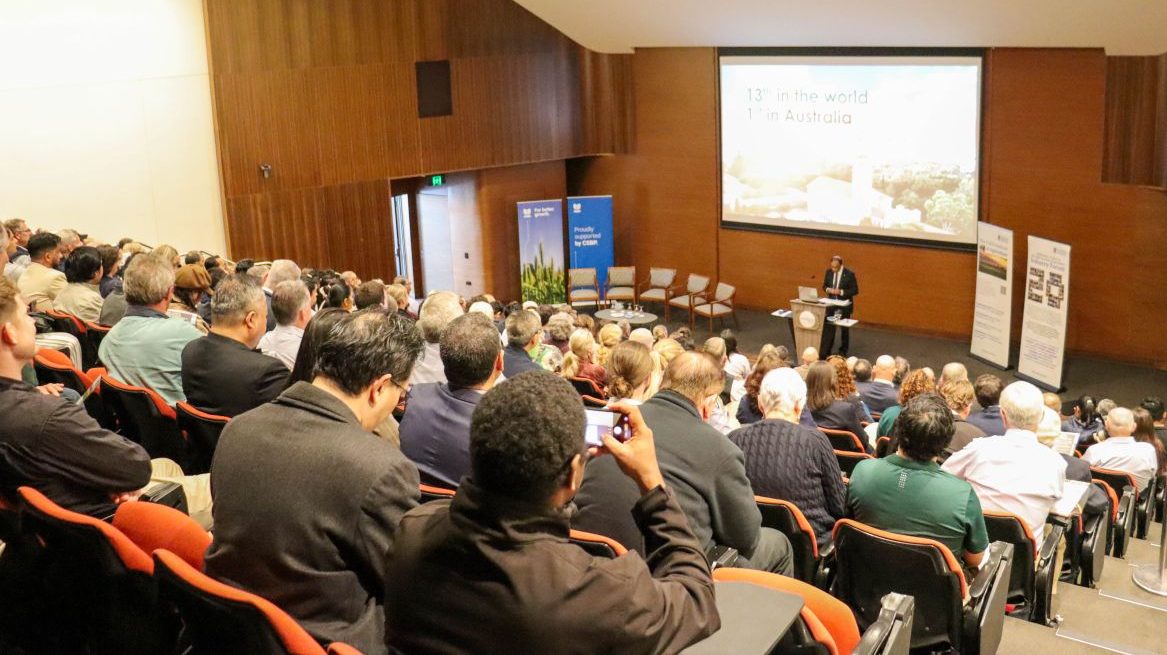
The UWA IOA held its Annual Industry Forum earlier this month. Photo: UWA IOA
THE DOMESTIC institutional food sector could provide a significant new market for Australian pulses, with aged-care demand alone estimated at up to 50,000 tonnes per annum, according to Wilson International Trade managing director Peter Wilson.
Mr Wilson, who is also the Grains Australia Pulse Council chair and serves as a board member of the Global Pulse Confederation, gave a presentation at the UWA Institute of Agriculture (IOA) Annual Industry Forum held July 8.
He said demand would increase further when other institutional markets were included, such as hospitals, defence facilities, education providers and correctional services.
In total, Mr Wilson said pulse demand from these markets could range from 150,000-500,000t in the best-case scenarios.

Peter Wilson speaking at UWA’s 2026 Annual Industry Forum.
He predicted lentils would capture the largest share of the pulse mix in this sector, accounting for 40-50 percent, followed by field peas at 25-35pc, chickpeas at 15-25pc and faba beans at 10-20pc.
“The institutional food system is a $20-50 billion economy here in Australia, and the value lies in the midstream process and the integration layer,” Mr Wilson said.
“So, if you said that we could find a new market for up to 50,000t of pulses just in aged care, if you did it right, people would be pretty excited about that.
“It’s easier than trying to get a market open somewhere offshore and it’s a high-value market.”
Sector cost savings
He estimated that incorporating pulses into meals as a complementary ingredient, rather than replacing meat entirely, could save the aged-care sector between $45 million and $350M a year.
“There’s really quite large institutional demand out there that could be influenced because pulses being added into the rotation or the ration of the diet can hit the nutritional requirements, which are largely regulatory.
“If you’re an aged-care facility, you’ve got regulatory requirements, you must feed the people properly and…none of them have got any money.”
Mr Wilson said an example dish was bolognaise made with lentils as a substitute for some of the meat, and this could reduce meal costs by about 18 percent, lower fat levels, maintain protein content, and increase fibre.
For other dishes, savings estimates varied, but were substantial at 20-40pc for pureed meals, 25-50pc for soups, and 15-35pc for casseroles.
He said this was achieved without cutting out all meat protein.
Scope as complementary protein
Mr Wilson said it was important to distinguish pulses as having the ability to be a complementary rather than a replacement ingredient in meat-based dishes.
“I’m suggesting that when we’re looking for new markets, it’s not about demonising another product.
“If I demonise beef and I think I’m going to replace it with a lentil, it’s not going to work.
“The pulse industry isn’t going to take on the red meat industry and think: ‘yeah, we’re nailing this sucker’ because we’re not.”
Mr Wilson said “if it comes down to cost per point of protein, soybeans win” and that comes with challenges in the Australian context.
“Then we have to demonise soybeans as our other vegetarian protein, because they’re grown in that dirty country called Brazil and there might be some deforestation.
“So if we have to exist by demonising another commodity, then we’re not going to survive.
“It’s about complementarity.”
Opening for further processing
Mr Wilson said the market opened new opportunities for value-added pulse products that would make it easier for institutions to include pulses in their dishes.
“If you can find a way to include pulses – it can’t be just send them a couple of bags of peas and see how they might use them – we’re going to have to get a little bit innovative to make sure people know how to use it.
“If you can make it easy for people to use this in an institutional format, then I think they would, we know it’ll work in aged care.”
He said the grains industry needed more facilities capable of further value-adding pulses beyond current levels.
“A lot of our capacity to actually get involved doesn’t exist today.
“We have lots of really good primary elevation where we’re moving stuff over shift-rail or into containers and over shift-rail.
“We have some primary processing where people are cleaning and boxing, bagging and boxing, so mungbeans are going out in bags and cases, some desi chickpeas are going out in bags.
“We have chana dhal manufacturing, so we have a little bit of what we call decortication, so where you take the skin off and you’re splitting it.
“At the end of the day, once you go beyond that sector, we don’t really have much.”
Mr Wilson said most of the ready-to-eat meals featuring pulses available in supermarkets were from India.
He said the opportunity lies in developing Australian-based processing using domestically produced commodities, such as manufacturing “prepared minced brown lentils” with targeted protein levels and at cheaper prices than animal meat.
“It’s not an agricultural opportunity, it’s a food system redesign opportunity, and value is created in the midstream conversion layer.”
Grain Central: Get our free news straight to your inbox – Click here
HAVE YOUR SAY