
 Weather:
North Dakota spring wheat tour finds fields swinging from best to worst within 10 miles of each other — no clean read yet, but conditions took a real hit Monday.
US corn/soybean belt losing soil moisture for a third straight week; heat currently camped in the west, worth watching how far east it pushes.
Canadian Prairies staying hot over the next week — that heat premium is a big part of what’s holding canola up despite the Chicago-led pullback.
France and broader Western Europe still baking — the heat wave is behind both the wheat crop downgrade and a 10 percent rapeseed yield hit, with sunflowers also getting hurt.
Markets
More damage to dry bulk vessels with an ADM barley vessel being hit by drones overnight – can’t imagine what it’s like sitting on these vessels at the moment.
Oil continues to move higher with the risk on the Red Sea the next input to the conflict. Yemen has talked a big game towards the Houthis, but, if they managed to cut Saudi access to the Red Sea, oil is too cheap.
July/Aug will be crucial data for Russian exports – in the 23/24 marketing year Russia punched out just under 10 million tonnes (Mt) wheat in those months to finish the marketing year at just over 53Mt. Current estimates are looking for 47-49Mt, so a few slow months will take some catching up.
Day Ahead – Australia
East coast values are still being driven by domestic El Niño risk. A very small glimmer of hope in the back end of the forecast for the east coast but the forecast needs to move to the front end before values reflect optimism.
Canola took a breather offshore but values feel supported domestically. The recent expansion of the GM export program to China along with wide open crush margins should keep bids supported.
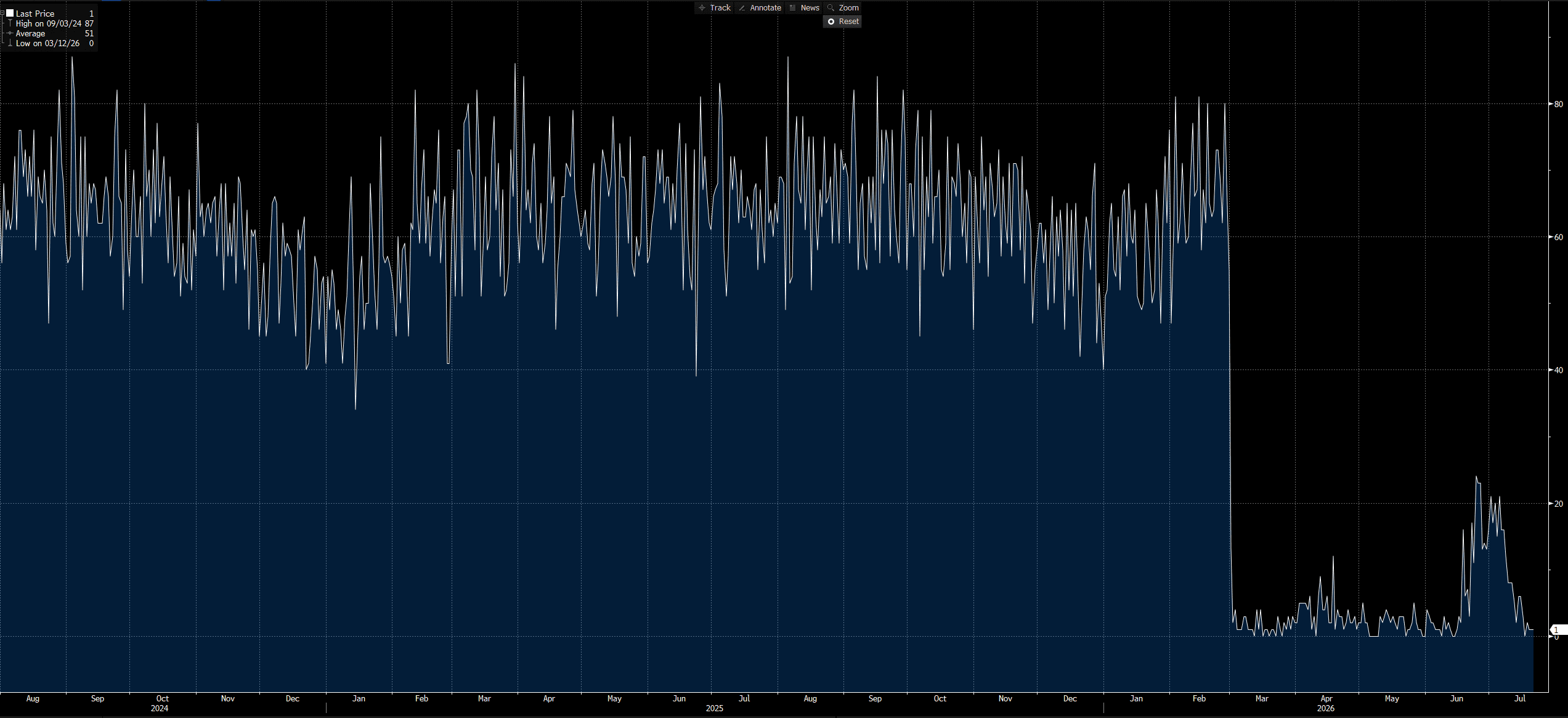
Strait of Hormuz Vessel Tanker Crossings. Source: Bloomberg
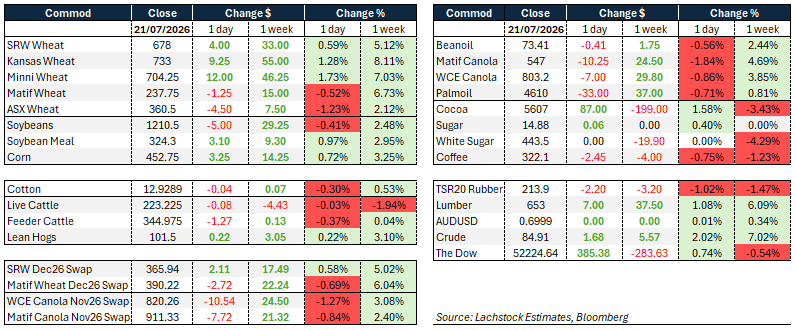
Wheat: Chicago wheat firmed as Black Sea risk continued to build premium into the market, with Brian Grete of Commstock Investments noting traders are still working out how much Ukraine/Russia disruption to price in.
Minneapolis led the complex after spring wheat conditions sank 5pc on Monday against expectations for a 2% decline, and the Wheat Quality Council’s crop tour found results varying wildly field to field, with interim director Sean Finnie flagging the worst and best plots of the day within ten miles of each other.
Russia tightened its grip on Black Sea shipping further, banning vessels from anchoring without air defence cover at Azov and Kavkaz, ports that handle roughly a quarter of Russia’s grain exports; a third-party vessel carrying ADM barley was struck by drones departing Odesa, though no casualties were reported.
SovEcon’s Andrey Sizov trimmed Russia’s wheat crop to 88.3Mt from 88.9Mt on weaker prospects around Krasnodar, while Commerzbank cut its French soft wheat estimate to 30.8Mt, down 7.6% on the year, citing Argus assessments of the ongoing heat; Matif has rallied nearly 15% since end-June on the back of it.
The consumer dilemma remains stark: Tunisia paid US$283/t for soft wheat against $268-273 fetched by Saudi Arabia only two weeks earlier, underlining how quickly the Black Sea premium is being rebuilt with no sign of normalcy in sight.
On trade, Washington’s fresh 50% tariff on Canadian goods and a third round of US-Mexico USMCA talks are adding noise, though TD Cowen’s Chris Krueger sees room over the next month for a face-saving unwind.
Other grains and oilseeds: Corn tracked wheat higher, with December setting a fresh high and closing above its 100-day moving average even after conditions fell 1% and soil moisture readings declined for a third straight week; USDA’s crop progress read corn at 67% good/excellent against 66% for soybeans.
The Black Sea overhang applies to corn too, given how much of Europe’s import needs will lean on Ukraine’s export window once it reopens. Beans were the softer link, with a surprise uptick in conditions and no fresh daily sales attracting offers, though meal held firm on strong South American values and bean oil softened on reports of a wave of Chinese used cooking oil due into China in early August; September crush still rose 7.25c to 310.50.
CME will list sorghum basis futures from August 24, pending regulatory sign-off.
Canola gave back some of Monday’s highs, with Winnipeg’s November contract down C$7.00/t to C$803.20 after dipping briefly below the C$800 psychological level before finding support; Phil Franz-Warkentin (Glacier FarmMedia) pointed to spillover from weaker Chicago beans and soyoil plus softer Matif rapeseed and Malaysian palm oil, though Mideast-driven crude strength and a hot Prairie forecast limited the damage.
Paris rapeseed itself extended its rally to a 3-year high near €560-563/t, with Expana’s Nouha Slama citing sunflower yield damage from the European heat wave as an added prop; France’s agriculture ministry is now projecting a 10% rapeseed yield hit.
Malaysian palm eased on weaker Dalian oils and softer crude, while India reported falling rice, oilseed and pulse plantings on below-average monsoon rains so far this season.
Macro: Oil extended its July surge, now up roughly 20% since hostilities between the US and Iran resumed, as the two sides traded strikes for a tenth straight day.
Trump downplayed prospects for near-term talks, saying Iran would need to negotiate “in a meaningful way,” while Houthi militants added a threatened naval blockade of Saudi Arabia to the mix, pushing Hormuz transits to their lowest in three weeks.
Goldman has floated Brent above $120 if the Hormuz disruption persists, and Defense Secretary Hegseth put the campaign’s cost so far at $37.5bn while pushing for a further $67bn in supplemental funding. US retail gasoline back above $4 a gallon adds a domestic political dimension ahead of the midterms.
The Aussie held steady near 0.7002 in early Wednesday trade, with CBA’s Samara Hammoud noting a rebound in US tech and semiconductor stocks offset the drag from higher oil and Treasury yields (3-year up 3bps to 4.56%, 10-year up 3bps to 4.98%). China’s Wang Yi signalled Beijing wants to deepen cooperation with both Canada and Australia, a mild positive for the currency against a backdrop of Trump’s Iran rhetoric and Hormuz-driven oil gains.
Black Sea and Hormuz risk are now compounding rather than competing narratives — wheat, corn and canola are all carrying geopolitical premium simultaneously, while crude’s ~20% July run is feeding straight through to vegoils via biofuel demand. Watch French/EU heat damage estimates (wheat and rapeseed both), the SRW/MWU spring wheat tour verdict, and whether Trump’s tariff actions against Canada spill into actual trade flow disruption.
Local: In the west of the country bids were stronger on canola and wheat, and were a touch softer on barley. New crop bids in Albany PZ were A$880/t FIS for canola and $846 for GM, wheat $371, and barley $328. Look for 26/27 canola bids to make fresh highs today.
East saw the liquidity vacuum through a dry 8-day forecast. This season has been all about the top and tail – southern growers cutting lentil yields due to extended wet ground – north considering what a crop will look like should it not rain for another month.
HAVE YOUR SAY