

The Australian Mungbean Association’s annual R&D forum was held in Toowoomba last week.
MAINTAINING access to the Chinese market was a key focus when the Australian Mungbean Association gathered for its R&D Forum in Toowoomba last week.
The forum was held against the backdrop of 10 Australian mungbean containers being rejected by China earlier this month because glyphosate residues were found to be five times above the allowable limit.
AMA president James Hunt said maximum residue limits (MRL) were “causing issues for all origins of mungbeans” imported into China.
“Myanmar, first and foremost, was pulled up on a number of chemicals, not just the one that’s mainly causing us grief, but they were pulled up on many chemicals,” Mr Hunt said.
“Therefore, up to more than a third of their crop was not allowed in there straight away.”
He said that “turned into more like 50 percent of their crop” having Chinese market access issues, and the disruption to supply it caused saw Australian values jump significantly into the $1500-$1700/t bracket.
However, Mr Hunt said it also resulted in Australian mungbeans being tested, and this has prompted greater consultation with growers on appropriate chemical use, while also promoting the benefits of mechanical desiccation and increased crop testing.
He said the National Residue Survey (NRS) stepped in to conduct the testing, with further work needed to determine how and when it could be carried out accurately.
“NRS has been amazing; it has tested our inward samples and has tested our outward samples.
“I will say there’s a huge amount of variability in the testing… and this is causing issues, because no matter how much testing we do, when another sample is drawn and tested, you’re going to have another result.”
Mr Hunt said there are questions about the process which will be “addressed through the AMA over time”.
He said the process has allowed the AMA the “opportunity to gather the data, collate the data, and then use that data in the future to be better at it”, and Myanmar’s response to the residue issue may be to pivot to production of pulses other than mungbeans.
“They won’t wipe mungbeans, but they have other options – black matpe, pigeon peas for the Indian market – which are running a bit of a high at the moment too.
“So if they’ve got issues in one crop, they can pivot to another crop…which means Australia is in a great place to fill that gap and to bring that value home.”
New industry fund
Mr Hunt, also managing director at Australian Choice Exports, said despite these issues, the Australian mungbean industry was “in a growth period”.
This season, a strong Central Queensland crop lifted the mungbean harvest to about 120,000 tonnes, around 10,000t more than the previous year, with higher yields more than offsetting a smaller planted area.
The forum also saw the launch of the Paul McIntosh Research Investment Fund which will provide a total of up to $200,000 in AMA co-investment and research projects over the next three years, commencing October 1.
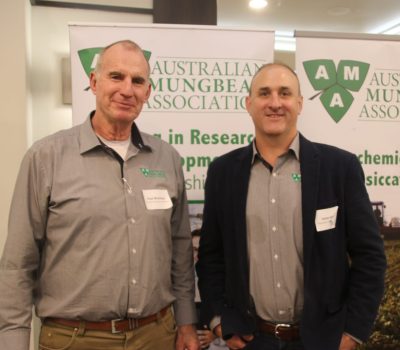
Paul McIntosh and James Hunt
“We acknowledge Paul’s significant contribution to the industry over a long time,” Mr Hunt said.
“The AMA is focused on reinvesting in the industry.
“We’re really looking for it to align with our key objectives in our strategic plan and likelihood of adoption through the industry.”
He said following the formal presentations at the forum, the AMA would be considering the first proposals put forward for the investment fund.
Pest, disease monitoring
Queensland Department of Primary Industries researchers Lisa Kelly and Trevor Volp provided updates on pest and disease pressures affecting mungbeans and related crops as part of their monitoring activities.
Dr Kelly said disease incidence in mungbeans was “strongly associated with the weather conditions that we’re seeing each season”.
“Last season, it was a hot, dry season, so we didn’t have as many disease outbreaks that you can get in some seasons,” Dr Kelly said.
“So those most common diseases tend to occur every season, but they will differ in their incidence and severity.”
She identified fusarium wilt and powdery mildew as the most common and recurring diseases affecting mungbean crops each season.
Dr Kelly said Tobacco H3 virus was the major disease concern in CQ, while Cercospora leaf spot was more commonly affecting crops in the Burdekin region.
Dr Volp provided an update on pest pressures affecting mungbeans, including pests that are already present or pose a potential risk to crops.
He discussed three pests: leaf miners, bean podborers and cluster caterpillars.
Dr Volp said all the leaf miner infestations in southern Qld and the Burdekin recently have been the American serpentine species and there had been “very high levels of parasitism” to help regulate populations.
“The sky’s not falling with this pest… this is more of a watch and see what happens in the future.”
He said growers would be familiar with bean pod borers, considered “the number one pest issue in mungbeans”.
“Particularly in Central Queensland, we’ve had two consecutive high-pressure seasons.”
Dr Volp said concerns had been raised about potential resistance to the key insecticide Vantacor, but based on the information available, he believed it was “most likely a rate issue”.
“The Vantacor rates we have here in Australia are quite low compared to some of the overseas rates and we suspect there needs to be a bit more work done in understanding how these chemicals effectively are working to control these pests.”
He also outlined other potential pest management approaches, with some currently available to Australian growers and others not yet accessible.
“Podborer is also a tricky pest because it moves so quickly in terms of development and it’s very cryptic, so it’s difficult to sample.
“We suspect we can do some stuff with more effective sampling including monitoring and pheromone traps.
“There is a lure that’s been developed overseas; you can buy it out of India for a dollar a pop, but we can’t bring it into the country yet because we don’t have a permit for it from the APVMA.
“There’s also a biopesticide out overseas, the same thing, we can’t import it to the country.”
Sleeper pest
Dr Volp identified cluster caterpillars as a “sleeper pest” for mungbeans as it was already causing issues in the Western Australian horticulture industry and showing potential in parts of Qld.
“Occasionally you’ll get an outbreak, but usually it’s easy to control with the helicoverpa insecticides and I’ve got asterisks there because things are changing.
“Over the last couple of years, cluster caterpillars have been very busy evolving resistance to insecticides.”
He said there was resistance recorded in parts of WA, including Kununurra, to “older chemicals” as well as group 6 and group 28 chemicals.
He said a population of caterpillars found in Burdekin soybean crops in April was screened and found to have “high levels of resistance” to group 6 and group 28 insecticides.
“What we’re theorising at the moment is that resistance has spread across the north of the country, it’s made its way to north Queensland, and now we’re sort of in the wait and see what’s going to happen in the southern Queensland areas.”
Dr Volp said there was no current screening program for cluster caterpillar, as monitoring had previously been driven by the cotton industry before Bt technology made cotton resistant to the pest.
“We really need to take a look at the populations and see what resistances are actually out there, and then develop some strategies to not only control the pest in the crop better, but try and keep a handle on the resistance.”
Grain Central: Get our free news straight to your inbox – Click here
HAVE YOUR SAY