
 Weather:
North Dakota tour: mixed, field-to-field variability, no clean read yet.
US Corn Belt: heat ridge holding over the west, soil moisture down a third week, models split on eastward push by weekend.
Canadian Prairies: hot but not a formal heat-wave event, no relief in sight, canola premium intact.
Western Europe/France: second heat wave (35-42°C) still hitting corn and sunflowers.
Markets
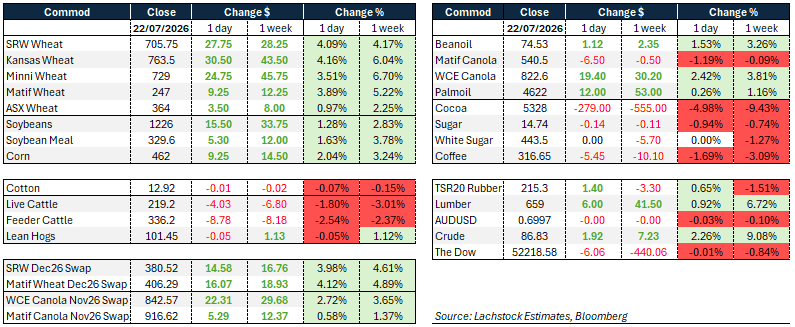
Wheat – Broke above US$7/bu for the first time since late 2023 (SRW +4.09pc day, +4.17pc week), driven by worsening Black Sea shipping disruption — night loadings halted at Novo, a vessel struck at Taman, Russia barring anchorage at Azov/Kavkaz ports — with the market treating this as an actual Russian flow disruption, not the usual Ukraine-only flare-up.
Corn/soybeans – Corn up on technical momentum and a fresh Matif maize contract high, with a $21.2m block call spread fuelling China import speculation; beans added weather premium on returning Midwest heat and Chinese buying interest.
Canola – ICE canola hit three-year highs (Nov +2.42pc day, +3.81pc week) on crude spillover and Prairie heat premium, clearing chart resistance near C$800; Aug Matif canola bucked the trend, down slightly but is in delivery.
Macro – Crude rallied (+2.26pc day, +9.08pc week) as the Iran conflict widened — Houthis striking Red Sea tankers, US on its 12th night of strikes on Iran — pushing Treasury yields to two-month highs on inflation risk.
Day Ahead – Australia
The sheer amount of missiles/drones deployed is staggering. Best estimates have pegged Russian July wheat exports at 2 million tonnes (Mt) and, with Aug in serious doubt numbers quickly don’t add up. Black Sea values are caught between finding a bid and a ship to trying to leverage off the global rally – meanwhile, every load that can will be pointed to the baltic. Messy.
What does this mean for Australia – Asian consumers will be considering just how much of their demand they can safely allocate from the Black Sea. The test for the Australian exporter is, can they extract tonnage from the grower?
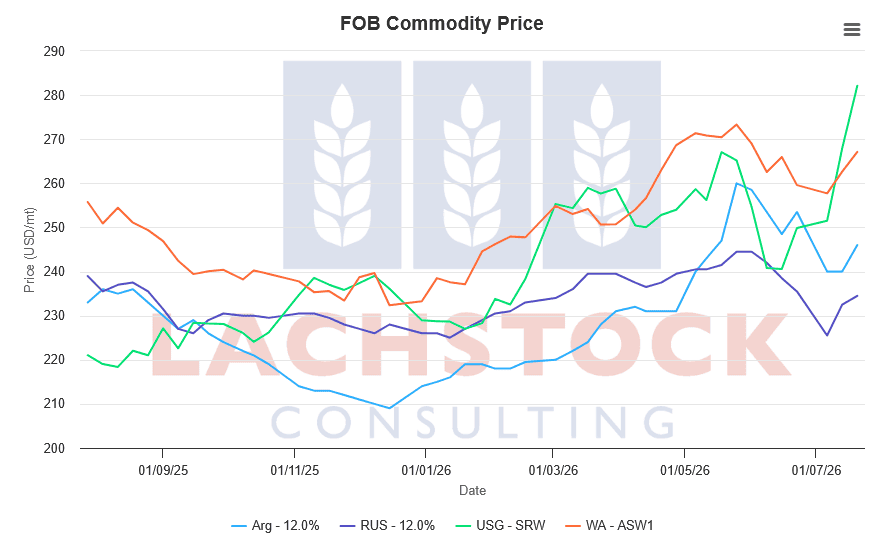 Wheat: Wheat closed above $7 a bushel for the first time since late 2023, and the driver is unmistakably the Black Sea rather than the usual flare-and-fade.
Novo night loadings were halted after Ukrainian drones passed nearby, with night restrictions potentially running five days; a vessel was struck in the Russian port of Taman, Russia has barred anchorage at Azov and Kavkaz ports lacking air defenses, and an ADM barley carrier was hit at Odesa.
Ukraine has targeted at least 124 vessels, including 89 tankers, since July 8.
The distinction traders are drawing this time is that Russian export flows themselves are impeded during the August-November window that typically carries 5Mt a month, not just Ukrainian tonnage.
SovEcon trimmed its Russian crop estimate to 88.3Mt, while Kazakhstan raised its export forecast 5pc to 14.3Mt and EU soft wheat exports fell 46pc y/y.
On the crop tour, North Dakota’s southern route came in at 45.9-46.0bpa versus roughly 50bpa a year ago though still near the 5-year average, while the northwest route showed a sharp yield improvement at 52.9 bpa versus 29.5 last year.
Jordan tendered for 120,000t milling wheat, and Thursday’s export sales are expected around 375,000t against 325,000t needed to match the USDA pace.
Other grains and oilseeds: Corn rode technical momentum and a fresh contract high in Matif maize, up €8/t, with the deteriorating EU crop making Ukrainian corn disruption particularly ill-timed just as Europe’s need for feed grain grows.
A 100,000-lot December call spread crossed as a $21.2 million block trade, fuelling speculation about a Chinese import program.
Sales tomorrow are expected around 600,000t old and new crop each.
Soybeans added weather premium ahead of a return of Midwest heat this weekend and a dry outlook in the 6-10 day window, with China buying interest and firmer energy also supportive; the September crush margin rose 8.5 cents to 319.
ICE canola printed 3-year highs, with the November contract clearing prior resistance near C$800 on spillover from the crude rally and broader wheat strength, alongside a weather premium bid; volume was 56,076 contracts versus 55,172 Tuesday.
Matif canola bucked the trend with a modest pullback.
Elsewhere, Brazil is set to cede its position as the world’s second-largest corn exporter to Argentina in 2025/26 as shipments to Iran collapsed amid the conflict there, while India’s edible oil imports are expected to climb to around 1.5Mt/month into the festive season as crushing slows (Solvent Extractors’ Association).
Macro: Energy carried the macro tape as the Iran conflict widened further.
The Houthis said they struck two tankers in the Red Sea, with one reportedly hit off Saudi Arabia’s coast, and US Central Command marked its twelfth consecutive night of strikes on Iran while Kuwait fended off a drone incursion.
Brent pushed above $95 and WTI above $88 in early trade before settling back, with both sides showing little appetite for talks and Iran continuing to insist on control of Hormuz traffic.
Treasury yields sit at two-month highs on inflation concern, and the World Bank warned the conflict could knock global growth as low as 1.3pc from 2.9pc last year.
The economic and political toll is becoming a domestic issue for Trump ahead of November’s midterms, with the war now estimated to have cost $37.5 billion and four US personnel killed in the past week.
Equities were little moved despite the backdrop, while cocoa extended a sharp weekly slide and cattle softened alongside broader softs weakness.
Local: Bids yesterday were stronger on wheat in the west of the country, canola and barley were back slightly. New crop bids in Albany PZ were A$882/t FIS for canola and $851 for GM, wheat $375, and barley $328. Look for bids to improve today across the board.
East coast wheat and barley values were largely unchanged yesterday while canola eased with offshore moves. Today will be a different story. Offshore markets will bleed into prices as the world attempts to reshuffle the decks and find a solution for the Black Sea troubles.
Forecasts are providing the bare minimum of hope for the north – back end is showing anywhere from 5-20mm but is sticking in the back.
HAVE YOUR SAY