
 Weather:
US Northern Plains/ND: Recent spate of 100°F+ days stressing spring wheat into harvest; WQC crop tour finalised yield at 48 bpa, well below USDA’s 58 bpa call. Another round of elevated temps due late this weekend.
US Corn Belt: Hot, dry conditions squeezing soil moisture ahead of pollination-critical stretch; StoneX-type chatter has moved from ~185 bpa (CWG) toward something closer to 182, with risk of 180-type talk if GFS heat verifies.
Europe: Widespread drought — France facing potential smallest maize crop in 50 years, Romania restricting irrigation, Netherlands declared water shortage, seven Greek islands in drought emergency. Rhine levels falling again, hitting barge freight. Another above-average heat spell forecast, adding pressure to EU corn.
Canada/Prairies: Flip from earlier excess moisture (acreage abandonment, disease) to now hot and dry, keeping a weather premium bid into canola
Markets
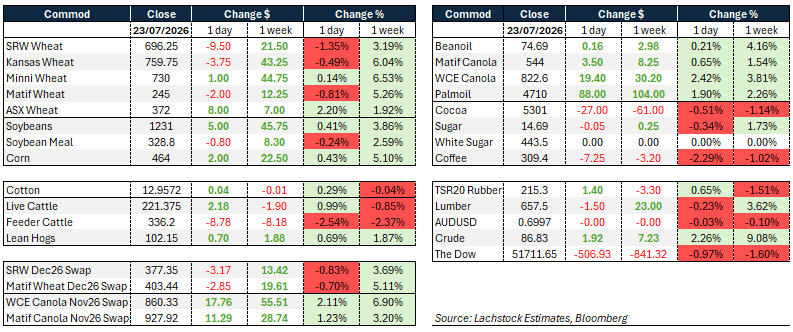
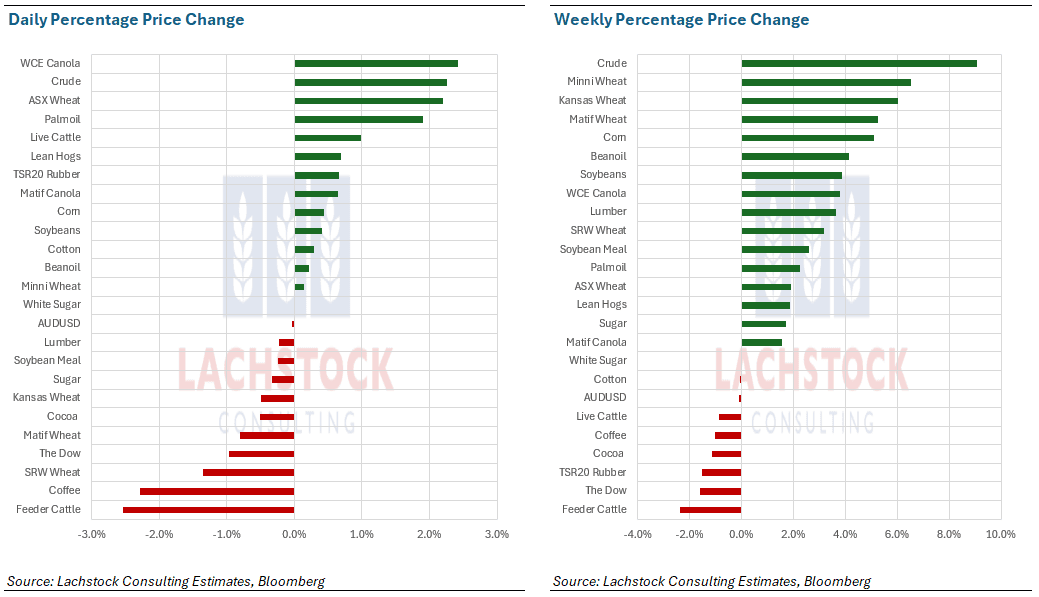
Wheat: winter wheat pulled back (SRW -1.35 percent, Matif -0.81pc) as this week’s Black Sea rally was seen as overdone, though BSEA disruption and Ukrainian export losses remain unresolved
Row crops: corn and soybeans firmed on heat stress and crude strength; new-crop bean/meal sales beat expectations, China buying continued
Canola: ICE WCE canola hit fresh three-year highs (+2.42pc day, +3.81pc week), outpacing soyoil/rapeseed/palm oil on Prairie weather premium
Macro: Brent broke $100/bbl on Red Sea Houthi tanker strikes; Dow sold off (-0.97pc) on the energy shock and rising yields; new US forced-labor tariffs (10-12.5pc, ~60 economies) take effect Friday
Day Ahead – Australia
Canola higher, wheat/barley sideways.
Forecasts for the east coast remain largely unchanged with little to no moisture in NNSW or QLD.
Supply and Demand game of chicken. The supply disruptions will have the Asian consumer on high alert. Last year they were knocked over by Argy with there most aggressive export program in history – while there is a long way to go, Argy may not have the production to offset the Black Sea shortfall.
Donald has slapped the world with a bunch of tariffs which, if nothing else, has ramped the likelihood of a rate increase. This has kept the AUD below the magical 0.7000 mark. However, our employment data adds some support to a local rate increase.
 Wheat: Winter wheat gave back some of this week’s Black Sea-driven surge, with traders calling the rally overdone even as the underlying disruption deepens.
Russia warned it was unsafe to navigate its Black Sea exclusive economic zone after a fresh round of Ukrainian strikes, while Ukrainian shipowners have themselves suspended vessel arrivals at the country’s ports following intensified Russian attacks on port infrastructure and shipping — Ukraine has now lost roughly a third of its Black Sea export capacity.
Moscow is offering to cover most rail freight costs to reroute grain via Rostov to Baltic and other Black Sea outlets. French loadings at Rouen jumped to 200,355 tonnes for the week from 103,386t previously as European buyers pivot away from constrained Russian supply, though the wider European picture is turning bearish on production: drought has spread across France, Romania, the Netherlands and Greece, and the Rhine has fallen again, adding freight friction. Morocco extended its prohibitive import tax on soft wheat to end-August to protect the domestic harvest window.
Closer to home, the Wheat Quality Council’s spring wheat tour finalised North Dakota yields at 48 bpa, ten bushels below the USDA’s 58 bpa call and similar to last year, as a run of 100-degree days squeezes crops into harvest; growers described the price volatility as familiar territory after four years of Black Sea-driven whipsaws.
US wheat export sales were soft at 290,000 tonnes against a 375,000 tonne expectation, led by Mexico and Taiwan.
Minni and ASX bucked the pullback, the latter supported by a firmer AUD-adjusted local bid structure even as the currency itself weakened.
Other grains and oilseeds: Row crops firmed on both crude strength and Corn Belt heat stress, with corn and soybeans finding two-sided support as forecasts turn hot and dry into the weekend. New-crop bean sales beat expectations at 1.537 million tonnes (Mt) against 1.4Mt forecast, meal sales came in nearly triple estimates at 406,000t, and China continued buying.
Brazil’s 2026/27 bean crop is expected to slip 2pc to 178Mt according to Rabobank’s Marcela Marini, with planted area set to pause after two decades of roughly 4pc annual growth.
Canola was the standout, ICE WCE pushing to fresh three-year highs on Prairie production risk — earlier excess moisture drove acreage abandonment and disease, and the pattern has now flipped to hot and dry — while Middle East-driven crude gains outpaced comparable moves in Chicago soyoil, European rapeseed and Malaysian palm oil.
Feeder cattle and coffee were the session’s clear laggards, while softs were mixed and rubber gave back its weekly gain on a firmer daily print.
Macro: Brent pushed through $100 a barrel for the first time in two months after Iran-backed Houthi forces claimed strikes on two Saudi tankers in the Red Sea, opening a second potential chokepoint alongside the near-standstill at Hormuz.
Trump said the US would hold Iran accountable for Houthi actions as American strikes on Iran continued into a twelfth consecutive night.
Equities sold off on the combined energy shock and a jump in Treasury yields, which Ag Bull’s Jim Wiesemeyer flagged as poorly timed for farm budgets already strained by higher input costs and operating leverage.
On trade, Washington finalised forced-labor tariffs of 10-12.5pc on some 60 economies effective Friday, replacing the expiring 10pc global levy; Mexico, the UK, Canada and India face 10pc, the EU and Taiwan at least 10pc, and Japan, Switzerland and South Korea at least 12.5pc, with USMCA-covered goods and fuel, food and fertiliser shipments exempted.
Separately, Trump has proposed Section 338 tariffs on Canadian goods covering about 5pc of US imports from Canada, set to take effect August 19 depending on negotiations.
Locally, CBA’s Michael Tang flagged upside risk to Australian rate pricing into next week’s Q2 CPI (forecast +0.9pc q/q) and a speech from RBA Governor Bullock, following strong June jobs data; the 3-year yield rose 5bps to 4.61pc, though AUD itself was softer on the day within a broadly risk-off macro tape.
Local: Broadly higher yesterday across the board with offshore strength the rising tide that is lifting all boats.
Barley is the laggard with WA bids still anchored around A$330/t for new crop
Ocean freight markets are not suggesting the Asian consumer is panicking at this point. The shipping constrictions are creating a deficit that is conceivably manageable at this point. However, should these restrictions last longer, global balance sheets will start to look a little hungry.
HAVE YOUR SAY