
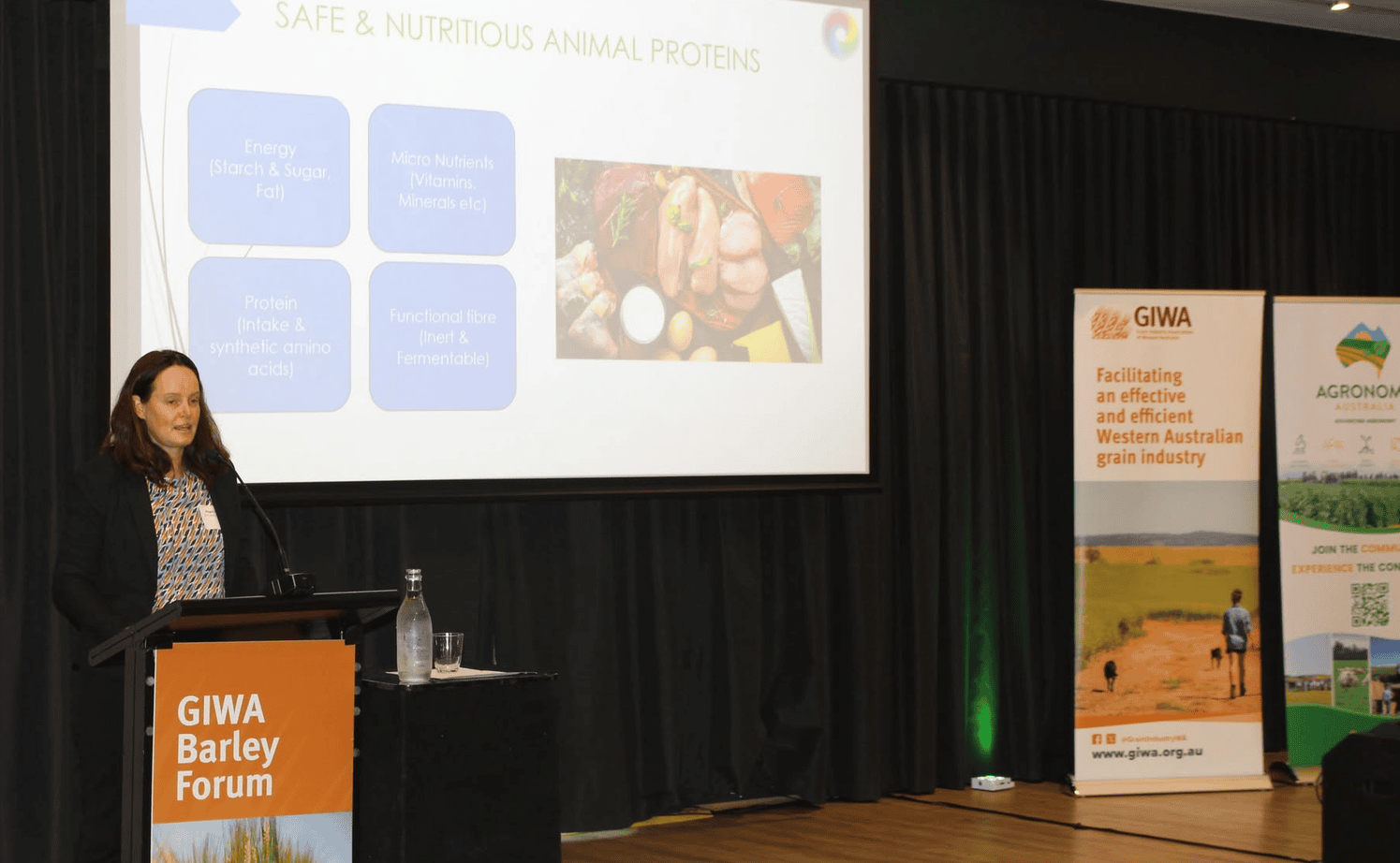
Dr Megan Edwards presents at the GIWA Barley Forum held in Perth last week. Photo: GIWA
AUSTRALIA could do more to promote the fibre and phosphorous content of its barley in a bid to increase its appeal to Asian feedmills.
That was the message from ACE Livestock Consulting animal nutrition consultant Megan Edwards, speaking at last week’s Grain Industry Association of Western Australia Barley Forum.
While corn is likely to remain Asia’s favourite feedgrain, Dr Edwards said an opportunity exists for WA barley to work into Asian livestock diets.
This is tied to barley being a desirable inclusion for animal gut health, and as signs appear that some Asian markets prefer or require antibiotic-free meat.
“Barley is the clear winner when it comes to functional fibre and it’s probably an aspect we need to promote more when we’re promoting Australian barley,” Dr Edwards told the forum.
She said Australian barley already appeals to some Asian feedmills for its ability to naturally package “the protein and the phosphorous and the fibre”.
Behind energy and protein, Dr Edwards said phosphorous was the third-most expensive component in livestock diets, and its cost has risen in response to the conflict disrupting production and shipping of it from the Persian Gulf.
She said this has placed “huge limitations” on the availability of phosphorous, and barley inclusion is one option for Asian millers of animal feed to limit further pressure on their margins.
More complex mix
Dr Edwards said most feed companies in Asia mill for more than one species, and while barley has a low inclusion rate in poultry and aquaculture mixes, it is a preferred grain for dairy and beef cattle, sheep, goats, and pigs.
All up, she estimates barley accounts for only 3 percent of the Asian animal diet amid widening acceptance.
Ms Edwards said China was using 5-6 million tonnes of feed barley, primarily French and Ukrainian, which “kind of disappears” when corn works on price and supply.
“Ten to 15 years ago, when they were just focused on corn and soy, they would just have two silos.”
Soymeal has long been the Asian feed miller’s protein source of choice, and corn has been the frontrunner for starch for energy, not least because its yellow pigment gives poultry fat and meat the colour desired by Asian consumers.
“If we can use barley…in poultry, we have to pay for pigments as well; that has to be factored in.”
These days, options are considerably broader, and Dr Edwards said mills are either using or considering wheat and barley, which contain non-starch polysaccharides, so “readily available and cheap enzymes” are required to break them down.
“We’re seeing more and more different silos at feedmills.”
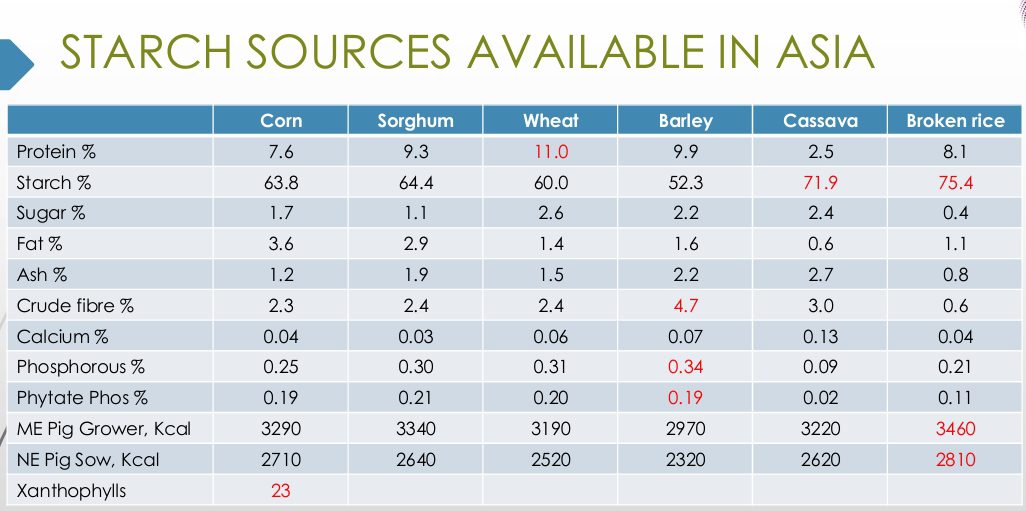
Source: ACE Consulting
Dr Edwards said barley is a low-inclusion input for aquaculture and poultry, but is a preferred grain for pigs in markets that are antibiotic free.
While most Asian jurisdictions allow the use of antibiotics in feed, the use of functional fibre in the animal diet was being looked at to “feed the microbiome” as an alternative.
She ran through the two kinds of fibre, fermentable and inert, which promotes health in the pig by enhancing stomach development and capacity, providing a prebiotic substrate for its gut microbiome, and stimulating health in its mucin layer, all positives for pig behaviour and welfare.
“Corn doesn’t give us that…but barley definitely does.”
Dr Edwards said animal welfare was increasingly on the agenda in Asian nations, with Thailand and also China making improvements, and taking steps towards healthier animal diets.
“They’re going to have to use fibre to their advantage as well.”
On the production side, Dr Edwards said barley has the advantage of requiring less energy to mill than corn, but will only work into rations with or instead of corn if mill managers are willing to accommodate a different input.
“Corn is the dominant grain; it’s the one they’re most familiar with and they’ve used for a long time.”
Cassava and broken rice are also popular sources of starch in Asian feed mixes.
She said a missed opportunity for Australian feed barley may be its lower beta glucan levels when compared to supply from other countries.
“I don’t know whether that point is advertised; we may have better digestibility than our competitors.”
Dr Edwards said on the plus side, WA feed ingredients were favoured for their low moisture, which gives a higher yield per volume purchased, and low mycotoxin risk, even when stored in hot tropical conditions.
“I hear very good things from the Asian market when it comes to Australian grains.”
Proximity of WA to Asian markets translates to relative short shipping legs, another advantage.
However, Dr Edwards said barley comes to the Asian feed market with precious little other information.
That includes barley variety, year and conditions of harvest, yield per hectare, and fertiliser inputs.
She said relatively low levels of fertiliser run in favour of feed barley.
“Not changing level of phosphorous but does change amount available to animal.”
On the fly
Dr Edwards said animal protein and alcohol purchasing are increasing with the rise of Asian incomes.
The trend is bolstering the supply of brewing byproducts available to the stockfeed industry, and creating a further role for barley in the Asian stockfeed diet as a habitat for contained production of black soldier fly larvae.
While ACE Consulting typically deals with whole or semi-processed grains and oilseeds in animal diets, it is also involved in evaluating black soldier fly larvae in the animal diet.
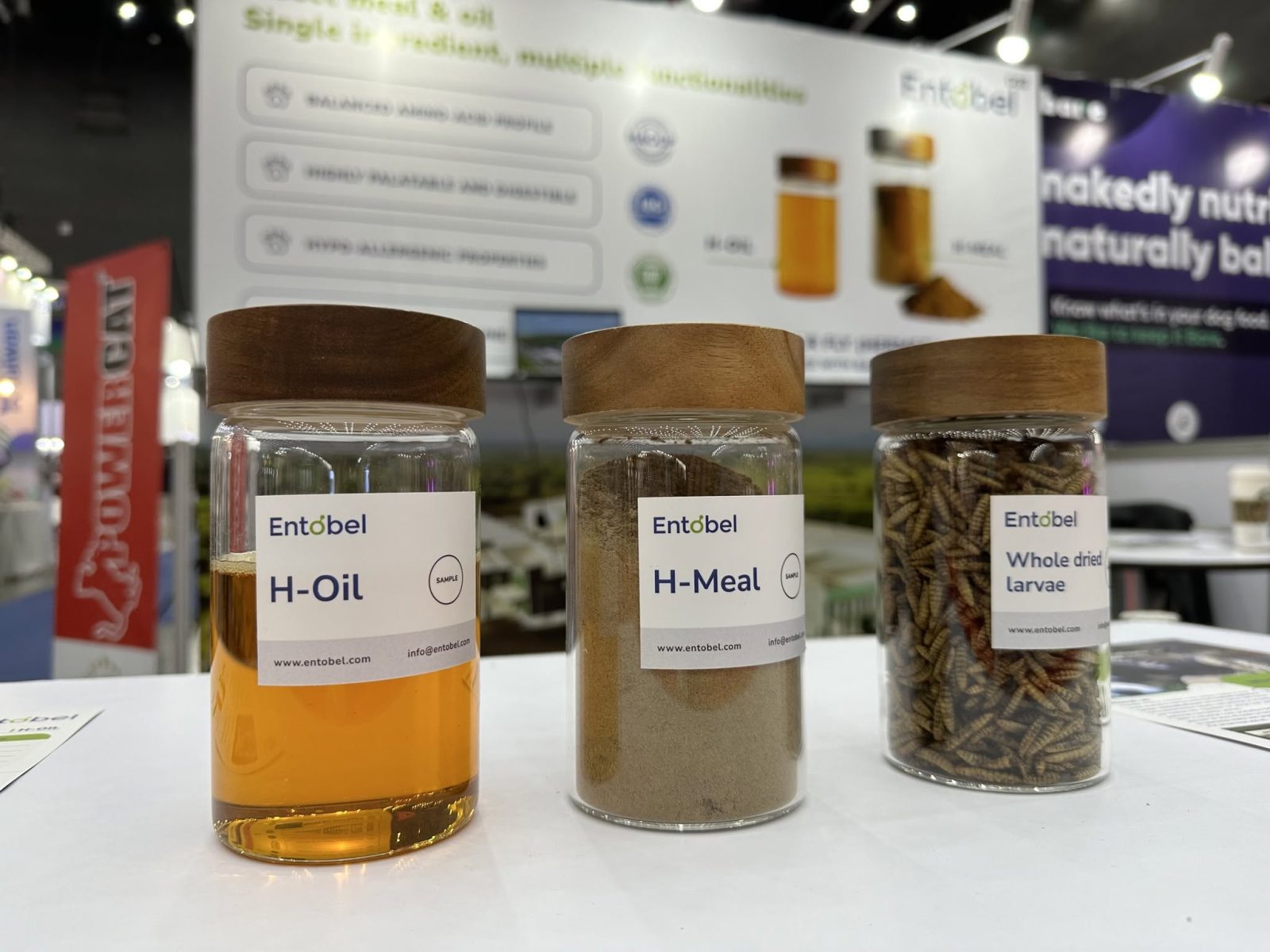
Singapore-based company Entobel is using black soldier flies to make inputs for the stockfeed industry. Photo: Entobel
The larvae are coming from sources including Entobel’s factory in Vietnam which is using 9.3t of brewers’ waste to produce 1t of protein from the larvae in just 10 days.
“It’s right next to Heineken,” Dr Edwards said of the plant’s location.
The brewers’ waste then becomes frass, which can be used as soil aerator for cropping.
“There is some research to show you can use it to grow more barley.”
Dr Edwards said the main market for larvae is aquaculture, and it is also a viable and sustainable inclusion in pig, poultry and pet food, and can be used to create oil and high-protein meal.
“What it is doing is partially replacing fishmeal.”
Grain Central: Get our free news straight to your inbox – Click here
HAVE YOUR SAY